PRÁTICA COM QUESTÕES OFICIAIS
Questão 79 da UFPR 2010 (inglês)
Texto-base das questões 79 a 80 · 1ª fase
As questões 79 e 80 referem-se ao texto a seguir.
A team from Northwestern University, Illinois, found that when you eat, not just how you eat, could make a big difference. Scientists found that when mice ate at unusual hours, they put on twice as much weight, despite exercising and eating as much as the other mice. The study, in the journal Obesity, is said to be the first to show directly that there is a “wrong” time to eat. Recent studies have suggested that circadian rhythms, the body’s internal clock, have a role in how our bodies use up energy. However, this had been difficult to prove definitively.
Deanna Arble, the main author of the study, said: “One of our research interests is shift workers1, who tend to be overweight. This got us thinking that eating at the wrong time of day might be contributing to weight gain”.
The researchers looked at two groups of mice over a six-week period. Both groups were fed a high-fat diet, but at different times of the mice “waking cycle”. One group of mice ate at times when they would normally be asleep. They put on twice as much weight. This was despite the fact that they did the same level of activity, and ate the same amount of food, as the other mice. The researchers believe that the findings may have implications for people worried about their weight.
1 shift workers = people who work at night
(http//www.bbc.co.uk – 08/09/2009. Adapted.)
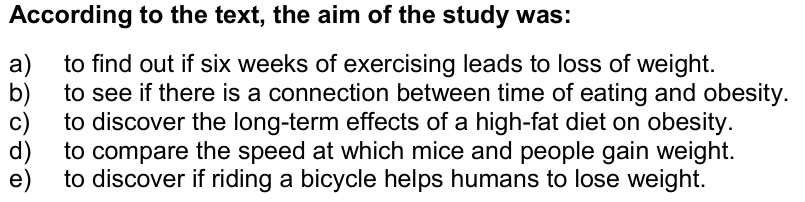
According to the text, the aim of the study was:
- Ato find out if six weeks of exercising leads to loss of weight.
- Bto see if there is a connection between time of eating and obesity.
- Cto discover the long-term effects of a high-fat diet on obesity.
- Dto compare the speed at which mice and people gain weight.
- Eto discover if riding a bicycle helps humans to lose weight.
Reportar erro na questão
Resolução comentada
A pergunta pede o objetivo do estudo, ou seja, o que os pesquisadores queriam descobrir. Esse objetivo aparece na ideia central do texto e na fala da autora principal.
-
No primeiro parágrafo: a equipe descobriu que when you eat, e não só how you eat, faz diferença. Camundongos que comeram em horários incomuns engordaram o dobro, mesmo com o mesmo exercício e a mesma quantidade de comida.
-
Na fala de Deanna Arble: os trabalhadores de turno tendem a ter sobrepeso, o que levou a pensar que "eating at the wrong time of day might be contributing to weight gain" (comer na hora errada pode contribuir para o ganho de peso).
-
No terceiro parágrafo: os dois grupos comeram a mesma dieta rica em gordura, mudando apenas o horário em relação ao ciclo de vigília. Logo, a variável testada foi o horário da refeição, e o resultado observado foi o ganho de peso.
Portanto, o estudo quis verificar se existe relação entre o horário de comer e a obesidade (ganho de peso).
Os demais itens citam elementos que não são o foco: exercício como causa de perda de peso, efeitos de longo prazo da dieta, comparação com humanos ou bicicleta. Nada disso aparece como objetivo no texto.
Alternativa B.
Por que as outras alternativas estão erradas
- AO exercício foi mantido igual nos dois grupos; o estudo não testou se exercitar-se emagrece.
- CA dieta rica em gordura era igual para os dois grupos, e o estudo durou seis semanas, sem foco em efeitos de longo prazo.
- DSó foram estudados camundongos; não houve comparação de velocidade de ganho de peso com humanos.
- EAndar de bicicleta não é mencionado no texto; é uma invenção sem base.
Assunto: Informações explícitas e detalhes.
Reportar erro na resolução
Ver como caiu na prova
Fonte: UFPR 2010 · 1ª fase. Prova oficial ↗