PRÁTICA COM QUESTÕES OFICIAIS
Questão 78 da UFPR 2010 (inglês)
Texto-base das questões 75 a 78 · 1ª fase
As questões 75 a 78 referem-se ao texto a seguir.
In recent years there have been suggestions that, instead of raising sheep, Australia should be raising kangaroos, which (unlike sheep) are native Australian species that are adapted to Australian plants and climates. It is claimed that the soft paws of kangaroos are less damaging to soil than are the hard hooves of sheep. Kangaroo meat is lean, healthy, and (in my opinion) absolutely delicious. In addition to their meat, kangaroos yield valuable hides1. All of those points are cited as arguments to support replacing sheep herding with kangaroo ranching.
However, that proposal faces real obstacles, both biological and cultural ones. Unlike sheep, kangaroos are not herd animals that will docilely obey one shepherd and a dog, or that can be rounded up and marched obediently up ramps into trucks for shipment to the slaughterhouse. Instead, kangaroo ranchers have to hire hunters to chase down and shoot their kangaroos one by one. Further problems with kangaroos are their mobility and ability to jump fences: if you invest in promoting growth of a kangaroo population on your property, and if your kangaroos perceive some inducement to move (such as rain falling somewhere else), your valuable crop of kangaroos may end up 30 miles away on somebody else’s property. Kangaroo meat is accepted in Germany and some is exported there, but the sale of kangaroo meat faces cultural obstacles elsewhere. For Australians, kangaroo meat has little appeal, and they continue to prefer their more traditional types of meat, especially lamb and beef. Many Australian animal welfare advocates oppose kangaroo harvesting, not taking into consideration the fact that living conditions and slaughter methods are much crueler for domestic sheep and cattle than for wild kangaroos. The U.S. explicitly forbids the importation of kangaroo meat because we find the beasts cute, and because a congressman’s wife heard that kangaroos are endangered. Some kangaroo species are indeed endangered, but ironically the species actually harvested for meat are abundant pest animals in Australia.
(DIAMOND, J. Collapse. New York: Penguin, 2005. Adaptado)
1 hides = skins
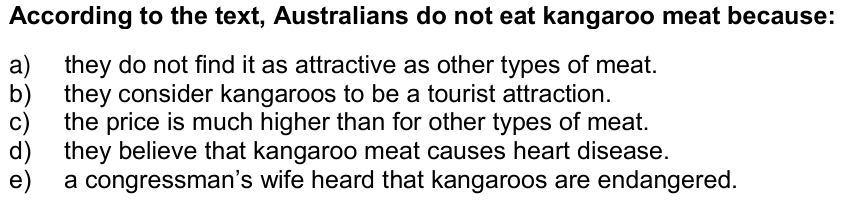
According to the text, Australians do not eat kangaroo meat because:
- Athey do not find it as attractive as other types of meat.
- Bthey consider kangaroos to be a tourist attraction.
- Cthe price is much higher than for other types of meat.
- Dthey believe that kangaroo meat causes heart disease.
- Ea congressman’s wife heard that kangaroos are endangered.
Reportar erro na questão
Resolução comentada
A pergunta pede o motivo pelo qual os australianos não comem carne de canguru. Ele aparece no trecho sobre os obstáculos culturais:
"For Australians, kangaroo meat has little appeal, and they continue to prefer their more traditional types of meat, especially lamb and beef."
Traduzindo: "Para os australianos, a carne de canguru tem pouco apelo, e eles continuam a preferir seus tipos de carne mais tradicionais, especialmente cordeiro e carne bovina."
Ou seja, o autor atribui a rejeição a uma questão de gosto e tradição: a carne de canguru atrai menos que as outras. É isso que diz a alternativa A, com "find it as attractive" retomando "has little appeal".
Confira as demais:
- Turismo: o texto não fala em canguru como atração turística.
- Preço: não há nenhuma menção a custo.
- Doença cardíaca: o texto diz o contrário, que a carne é "lean, healthy" (magra e saudável).
- A esposa do congressista: esse argumento explica a proibição de importar a carne nos EUA, não o hábito dos australianos.
Alternativa A.
Pegadinha: A alternativa E engana por usar um trecho real do texto, mas ele se refere aos Estados Unidos, não aos australianos.
Por que as outras alternativas estão erradas
- BO texto não menciona canguru como atração turística.
- CNão há qualquer referência a preço da carne no texto.
- DO texto diz que a carne é magra e saudável, o oposto de causar doença cardíaca.
- EA história da esposa do congressista explica a proibição nos EUA, não a preferência dos australianos.
Assunto: Informações explícitas e detalhes.
Reportar erro na resolução
Ver como caiu na prova
Fonte: UFPR 2010 · 1ª fase. Prova oficial ↗