PRÁTICA COM QUESTÕES OFICIAIS
Questão 80 da UFPR 2010 (inglês)
Texto-base das questões 79 a 80 · 1ª fase
As questões 79 e 80 referem-se ao texto a seguir.
A team from Northwestern University, Illinois, found that when you eat, not just how you eat, could make a big difference. Scientists found that when mice ate at unusual hours, they put on twice as much weight, despite exercising and eating as much as the other mice. The study, in the journal Obesity, is said to be the first to show directly that there is a “wrong” time to eat. Recent studies have suggested that circadian rhythms, the body’s internal clock, have a role in how our bodies use up energy. However, this had been difficult to prove definitively.
Deanna Arble, the main author of the study, said: “One of our research interests is shift workers1, who tend to be overweight. This got us thinking that eating at the wrong time of day might be contributing to weight gain”.
The researchers looked at two groups of mice over a six-week period. Both groups were fed a high-fat diet, but at different times of the mice “waking cycle”. One group of mice ate at times when they would normally be asleep. They put on twice as much weight. This was despite the fact that they did the same level of activity, and ate the same amount of food, as the other mice. The researchers believe that the findings may have implications for people worried about their weight.
1 shift workers = people who work at night
(http//www.bbc.co.uk – 08/09/2009. Adapted.)
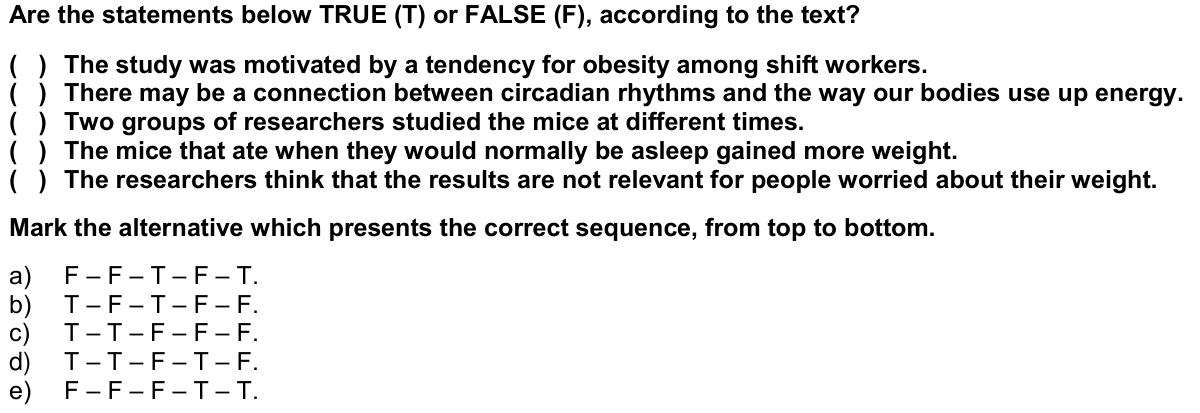
Are the statements below TRUE (T) or FALSE (F), according to the text?
( ) The study was motivated by a tendency for obesity among shift workers.
( ) There may be a connection between circadian rhythms and the way our bodies use up energy.
( ) Two groups of researchers studied the mice at different times.
( ) The mice that ate when they would normally be asleep gained more weight.
( ) The researchers think that the results are not relevant for people worried about their weight.
Mark the alternative which presents the correct sequence, from top to bottom.
- AF – F – T – F – T.
- BT – F – T – F – F.
- CT – T – F – F – F.
- DT – T – F – T – F.
- EF – F – F – T – T.
Reportar erro na questão
Resolução comentada
Vamos julgar cada afirmação com base no texto.
-
O estudo foi motivado por uma tendência à obesidade entre trabalhadores de turnos. Verdadeira (T). Arble diz que um dos interesses de pesquisa é o shift workers, "who tend to be overweight", e que isso os levou a pensar no horário das refeições.
-
Pode haver uma conexão entre ritmos circadianos e o modo como o corpo gasta energia. Verdadeira (T). O texto diz que estudos recentes sugerem que os ritmos circadianos têm papel em como o corpo usa energia. O verbo "may" combina com "suggested".
-
Dois grupos de pesquisadores estudaram os ratos em horários diferentes. Falsa (F). Eram dois grupos de ratos ("two groups of mice"), não de pesquisadores. Os ratos comiam em horários diferentes.
-
Os ratos que comeram quando normalmente dormiriam ganharam mais peso. Verdadeira (T). O texto afirma que esse grupo ganhou o dobro do peso ("put on twice as much weight").
-
Os pesquisadores acham que os resultados não são relevantes para quem se preocupa com o peso. Falsa (F). O texto diz o contrário: os achados "may have implications" para essas pessoas.
A sequência é T – T – F – T – F.
Alternativa D.
Pegadinha: A 3ª afirmação engana ao trocar "groups of mice" por "groups of researchers", e a 5ª inverte o sentido de "implications for people worried about their weight".
Por que as outras alternativas estão erradas
- AInverte quase tudo: nega a motivação pelos trabalhadores de turnos e a ligação com ritmos circadianos, e dá como verdadeira a última, que contradiz o texto.
- BMarca a 3ª como verdadeira (confunde grupos de ratos com grupos de pesquisadores) e a 2ª e a 4ª como falsas, embora o texto as sustente.
- CErra a 4ª: o texto diz claramente que os ratos que comeram na hora de dormir engordaram o dobro.
- ENega a 1ª e a 2ª, que o texto apoia, e aceita a 5ª, que contradiz a conclusão dos pesquisadores.
Assunto: Informações explícitas e detalhes.
Reportar erro na resolução
Ver como caiu na prova
Fonte: UFPR 2010 · 1ª fase. Prova oficial ↗