PRÁTICA COM QUESTÕES OFICIAIS
Questão 46 do ITA 2027
Texto-base das questões 46 a 47 · 1ª fase
Few individuals have shaped the trajectory of an entire industry the way Ozires Silva shaped aviation. As a military pilot, engineer, entrepreneur, and public servant, Silva did not merely found Embraer — he repeatedly rescued, redirected, and reinvented it.
[I]
After joining the Brazilian Air Force at the age of 17, he flew missions across remote areas of the Amazon. There, he saw firsthand the vast distances and difficult terrain that separated Brazilians from one another, and began to understand aviation’s power not just as a tool of transport, but as an agent of national integration.
[II]
After graduation, he joined the Centro Técnico Aeroespacial (CTA) and led the design of a small regional aircraft, the EMB-110 Bandeirante. But when it came time to move from prototype to production, Silva faced a defining obstacle: no investor would back the project. Brazil’s industrial elite believed aircraft manufacturing was too risky, too expensive, and best left to the Americans or Europeans.
[III]
Under his leadership, Embraer launched successful aircraft like the Xingu, the Tucano, and the EMB-120 Brasilia, proving that Brazilian technology could compete globally. Each aircraft addressed a logistical challenge for Brazil while being designed with international scalability in mind.
[IV]
The privatization, completed in 1994, marked a turning point. Embraer quickly transitioned from a government-dependent firm to a lean, focused competitor in the international market. That transformation paved the way for the ERJ-145 regional jet, a commercial success that secured Embraer’s position as a leader in regional aviation.
In 2021, Silva received the Daniel Guggenheim Medal, the most prestigious award in aeronautical engineering, becoming the first Brazilian to earn the honor. His personal convictions and professional decisions were inseparable from the company’s transformation from a state-backed experiment into one of the world’s most competitive aircraft manufacturers.
Fonte: OLIVEIRA, Renato. Ozires Silva: The living legend who built Embraer and transformed Brazil. AeroTime Hub, 15 ago. 2025. Disponível em https://www.aerotime.aero/articles/ozires-silva-embraer-legacy. Adaptado.
PARÁGRAFOS SUPRIMIDOS E EMBARALHADOS
(A) With conviction and diplomatic skill, Silva took his case to the federal government. In 1969, his efforts bore fruit: the state created Embraer, and Ozires Silva became its first president. As Silva built Embraer from the ground up, he faced the full spectrum of challenges: funding gaps, foreign competition, military skepticism, and bureaucratic inertia. But he also gained allies — engineers, test pilots, and industrialists who believed in the mission.
(B) Silva’s story begins not in a boardroom or a laboratory, but in the interior of Sao Paulo state. Born in 1931 in Bauru, he came of age in a Brazil that relied on imported technologies and foreign industries. His journey began not with ambition for wealth or fame, but with a simple, patriotic question: Why can’t Brazil build its own airplanes?
(C) Determined to change his country’s course, Silva enrolled at the Instituto Tecnologico de Aeronautica (ITA), a newly created engineering school designed to empower Brazil’s aerospace future. There, he honed the technical skills needed to turn vision into reality.
(D) Though the company grew, Silva realized Embraer’s long-term success required independence from political cycles. In the late 1980s, he stepped away to serve as president of Petrobras and later as Minister of Infrastructure. But Embraer faltered under state control, and by the early 1990s, it faced severe financial trouble. Silva returned in 1991 to lead a bold and controversial initiative: privatization.
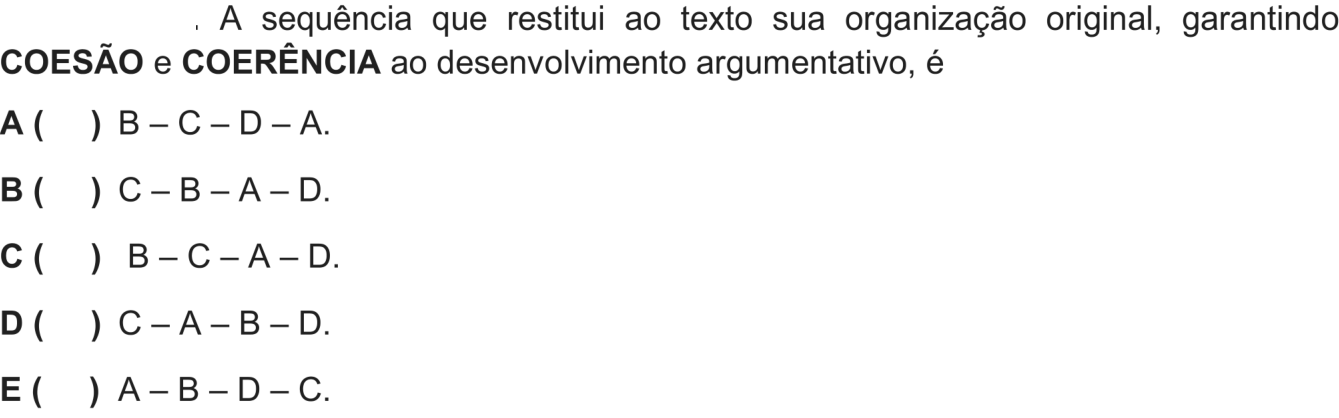
A sequência que restitui ao texto sua organização original, garantindo COESÃO e COERÊNCIA ao desenvolvimento argumentativo, é
- AB – C – D – A.
- BC – B – A – D.
- CB – C – A – D.
- DC – A – B – D.
- EA – B – D – C.
Reportar erro na questão
Resolução comentada
O texto tem quatro lacunas, [I] a [IV], e cada parágrafo suprimido precisa se encaixar pelas pistas de cronologia e pelos conectivos.
-
Os parágrafos que aparecem depois das lacunas dão as âncoras. Antes de [I] há só a introdução geral. Depois de [I] vem a Força Aérea aos 17 anos, e depois de [II] vem a frase "After graduation, he joined the CTA". Isso exige que [II] fale de formação acadêmica, e esse é o parágrafo C (ITA, "honed the technical skills").
-
Antes de C, a ordem natural é a origem de Silva: nascido em Bauru em 1931, com a pergunta patriótica "Why can't Brazil build its own airplanes?". Esse é o parágrafo B, que ocupa [I]. O trecho seguinte, sobre a Força Aérea aos 17 anos, continua a juventude, e depois vem o ITA.
-
A lacuna [III] vem logo após o obstáculo ("no investor would back the project"). O parágrafo A resolve isso: "Silva took his case to the federal government", a criação da Embraer em 1969 e a presidência. Depois disso o trecho seguinte, "Under his leadership, Embraer launched successful aircraft", faz sentido.
-
A lacuna [IV] vem antes de "The privatization, completed in 1994". O parágrafo D termina com Silva voltando em 1991 para liderar a privatização, então encaixa aí.
Ordem: B – C – A – D.
Alternativa C.
Por que as outras alternativas estão erradas
- AColoca D antes de A, mas a privatização (1991) não pode vir antes da criação da Embraer (1969).
- BComeça por C, mas o ITA vem depois da origem e infância em Bauru (B), e o texto já abre com a Força Aérea.
- DPõe B na terceira posição, mas a biografia de origem não pode vir após a criação da empresa; também quebra "After graduation".
- EComeça pela criação da Embraer (A), quebrando a cronologia e o fio da narrativa.
Assuntos: coesão e coerência textual, ordenação de parágrafos, cronologia narrativa.
Reportar erro na resolução
Ver como caiu na prova
Fonte: ITA 2027 · 1ª fase. Prova oficial ↗