PRÁTICA COM QUESTÕES OFICIAIS
Questão 38 do ITA 2027
Texto-base das questões 37 a 39 · 1ª fase
Tech for good: What it means and how we can deliver on it
The sector encompassing health tech, education tech, cleantech, femtech and enterprise environmental, social and governance (ESG) software is seeing increased investments, reaching $79 billion globally in 2021. But at the Tech for Good Institute (TFGI), we found that varying definitions across the tech for good ecosystem meant varying expectations. Without a shared understanding of tech for good, it’s no surprise that the jury’s still out on whether technology is delivering a net positive impact.
In February 2023, TFGI ran a flash poll on public perceptions of tech for good in Southeast Asia. Of the 212 respondents from Indonesia, Malaysia, the Philippines, Singapore, Thailand, and Vietnam, only 46% strongly agreed or agreed that technology and the digital economy have delivered their promise for the region. Almost as many (37%) stayed neutral. [...]
Responsible digital economy companies examine their systems, processes, products and services to identify and mitigate negative consequences in upstream development and downstream impacts of products and services.
Digital technologies can be inherently values-driven, so upstream considerations include developing systems with inclusion, security and data protection baked in, with transparency to build trust. For example, developers can proactively ensure datasets that train algorithms are unbiased or design systems for frictionless data sharing or systematic data protection.
Downstream considerations include maintaining consumer choice and protecting livelihoods and users’ health and well-being. With rapidly evolving digital technologies, operating responsibly is a moving goalpost. As regulators pay attention to players in the digital economy, the business case for mitigating negative impacts can be as straightforward as maintaining licences.
In our poll, only 14% of respondents thought responsibility alone constituted tech for good, suggesting sustainability is necessary but more is needed.
Fonte: TAN, Ming.Tech for good: What it means and how we can deliver on it. Weforum.org. 01 jul 2025. Disponível em https://www.weforum.org/stories/2023/03/tech-for-good-what-does-it-mean-and-how-can-we-deliver-on-it/
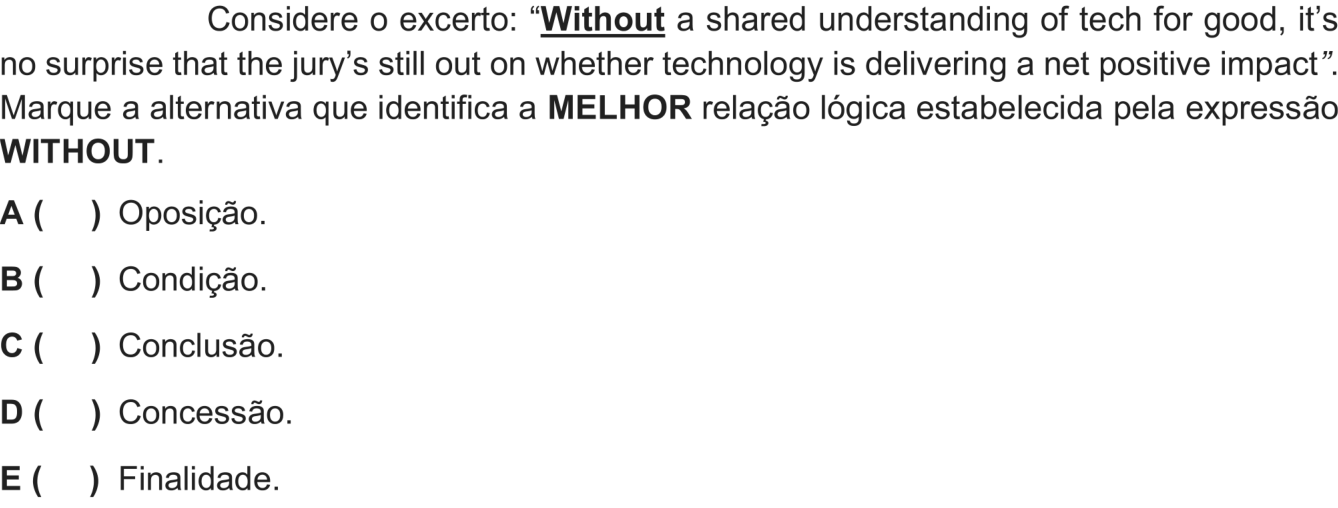
Considere o excerto: “Without a shared understanding of tech for good, it’s no surprise that the jury’s still out on whether technology is delivering a net positive impact”. Marque a alternativa que identifica a MELHOR relação lógica estabelecida pela expressão WITHOUT.
- AOposição.
- BCondição.
- CConclusão.
- DConcessão.
- EFinalidade.
Reportar erro na questão
Resolução comentada
Veja a frase: "Without a shared understanding of tech for good, it's no surprise that the jury's still out...". Traduzindo: "Sem um entendimento compartilhado sobre tecnologia para o bem, não é surpresa que ainda não haja veredito sobre...".
- Without equivale a "if there is not" / "if we don't have": "Se não há um entendimento compartilhado, não surpreende que o veredito siga indefinido".
- A ausência do entendimento comum é a circunstância da qual depende a consequência (o júri ainda não ter decidido). Essa é a lógica de uma condição, no caso uma condição negativa.
- Não há contraste entre as ideias, então não é oposição nem concessão (que seria "even though", "despite").
- Não há ideia de meta ou propósito ("in order to"), então não é finalidade.
- Without não introduz uma conclusão como "therefore" ou "thus"; a conclusão é a oração principal ("it's no surprise..."), e o without apresenta a causa/condição dela.
Portanto, a expressão estabelece uma relação de condição: sem o entendimento compartilhado, é natural que não haja veredito.
Alternativa B.
Por que as outras alternativas estão erradas
- ANão há contraste entre as ideias; a segunda decorre da primeira, não se opõe a ela.
- CA conclusão está na oração principal, não no termo 'without', que introduz a circunstância da qual ela depende.
- DConcessão exigiria algo como 'although' ou 'despite', admitindo um fato que não impede o resultado, e aqui a falta de entendimento explica o resultado.
- ENão há propósito ou meta, como em 'in order to' ou 'so that'.
Assuntos: relações lógicas, conectivos, interpretação de texto em inglês.
Reportar erro na resolução
Ver como caiu na prova
Fonte: ITA 2027 · 1ª fase. Prova oficial ↗