PRÁTICA COM QUESTÕES OFICIAIS
Questão 48 do ITA 2025
Leia o texto a seguir para responder às questões de 45 a 48. · 1ª fase
As scientists explore AI-written text, journals hammer out policies
Many ask authors to disclose use of ChatGPT and other generative artificial intelligence
“It’s all we’ve been talking about since November,” says Patrick Franzen, publishing director for SPIE, the international society for optics and photonics. He’s referring to ChatGPT, the artificial intelligence (AI) - powered chatbot unveiled that month. In response to a prompt, ChatGPT can spin out fluent and seemingly well-informed reports, essays — and scientific manuscripts. Worried about the ethics and accuracy of such content, Franzen and managers at other journals are scrambling to protect the scholarly literature from a potential flood of manuscripts written in whole or part by computer programs.
Some publishers have not yet formulated policies. Most of those that have avoid an outright ban on AI-generated text, but ask authors to disclose their use of the automated tools, as SPIE is likely to do. For now, editors and peer reviewers have few alternatives, as they lack enforcement tools. No software so far can consistently detect the synthetic text the majority of the time.[. . .]
In some cases, the resulting text is indistinguishable from what people would write. to identify one-third of them as written by machine, according to a December 2022 preprint. AI developers are expected to create even more powerful versions, including ones trained specifi-cally on scientific literature - a prospect that has sent a shock wave through the scholarly publishing industry.
So far, scientists report playing around with ChatGPT to explore its capabilities, and a few have listed ChatGPT as a co-author on manuscripts. Publishing experts worry such limited use could morph into a spike of manuscripts containing substantial chunks of AI-written text.
Fonte: BRAINARD, Jeffrey. As scientists explore AI-written text, journals hammer out policies. Science, v. 379, n. 6634, p. 740-741, 22 fev.2023. Disponível em https://www.science.org/content/article/scientists-explore-ai-written-text-journals-hammer-policies.
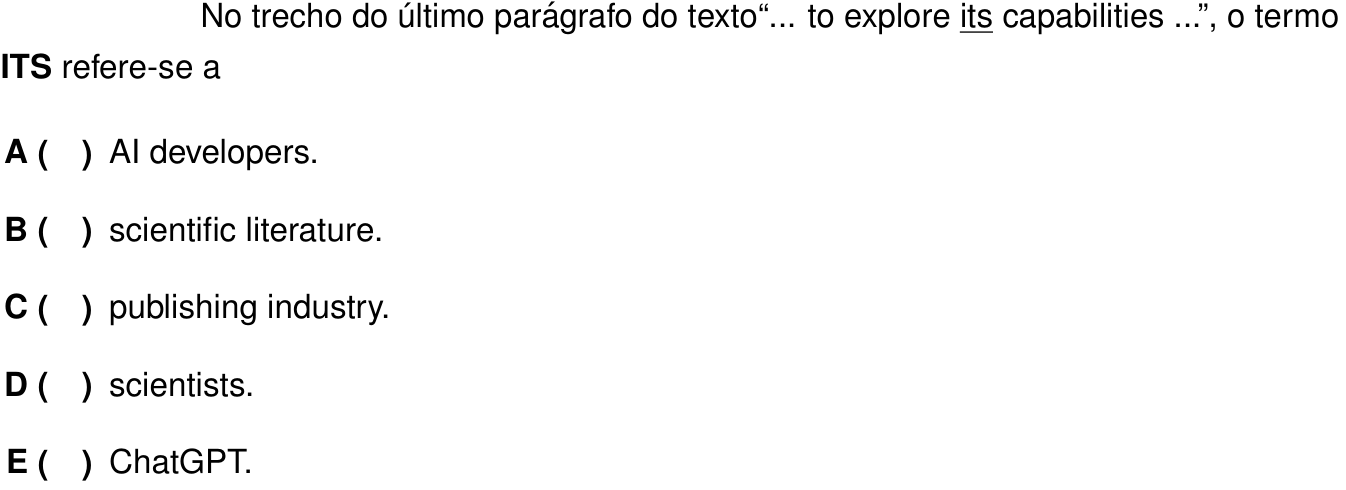
No trecho do último parágrafo do texto“... to explore its capabilities ...”, o termo ITS refere-se a
- AAI developers.
- Bscientific literature.
- Cpublishing industry.
- Dscientists.
- EChatGPT.
Reportar erro na questão
Resolução comentada
Pronomes possessivos como its (usado para coisas, não para pessoas) retomam um termo já mencionado. Para achar o referente, leia a frase inteira:
"scientists report playing around with ChatGPT to explore its capabilities"
- Its é possessivo neutro, singular. Serve para coisa ou ente não humano; para pessoas, o inglês usaria their (plural) ou his/her.
- Os candidatos plurais ou humanos ficam de fora: AI developers, scientists e publishing industry não combinam com its. Se fosse scientists, o texto traria their capabilities.
- Scientific literature aparece em outro parágrafo e não faz sentido aqui: os cientistas não "brincam" com ela para explorar suas capacidades.
- O termo singular mais próximo e coerente é ChatGPT, a ferramenta com a qual os cientistas estão "brincando" (playing around with). Explorar "as capacidades do ChatGPT" é exatamente o sentido da frase.
Portanto, its = ChatGPT.
Alternativa E.
Pegadinha: A alternativa D engana quem pega o sujeito da frase (scientists) em vez do termo singular que acompanha o verbo de exploração.
Por que as outras alternativas estão erradas
- AAI developers é plural e humano; o possessivo seria their, e eles nem aparecem na frase.
- BScientific literature está em outro parágrafo e não é aquilo cujas capacidades os cientistas exploram.
- CPublishing industry não é o objeto da exploração; é citada só como afetada pelo choque.
- DScientists é o sujeito e plural; o possessivo correspondente seria their, não its.
Assunto: Referência pronominal e pronomes.
Reportar erro na resolução
Ver como caiu na prova
Fonte: ITA 2025 · 1ª fase. Prova oficial ↗