PRÁTICA COM QUESTÕES OFICIAIS
Questão 40 do ITA 2021
Texto-base das questões 37 a 40 · 1ª fase
As questões de 37 a 40 referem-se ao texto destacado a seguir.
When my family first moved to North Carolina, we lived in a rented house three blocks from the school where I would begin the third grade. My mother made friends with one of the neighbors, but one seemed enough for her. Within a year we would move again and, as she explained, there wasn’t much point in getting too close to people we would have to say good-bye to. Our next house was less than a mile away, and the short journey would hardly merit tears or even good-byes, for that matter. It was more of a “see you later” situation, but still I adopted my mother’s attitude, as it allowed me to pretend that not making friends was a conscious choice. I could if I wanted to. It just wasn’t the right time.
Back in New York State, we had lived in the country, with no sidewalks or streetlights; you could leave the house and still be alone. But here, when you looked out the window, you saw other houses, and people inside those houses. I hoped that in walking around after dark I might witness a murder, but for the most part our neighbors just sat in their living rooms, watching TV. The only place that seemed truly different was owned by a man named Mr. Tomkey, who did not believe in television [...].
To say that you did not believe in television was different from saying that you did not care for it. Belief implied that television had a master plan and that you were against it. It also suggested that you thought too much. When my mother reported that Mr. Tomkey did not believe in television, my father said, “Well, good for him. I don't know that I believe in it, either”. “That's exactly how I feel,” my mother said, and then my parents watched the news, and whatever came on after the news.
SEDARIS, David. Dress Your Family in Corduroy and Denim. Recurso eletrônico. Boston: Little, Brown and Company, 2004, p. 5.
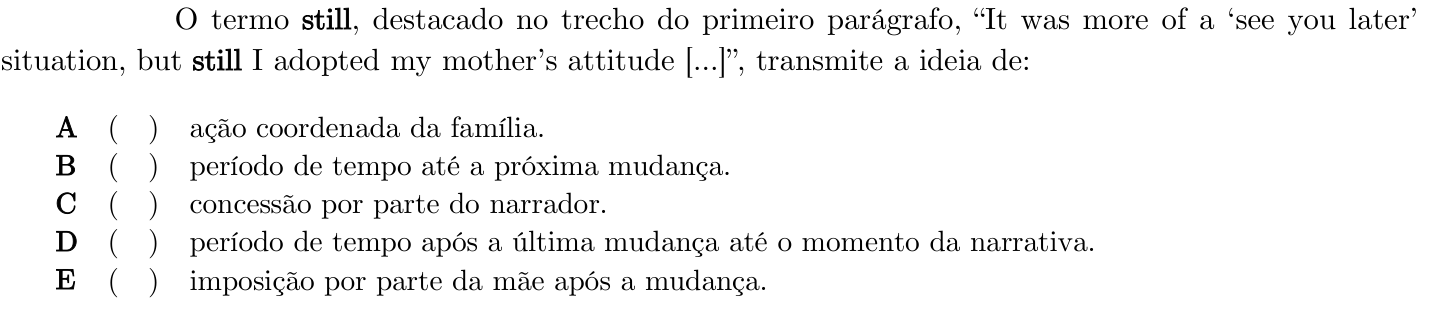
O termo still, destacado no trecho do primeiro parágrafo, “It was more of a ‘see you later’ situation, but still I adopted my mother’s attitude […]”, transmite a ideia de:
- Aação coordenada da família.
- Bperíodo de tempo até a próxima mudança.
- Cconcessão por parte do narrador.
- Dperíodo de tempo após a última mudança até o momento da narrativa.
- Eimposição por parte da mãe após a mudança.
Reportar erro na questão
Resolução comentada
Aqui still não indica tempo ("ainda"), e sim contraste, com o sentido de "mesmo assim", "ainda assim", "apesar disso". É um advérbio conectivo que introduz uma ideia contrária ao que se esperava, como o nevertheless.
Veja a estrutura da frase:
- A primeira parte diz que a mudança era curta, quase um "até logo" (it was more of a "see you later" situation). Isso sugere que não haveria motivo para adotar a postura de despedida da mãe.
- Depois vem o but still, que marca a oposição: mesmo assim, o narrador adotou a atitude da mãe.
- A frase seguinte explica o motivo: assim ele podia fingir que não fazer amigos era escolha sua.
Assim, o narrador reconhece que o argumento da mãe não se aplicava tão bem ao caso, mas cede e adota a atitude dela mesmo assim. Esse é o valor de concessão: admite-se um fato que poderia levar a outra conclusão, e a ação acontece apesar dele.
A ideia é do narrador (I adopted), não de uma ordem da mãe nem de um fato sobre tempo ou sobre a família toda.
Alternativa C.
Pegadinha: As alternativas B e D exploram o sentido mais comum de "still" ("ainda"), que aqui não se aplica, pois ele funciona como conector de contraste.
Por que as outras alternativas estão erradas
- AO sujeito é só o narrador ("I adopted"); não há ação coordenada da família.
- BLê "still" como "ainda" (tempo), mas aqui ele significa "mesmo assim".
- DTambém interpreta "still" como tempo, e o trecho não fala do período até o momento da narrativa.
- EA mãe não impõe nada; o narrador adota a atitude por conta própria, para fingir que era escolha.
Assuntos: conectivos, interpretação de texto, advérbio still.
Reportar erro na resolução
Ver como caiu na prova
Fonte: ITA 2021 · 1ª fase. Prova oficial ↗