PRÁTICA COM QUESTÕES OFICIAIS
Questão 7 (Inglês) do ITA 2012
Texto-base das questões 06 a 08 · Inglês
As questões de 6 a 8 referem-se ao seguinte texto:
Thursday, Feb. 10, 2011
2045: The Year Man Becomes Immortal
By Lev Grossman
(...), Kurzweil believes that we’re approaching a moment when computers will become intelligent, and not just intelligent but more intelligent than humans. When that happens, humanity – our bodies, our minds, our civilization – will be completely and irreversibly transformed. He believes that this moment is not only inevitable but imminent. According to his calculations, the end of human civilization as we know it is about 35 years away.
Computers are getting faster. Everybody knows that. Also, computers are getting faster faster – that is, the rate at which they’re getting faster is increasing.
True? True.
So if computers are getting so much faster, so incredibly fast, there might conceivably come a moment when they are capable of something comparable to human intelligence. Artificial intelligence. All that horsepower could be put in the service of emulating whatever it is our brains are doing when they create consciousness – not just doing arithmetic very quickly or composing piano music but also driving cars, writing books, making ethical decisions, appreciating fancy paintings, making witty observations at cocktail parties.
If you can swallow that idea, and Kurzweil and a lot of other very smart people can, then all bets are off. From that point on, there’s no reason to think computers would stop getting more powerful. They would keep on developing until they were far more intelligent than we are. Their rate of development would also continue to increase, because they would take over their own development from their slower-thinking human creators. Imagine a computer scientist that was itself a super-intelligent computer. It would work incredibility quickly. It could draw on huge amounts of data effortlessly. It wouldn’t even take breaks to play Farmville.
(...)
http://www.time.com/printout/0,8816,2048138,00.html. Acesso em 07/04/2011. Adaptado.
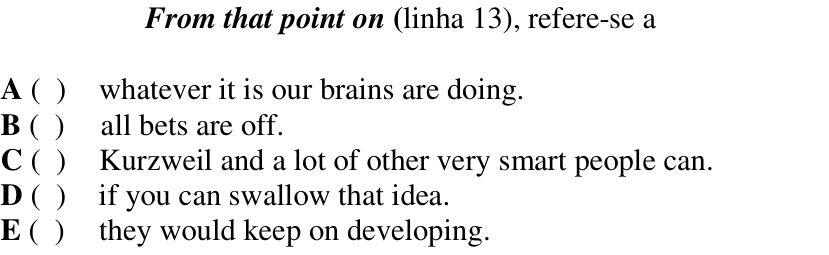
From that point on (linha 13), refere-se a
- Awhatever it is our brains are doing.
- Ball bets are off.
- CKurzweil and a lot of other very smart people can.
- Dif you can swallow that idea.
- Ethey would keep on developing.
Você já respondeu questões neste aparelho. Crie sua conta grátis para guardar o histórico e refazer as que errou.
Resposta salva no seu histórico.
Reportar erro na questão
Resolução comentada
A expressão from that point on significa "a partir desse momento". Ela é um marcador temporal e precisa de um ponto anterior no texto, algo que funcione como marco inicial.
Veja a frase: "If you can swallow that idea, and Kurzweil and a lot of other very smart people can, then all bets are off. From that point on, there's no reason to think computers would stop getting more powerful."
- That idea é a ideia de que os computadores podem alcançar uma inteligência comparável à humana, descrita no parágrafo anterior.
- A condição "if you can swallow that idea" (se você consegue engolir essa ideia, isto é, aceitá-la) marca o ponto de partida do raciocínio.
- Portanto, "a partir desse ponto" quer dizer: a partir do momento em que se aceita essa ideia, não há razão para achar que os computadores deixariam de ficar mais poderosos.
Os outros trechos não funcionam como marco: all bets are off é uma consequência ("tudo é possível"), Kurzweil... can é só uma aposição, e they would keep on developing vem depois da expressão, não antes. Whatever it is our brains are doing pertence ao parágrafo anterior e não é o ponto retomado.
A referência é a condição "if you can swallow that idea".
Alternativa D.
Por que as outras alternativas estão erradas
- A"Whatever it is our brains are doing" é só a descrição da consciência no parágrafo anterior, não o ponto de partida retomado.
- B"All bets are off" é a consequência da condição e vem imediatamente antes, mas não é o marco a partir do qual se conta; a expressão retoma a condição.
- C"Kurzweil and a lot of other very smart people can" apenas indica quem aceita a ideia, sem marcar um momento.
- E"They would keep on developing" vem depois da expressão, então não pode ser o ponto a que ela se refere.
Assunto: Referência pronominal e pronomes.
Reportar erro na resolução
Ver como caiu na prova
Fonte: ITA 2012 · Inglês. Prova oficial ↗