PRÁTICA COM QUESTÕES OFICIAIS
Questão 16 (Inglês) do ITA 2010
Texto-base das questões 14 a 18 · Inglês
As questões de 14 a 18 referem-se ao texto abaixo:
In August of 2000, a Japanese scientist named Toshiyuki Nakagaki announced that he had trained an amoebalike organism called slime mold to find the shortest route through a maze. Nakagaki had placed the mold in a small maze comprising four possible routes and planted pieces of food at two of the exits. Despite its being an incredibly primitive organism (a close relative of ordinary fungi) with no centralized brain whatsoever, the slime mold managed to plot the most efficient route to the food, stretching its body through the maze so that it connected directly to the two food sources. Without any apparent cognitive resources, the slime mold had “solved” the maze puzzle.
For such a simple organism, the slime mold has an impressive intellectual pedigree. Nakagaki’s announcement was only the latest in a long chain of investigations into the subtleties of slime mold behavior. For scientists trying to understand systems that use relatively simple components to build higher-level intelligence, the slime mold may someday be seen as the equivalent of the finches and tortoises that Darwin observed on the Galapagos Islands.
How did such a lowly organism come to play such an important scientific role? That story begins in the late sixties in New York City, with a scientist named Evelyn Fox Keller. A Harvard Ph.D. in physics, Keller had written her dissertation on molecular biology, and she had spent some time exploring the nascent field of “non-equilibrium thermodynamics”, which in later years would come to be associated with complexity theory. By 1968, she was working as an associate at Sloan-Kettering in Manhattan, thinking about the application of mathematics to biological problems. Mathematics had played such a tremendous role in expanding our understanding of physics, Keller thought – so perhaps it might also be useful for understanding living systems.
In the spring of 1968, Keller met a visiting scholar named Lee Segel, an applied mathematician who shared her interests. It was Segel who first introduced her to the bizarre conduct of the slime mold, and together they began a series of investigations that would help transform not just our understanding of biological development but also the disparate worlds of brain science, software design, and urban studies.
(...)
Johnson, Steven. Emergence. Peguin Books Ltd. 2001, pp. 11-12.
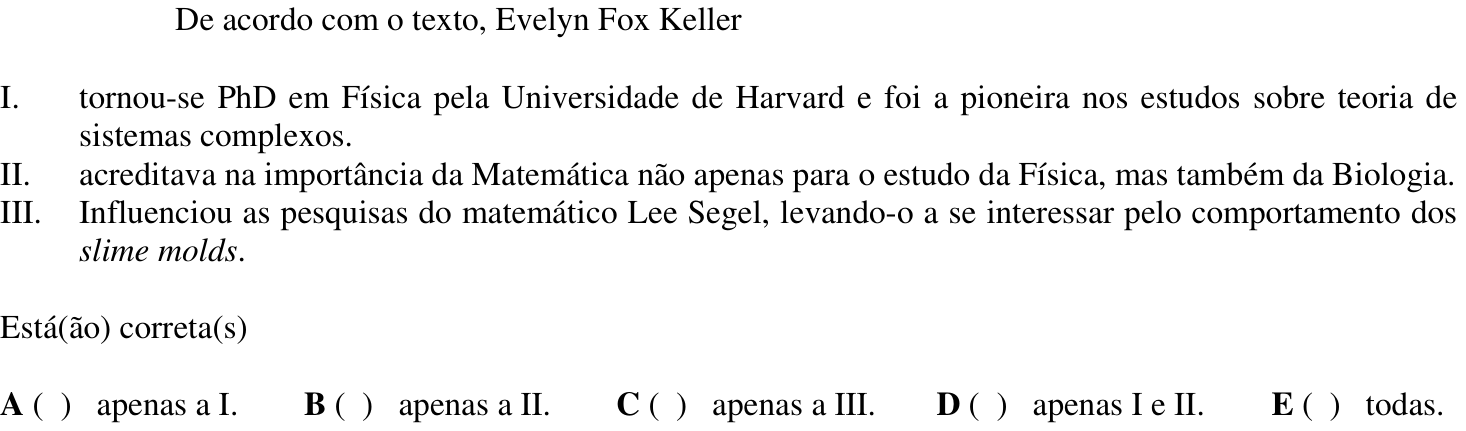
De acordo com o texto, Evelyn Fox Keller
I. tornou-se PhD em Física pela Universidade de Harvard e foi a pioneira nos estudos sobre teoria de sistemas complexos.
II. acreditava na importância da Matemática não apenas para o estudo da Física, mas também da Biologia.
III. Influenciou as pesquisas do matemático Lee Segel, levando-o a se interessar pelo comportamento dos slime molds.
Está(ão) correta(s)
- Aapenas a I.
- Bapenas a II.
- Capenas a III.
- Dapenas I e II.
- Etodas.
Você já respondeu questões neste aparelho. Crie sua conta grátis para guardar o histórico e refazer as que errou.
Resposta salva no seu histórico.
Reportar erro na questão
Resolução comentada
Vamos conferir cada afirmação com o que o texto diz sobre Keller.
I. O texto diz que Keller tinha PhD em Física por Harvard e que explorou o campo nascente da "non-equilibrium thermodynamics", que "in later years would come to be associated with complexity theory". Ou seja, ela estudou um campo que só mais tarde seria associado à teoria da complexidade. O texto não diz que ela foi pioneira nos estudos de sistemas complexos, e essa ideia foi acrescentada pela alternativa. Além disso, o texto diz que a tese dela foi sobre biologia molecular. Item falso.
II. O texto diz: a Matemática teve um papel enorme na ampliação da compreensão da Física, e Keller pensou que talvez também fosse útil para entender sistemas vivos ("living systems"). Isso corresponde à afirmação. Item verdadeiro.
III. O texto afirma o contrário: "It was Segel who first introduced her to the bizarre conduct of the slime mold". Foi Segel quem apresentou o comportamento do slime mold a Keller, e não ela a ele. A influência está invertida. Item falso.
Só o item II está correto.
Alternativa B.
Pegadinha: O item III engana ao inverter quem influenciou quem (foi Segel quem apresentou o slime mold a Keller), e o item I mistura um dado verdadeiro (PhD em Física por Harvard) com um falso (pioneirismo).
Por que as outras alternativas estão erradas
- AO item I atribui a Keller um pioneirismo em sistemas complexos que o texto não afirma; ela apenas explorou um campo que depois seria associado a eles.
- CO item III inverte a relação: foi Segel quem apresentou o slime mold a Keller.
- DInclui o item I, que é falso por atribuir pioneirismo não mencionado no texto.
- EInclui os itens I e III, ambos falsos.
Assunto: Informações explícitas e detalhes.
Reportar erro na resolução
Ver como caiu na prova
Fonte: ITA 2010 · Inglês. Prova oficial ↗