PRÁTICA COM QUESTÕES OFICIAIS
Questão 2 (Inglês) do ITA 2008
Texto-base das questões 01 a 03 · Inglês
As questões de 1 a 3 referem-se à seguinte página da internet:

| A Listing of Illinois Smoke-free Restaurants Patron Brochure (PDF) 65K Restaurant Owner Brochure (PDF) 68K Smoke-free Restaurant Certificate Illinois Clean Indoor Act |
The Illinois Smoke-free Restaurant Recognition Program recognizes those restaurants that have gone entirely smoke-free and raises public awareness to the dangers of exposure to second-hand smoke. Establishments choosing to participate in the program receive a certificate designating them as smoke-free restaurants and are listed on the Department’s Web site. Second-hand smoke is a combination of the smoke from a burning cigarette and the smoke exhaled by the smoker. It contaminates the air and is retained in clothing, curtains and furniture. More importantly, it represents a dangerous health hazard. The U.S. Environmental Protection Agency (EPA) concluded that second-hand smoke causes lung cancer in adult nonsmokers and impairs the respiratory health of children. The EPA classifies second-hand smoke as a group A carcinogen, a designation that means there is sufficient evidence that the substance causes cancer in humans. More than 4,000 different chemicals have been identified in second-hand smoke, and at least 43 of these chemicals cause cancer. EPA estimates that approximately 3,000 American nonsmokers die each year from lung cancer caused by second-hand smoke. The restaurants participating in this voluntary program have taken a progressive position by recognizing the need to go smoke-free to protect the health of their employees and patrons and by encouraging other restaurants across Illinois to participate. |
http://www.idph.state.il.us/tobacco/ilsmkfree.htm
Data da visita ao site: 26/06/2007
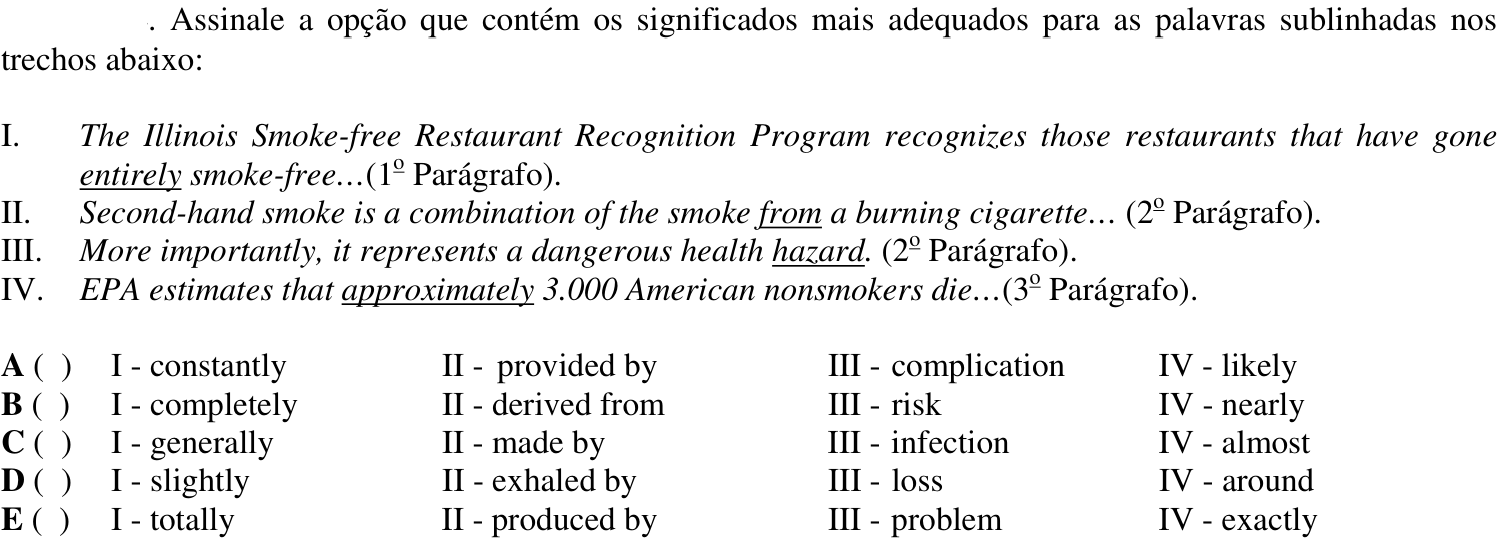
Assinale a opção que contém os significados mais adequados para as palavras sublinhadas nos trechos abaixo:
I. The Illinois Smoke-free Restaurant Recognition Program recognizes those restaurants that have gone entirely smoke-free...(1o Parágrafo).
II. Second-hand smoke is a combination of the smoke from a burning cigarette... (2o Parágrafo).
III. More importantly, it represents a dangerous health hazard. (2o Parágrafo).
IV. EPA estimates that approximately 3.000 American nonsmokers die...(3o Parágrafo).
- AI - constantly II - provided by III - complication IV - likely
- BI - completely II - derived from III - risk IV - nearly
- CI - generally II - made by III - infection IV - almost
- DI - slightly II - exhaled by III - loss IV - around
- EI - totally II - produced by III - problem IV - exactly
Você já respondeu questões neste aparelho. Crie sua conta grátis para guardar o histórico e refazer as que errou.
Resposta salva no seu histórico.
Reportar erro na questão
Resolução comentada
Cada item pede o sinônimo da palavra sublinhada no contexto.
-
entirely ("gone entirely smoke-free"): significa "inteiramente, por completo", isto é, completely ou totally. Isso elimina constantly (A), generally (C) e slightly (D).
-
from ("the smoke from a burning cigarette"): indica origem, a fumaça que vem do cigarro, ou seja, derived from, "proveniente de". Made by e produced by (C, E) até soam próximos, mas já estão eliminados pelo item I ou pelos itens III e IV.
-
hazard: significa "perigo, risco", e a frase fala de a dangerous health hazard, um risco à saúde. Logo, risk. Complication, infection, loss não são sinônimos, e problem é vago demais.
-
approximately ("approximately 3,000 ... die"): significa "aproximadamente", ou seja, nearly, almost ou around. Exactly (E) é o oposto e likely (A) quer dizer "provável".
Só a alternativa B acerta os quatro itens: completely, derived from, risk, nearly.
Alternativa B.
Por que as outras alternativas estão erradas
- A"constantly" significa constantemente, e "likely" é provável, não aproximadamente; "complication" não é perigo.
- C"generally" (geralmente) não equivale a entirely, e "infection" (infecção) não traduz hazard.
- D"slightly" (levemente) é o oposto de entirely, e "loss" (perda) não é hazard.
- E"exactly" (exatamente) contradiz approximately, e "problem" é genérico demais para hazard.
Assunto: Vocabulário em contexto e falsos cognatos.
Reportar erro na resolução
Ver como caiu na prova
Fonte: ITA 2008 · Inglês. Prova oficial ↗