PRÁTICA COM QUESTÕES OFICIAIS
Questão 40 (Português e Inglês) da 2ª fase do IME 2027
PARA AS QUESTÕES DE 31 A 40, RESPONDA DE ACORDO COM O TEXTO 4 A SEGUIR. · Português e Inglês
In 2026, the aviation community marks the 120th anniversary of the first public flight of the 14-Bis, performed by Brazilian aviation pioneer Alberto Santos-Dumont on October 23, 1906, in Paris. Widely regarded as a landmark in the history of aviation, the event remains closely associated with discussions about the origins of powered flight. The following text presents one perspective on this historical episode and the arguments supporting it.
Texto 4
The first flight, now without polemics
The polemics that have been dragging on for a century no longer exist for those who have informed themselves properly on the details of the history of the invention of flight. Santos-Dumont was in fact the first to fly by his own means, with autonomous takeoff and landing. On October 23, 1906, the 14- Bis covered 60 meters at a height of 3 meters, after running for some 100 meters on the Champs de Bagatelle, in Paris. On November 12, he flew for 220 meters, in the same place, and established the first record in aviation for speed: 41.3 kilometers an hour. The feat was ratified by the International Aeronautical Federation (FAI), created in 1905.
The brothers Orville and Wilbur Wright, bicycle mechanics from Dayton, Ohio, United States, were said to have flown on December 17, 1903. According to their own report, they covered 258 meters in 59 seconds, against strong winds on the beach at Kill Devil Hills, in Kitty Hawk, in North Carolina. The whole documentation on such an important fact was no more than a telegram and the presence of a few lifeguards who were looking for the wreckage of a ship. With the declared objective of keeping invention secret, to sell it to a military power, they only presented it publicly in 1908. The problem is that, to take off, the Flyer always depended on some external help, like a catapult to get it to run along rails and then to leave the ground, with the help of strong winds.
“Today, there is a modality of airplane that fits this very well, called motorglider, which does not take off on its own” says physicist Henrique Lins de Barros. Once in the air, it flies very well. “In 1908, the French planes would fly 10 km; the Wright had reached 124 km.”
The difference between the flights of Dumont and those of the Wrights is important for understanding the case. “In 1905, the aeroclubs of the entire world regulated the conditions that a flight would need to satisfy, to be validated” explains Rodrigo Moura Visoni, from UniRio, a student of the subject. According to these rules, the flight should be public and announced beforehand, and carried out in calm weather and on flat terrain. The height and time remaining in the air would not be considered as factors for declassification, but the takeoff had to be unassisted and the landing, accident-free. A qualified committee would accompany everything. “Only Dumont’s plane complied with all these rules and flew before hundreds of other people.”
The name arose when it was hitched to balloon No.14 in the preflight experiments. From 14 to 14- Bis was a hop. The Parisian press called it Oiseau de Proie (bird of prey). Dumont changed the 14-Bis until competing for and winning the Archdeacon award (3 thousand francs, for the unprecedented flight of the 60 meters) and the Aeroclub of France award (1.5 thousand francs, for the flight of 220 meters). He did not win the Deutsch-Archdeacon award (50 thousand francs, for flying a thousand meters in a closed circuit), won by Henri Farman. But he no longer had to. Santos-Dumont was in history.
Adapted from:<https://revistapesquisa.fapesp.br/en/100-years-in-the-air//> [Accessed on June 30th, 2026].
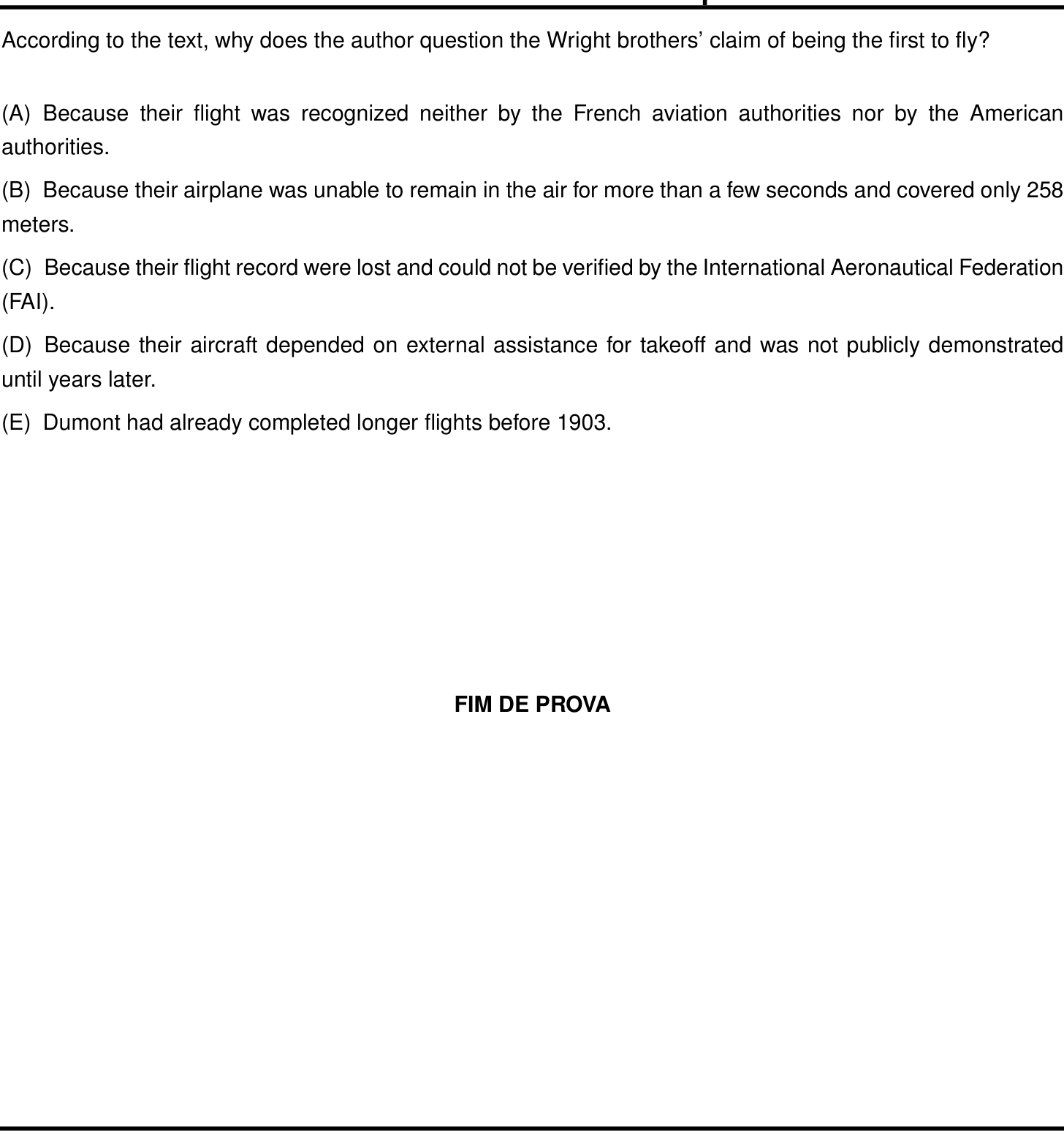
According to the text, why does the author question the Wright brothers’ claim of being the first to fly?
- ABecause their flight was recognized neither by the French aviation authorities nor by the American authorities.
- BBecause their airplane was unable to remain in the air for more than a few seconds and covered only 258 meters.
- CBecause their flight record were lost and could not be verified by the International Aeronautical Federation (FAI).
- DBecause their aircraft depended on external assistance for takeoff and was not publicly demonstrated until years later.
- EDumont had already completed longer flights before 1903.
Você já respondeu questões neste aparelho. Crie sua conta grátis para guardar o histórico e refazer as que errou.
Resposta salva no seu histórico.
Reportar erro na questão
Resolução comentada
O texto contesta o pioneirismo dos irmãos Wright com dois argumentos principais, e a pergunta pede a razão segundo o texto.
-
Sobre a decolagem: o texto diz que, "to take off, the Flyer always depended on some external help, like a catapult to get it to run along rails", além de ventos fortes. Pelas regras de 1905 dos aeroclubes, a decolagem tinha de ser sem ajuda ("unassisted"). O Flyer não cumpria esse requisito, ao contrário do 14-Bis, que decolou por meios próprios.
-
Sobre a comprovação: a documentação do voo de 1903 era "no more than a telegram" e a presença de alguns salva-vidas. Os irmãos só apresentaram o feito publicamente em 1908, para manter a invenção em segredo e vendê-la a uma potência militar. As regras também exigiam voo público e anunciado antes.
A alternativa que reúne esses dois pontos, ajuda externa na decolagem e demonstração pública apenas anos depois, é a D.
As demais afirmam coisas que o texto não diz: não menciona reconhecimento negado por autoridades, duração de poucos segundos como problema, registros perdidos nem voos anteriores de Dumont a 1903.
Alternativa D.
Por que as outras alternativas estão erradas
- AO texto não diz que franceses e americanos recusaram reconhecer o voo; a crítica é sobre as regras não cumpridas.
- BOs 59 segundos e 258 m não são apontados como falha; o texto nem diz que o avião não se sustentava no ar, e até elogia seu voo posterior.
- COs registros não são descritos como perdidos; a documentação é que era escassa (telegrama e testemunhas), e a FAI foi criada em 1905, depois de 1903.
- EDumont voou em 1906, não antes de 1903; além disso, a alternativa não explica o questionamento ao voo dos Wright e está fora do padrão das demais.
Assunto: Informações explícitas e detalhes.
Reportar erro na resolução
Ver como caiu na prova
Fonte: IME 2ª fase 2027 · Português e Inglês. Prova oficial ↗