PRÁTICA COM QUESTÕES OFICIAIS
Questão 28 (Português e Inglês) da 2ª fase do IME 2026
Texto-base das questões 21 a 30 · Português e Inglês
Text 1
ChatGPT May Be Eroding Critical Thinking Skills, According to a New MIT Study
By Andrew R. Chow
The study divided 54 subjects — 18 to 39 year-olds from the Boston area — into three groups, and asked them to write several SAT essays using OpenAI’s ChatGPT, Google’s search engine, and nothing at all, respectively. Researchers used an (electroencephalogram) EEG to record the writers’ brain activity across 32 regions, and found that of the three groups, ChatGPT users had the lowest brain engagement and “consistently underperformed at neural, linguistic, and behavioral levels.” Over the course of several months, ChatGPT users got lazier with each subsequent essay, often resorting to copy-and-paste by the end of the study.
The paper suggests that the usage of (Large Language Model) LLMs could actually harm learning, especially for younger users. The paper has not yet been peer reviewed, and its sample size is relatively small. But its paper’s main author Nataliya Kosmyna felt it was important to release the findings to elevate concerns that as society increasingly relies upon LLMs for immediate convenience, long-term brain development may be sacrificed in the process.
The group that wrote essays using ChatGPT all delivered extremely similar essays that lacked original thought, relying on the same expressions and ideas. Two English teachers who assessed the essays called them largely “soulless.” The EEGs revealed low executive control and attentional engagement. And by their third essay, many of the writers simply gave the prompt to ChatGPT and had it do almost all of the work. “It was more like, ‘just give me the essay, refine this sentence, edit it, and I’m done,’” Kosmyna says.
The brain-only group, conversely, showed the highest neural connectivity, especially in alpha, theta and delta bands, which are associated with creativity ideation, memory load, and semantic processing. Researchers found this group was more engaged and curious, and claimed ownership and expressed higher satisfaction with their essays.
The third group, which used Google Search, also expressed high satisfaction and active brain function. The difference here is notable because many people now search for information within AI chatbots as opposed to Google Search.
After writing the three essays, the subjects were then asked to re-write one of their previous efforts—but the ChatGPT group had to do so without the tool, while the brain-only group could now use ChatGPT. The first group remembered little of their own essays, and showed weaker alpha and theta brain waves, which likely reflected a bypassing of deep memory processes.
The second group, in contrast, performed well, exhibiting a significant increase in brain connectivity across all EEG frequency bands. This gives rise to the hope that AI, if used properly, could enhance learning as opposed to diminishing it.
Adapted from: TIME in https://time.com/7295195/ai-chatgpt-google-learning-school/ [Accessed on 15th July 2025].
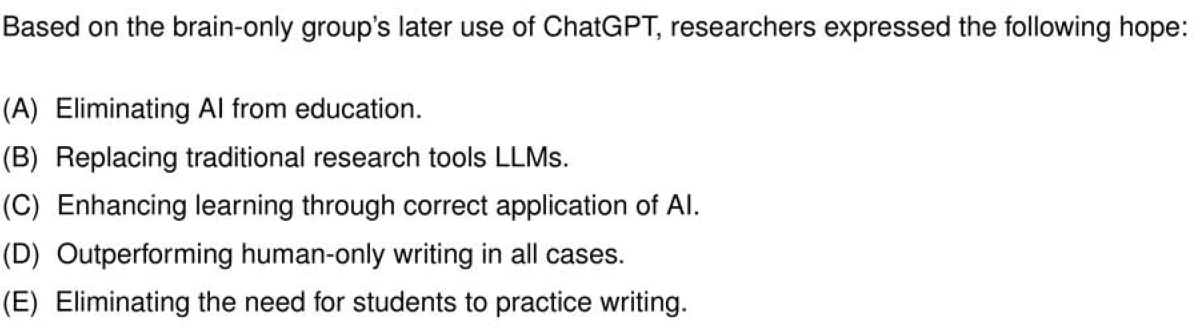
Based on the brain-only group’s later use of ChatGPT, researchers expressed the following hope:
- AEliminating AI from education.
- BReplacing traditional research tools LLMs.
- CEnhancing learning through correct application of AI.
- DOutperforming human-only writing in all cases.
- EEliminating the need for students to practice writing.
Reportar erro na questão
Resolução comentada
A questão pede a esperança expressa pelos pesquisadores a partir do uso posterior do ChatGPT pelo grupo que escreveu só com o cérebro.
-
No texto, depois dos três ensaios, os participantes reescreveram um dos textos anteriores. O grupo do ChatGPT ficou sem a ferramenta, e o grupo "brain-only" passou a poder usá-la.
-
O texto diz que esse segundo grupo, o brain-only, "performed well, exhibiting a significant increase in brain connectivity across all EEG frequency bands". Ou seja, usar a IA depois de já ter pensado e escrito por conta própria aumentou a atividade cerebral.
-
A conclusão vem na frase seguinte: "This gives rise to the hope that AI, if used properly, could enhance learning as opposed to diminishing it". Em tradução: isso dá origem à esperança de que a IA, se bem usada, possa melhorar a aprendizagem em vez de prejudicá-la.
-
Portanto, a esperança é que a IA aprimore o aprendizado quando aplicada de forma correta ("if used properly"). Isso corresponde à alternativa que fala em aprimorar a aprendizagem pelo uso correto da IA.
Nenhuma das outras opções aparece no texto: os pesquisadores não propõem banir a IA, substituir ferramentas de busca, afirmar superioridade em todos os casos nem dispensar a prática de escrita.
Alternativa C.
Por que as outras alternativas estão erradas
- AO texto alerta para riscos, mas não propõe eliminar a IA da educação; a esperança é de uso adequado.
- BO texto não defende substituir as ferramentas tradicionais de pesquisa por LLMs; apenas nota que muitos já buscam em chatbots.
- DGeneraliza demais: não se afirma que a IA supera a escrita humana em todos os casos.
- EContradiz o texto, que mostra os danos de deixar de praticar a escrita e a necessidade de engajamento mental.
Assunto: Inferência e ponto de vista do autor.
Reportar erro na resolução
Ver como caiu na prova
Fonte: IME 2ª fase 2026 · Português e Inglês. Prova oficial ↗