PRÁTICA COM QUESTÕES OFICIAIS
Questão 24 (Português e Inglês) da 2ª fase do IME 2026
Texto-base das questões 21 a 30 · Português e Inglês
Text 1
ChatGPT May Be Eroding Critical Thinking Skills, According to a New MIT Study
By Andrew R. Chow
The study divided 54 subjects — 18 to 39 year-olds from the Boston area — into three groups, and asked them to write several SAT essays using OpenAI’s ChatGPT, Google’s search engine, and nothing at all, respectively. Researchers used an (electroencephalogram) EEG to record the writers’ brain activity across 32 regions, and found that of the three groups, ChatGPT users had the lowest brain engagement and “consistently underperformed at neural, linguistic, and behavioral levels.” Over the course of several months, ChatGPT users got lazier with each subsequent essay, often resorting to copy-and-paste by the end of the study.
The paper suggests that the usage of (Large Language Model) LLMs could actually harm learning, especially for younger users. The paper has not yet been peer reviewed, and its sample size is relatively small. But its paper’s main author Nataliya Kosmyna felt it was important to release the findings to elevate concerns that as society increasingly relies upon LLMs for immediate convenience, long-term brain development may be sacrificed in the process.
The group that wrote essays using ChatGPT all delivered extremely similar essays that lacked original thought, relying on the same expressions and ideas. Two English teachers who assessed the essays called them largely “soulless.” The EEGs revealed low executive control and attentional engagement. And by their third essay, many of the writers simply gave the prompt to ChatGPT and had it do almost all of the work. “It was more like, ‘just give me the essay, refine this sentence, edit it, and I’m done,’” Kosmyna says.
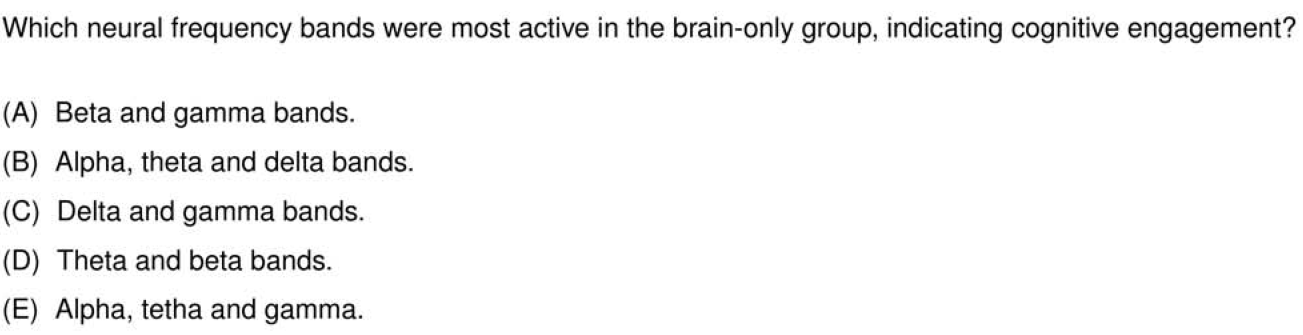
The brain-only group, conversely, showed the highest neural connectivity, especially in alpha, theta and delta bands, which are associated with creativity ideation, memory load, and semantic processing. Researchers found this group was more engaged and curious, and claimed ownership and expressed higher satisfaction with their essays.
The third group, which used Google Search, also expressed high satisfaction and active brain function. The difference here is notable because many people now search for information within AI chatbots as opposed to Google Search.
After writing the three essays, the subjects were then asked to re-write one of their previous efforts—but the ChatGPT group had to do so without the tool, while the brain-only group could now use ChatGPT. The first group remembered little of their own essays, and showed weaker alpha and theta brain waves, which likely reflected a bypassing of deep memory processes.
The second group, in contrast, performed well, exhibiting a significant increase in brain connectivity across all EEG frequency bands. This gives rise to the hope that AI, if used properly, could enhance learning as opposed to diminishing it.
Adapted from: TIME in https://time.com/7295195/ai-chatgpt-google-learning-school/ [Accessed on 15th July 2025].
Which neural frequency bands were most active in the brain-only group, indicating cognitive engagement?
- ABeta and gamma bands.
- BAlpha, theta and delta bands.
- CDelta and gamma bands.
- DTheta and beta bands.
- EAlpha, tetha and gamma.
Reportar erro na questão
Resolução comentada
A pergunta é sobre quais bandas de frequência neural foram mais ativas no grupo que escreveu sem nenhuma ferramenta (o brain-only group).
O quarto parágrafo traz a informação: "The brain-only group, conversely, showed the highest neural connectivity, especially in alpha, theta and delta bands, which are associated with creativity ideation, memory load, and semantic processing." Em português: o grupo que usou só o cérebro mostrou a maior conectividade neural, sobretudo nas bandas alfa, teta e delta, associadas à ideação criativa, à carga de memória e ao processamento semântico.
Portanto, as três bandas citadas são exatamente alpha, theta e delta.
Conferindo as alternativas:
- Beta e gamma não aparecem no texto.
- A combinação alpha + theta + delta aparece na alternativa B.
- As demais trocam uma ou mais bandas por beta ou gamma, que o texto não menciona.
O texto também cita alpha e theta ao falar do grupo ChatGPT, mas ali elas estão enfraquecidas na tarefa de reescrita. Isso não muda a resposta, pois a pergunta é sobre o grupo brain-only.
Alternativa B.
Por que as outras alternativas estão erradas
- ABeta e gamma não são mencionadas no texto.
- CMantém delta, mas troca alpha e theta por gamma, que não aparece no texto.
- DInclui beta, ausente no texto, e omite alpha e delta.
- ESubstitui delta por gamma, que o texto não cita.
Assunto: Informações explícitas e detalhes.
Reportar erro na resolução
Ver como caiu na prova
Fonte: IME 2ª fase 2026 · Português e Inglês. Prova oficial ↗