PRÁTICA COM QUESTÕES OFICIAIS
Questão 24 (Português e Inglês) da 2ª fase do IME 2022
PARA AS QUESTÕES DE 21 A 28, ESCOLHA A ALTERNATIVA QUE COMPLETA O TEXTO 1 CORRETAMENTE. · Português e Inglês
(VALOR: 0,5 / QUESTÃO)
Text 1
THE PROMISE OF MR TRASH WHEEL
Carolyn Kormann
John Kellett, the former director of Baltimore’s Maritime Museum, used to cross a footbridge over Jones Falls, the largest tributary ______ (21) ______ into Baltimore’s Inner Harbor, every day on his way to work. “When it rained, there was a river of trash flowing down,” he told me. He ______ (22) ______ twenty years working on the harbor, primarily in environmental education and shipbuilding, and had a deep knowledge of its hydrodynamics and history. City officials, he told me, “said they were open to ideas, so I started sketching.” He drew plans for a machine powered by an ______ (23) ______ water wheel—a technology that ______ (24) ______ a staple throughout the city—designed to intercept trash at the mouth of Jones Falls, which is the main ______ (25) ______ of harbor pollution. A prototype was installed in 2008. By 2014, Kellett’s invention was reborn as Mr. Trash Wheel—a fifty-foot-long machine, weighing nearly a hundred thousand pounds, which resembles a friendly mollusk, with giant, ______ (26) ______ eyes and its own Twitter account.
Years later, Mr. Trash Wheel has spawned three replicas around Baltimore—Professor Trash Wheel, Captain Trash Wheel, and another that was announced last week but has yet to be named or installed in the water. Three local beers are named in their honor, and the city has both a trash-wheel ______ (27) ______ festival and a society dedicated to promoting environmental awareness known as the Order of the Wheel. As plastic pollution in the world’s oceans has become a growing crisis, the trash wheels have gained an international following. “Over the last few years, I’ve been getting calls and e-mails from all over the world,” Kellett said. A Japanese film ______ (28) ______ visited last week. “I’m still kind of in shock about how much attention it has garnered,” he went on. “Never in my wildest dreams would I ever have thought that this idea I sketched on a napkin would lead to all this.”
Adapted from: The New Yorker in https://www.newyorker.com/tech/annals-of-technology/the-promise-of-mr-trash-wheel [Accessed on 7th April 2021].
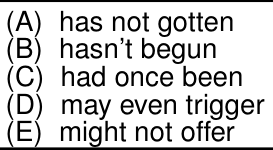
- Ahas not gotten
- Bhasn’t begun
- Chad once been
- Dmay even trigger
- Emight not offer
Reportar erro na questão
Resolução comentada
A lacuna (24) está em: "a technology that ______ a staple throughout the city". Ela pede uma forma verbal que, com "a staple" (um item básico, algo presente em toda parte), conte que a roda d'água foi, no passado, uma tecnologia comum em Baltimore.
O sentido do trecho é este: Kellett desenhou uma máquina movida a roda d'água, tecnologia que já foi um elemento básico na cidade. Isso indica um tempo passado anterior ao do projeto, e had once been exprime exatamente isso (past perfect, com "once" = "outrora").
Testando as demais:
- "has not gotten" e "hasn't begun" não combinam com "a staple": "get/begin" pedem complemento diferente ("gotten a staple" não faz sentido; "begun a staple" também não).
- "may even trigger" e "might not offer" exigem um objeto direto, que não existe aqui. Além disso, a tecnologia não "aciona" nem "oferece" "a staple".
Só "had once been" liga o sujeito "a technology" ao predicativo "a staple throughout the city" com sentido coerente.
Alternativa C.
Por que as outras alternativas estão erradas
- A"has not gotten a staple" não faz sentido e nega algo que o texto afirma sobre a roda d'água.
- B"hasn't begun a staple" é inadequado: o verbo "begin" não liga a tecnologia ao predicativo.
- D"may even trigger" é transitivo e exprime possibilidade, sem ligar o sujeito ao predicativo "a staple".
- E"might not offer" é transitivo e exprime possibilidade negativa, o que não combina com "a staple".
Assunto: Tempos verbais e verbos modais.
Reportar erro na resolução
Ver como caiu na prova
Fonte: IME 2ª fase 2022 · Português e Inglês. Prova oficial ↗