PRÁTICA COM QUESTÕES OFICIAIS
Questão 37 (Português e Inglês) da 2ª fase do IME 2020
PARA AS QUESTÕES 35 A 37, RESPONDA DE ACORDO COM O TEXTO 3 A SEGUIR. · Português e Inglês
Texto 3
CHAPTER 2
SCIENCE AND HOPE
[...]
I was a child in a time of hope. I wanted to be a scientist from my earliest school days. The crystallizing moment came when I first caught on that the stars are mighty suns, when it first dawned on me how staggeringly far away they must be to appear as mere points of light in the sky. I'm not sure I even knew the meaning of the word 'science' then, but I wanted somehow to immerse myself in all that grandeur. I was gripped by the splendour of the Universe, transfixed by the prospect of understanding how things really work, of helping to uncover deep mysteries, of exploring new worlds - maybe even literally. It has been my good fortune to have had that dream in part fulfilled. For me, the romance of science remains as appealing and new as it was on that day, more than half a century ago, when I was shown the wonders of the 1939 World's Fair.
Popularizing science - trying to make its methods and findings accessible to non-scientists - then follows naturally and immediately. Not explaining science seems to me perverse. When you're in love, you want to tell the world. This book is a personal statement, reflecting my lifelong love affair with science.
But there's another reason: science is more than a body of knowledge; it is a way of thinking.
[...]
Adaptado de SAGAN, Carl. The Demon-Haunted World. Science as a Candle in the Dark. Headline Book Publishing, 1997. Disponível em: http://www.metaphysicspirit.com/books/The Demon-Haunted World.pdf. Acesso em: 22/07/2019.
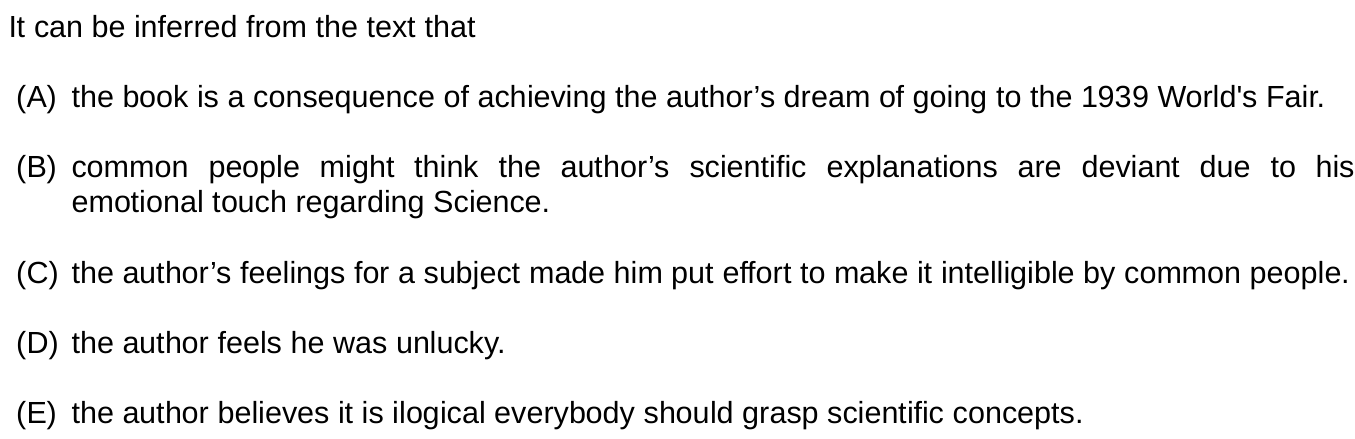
It can be inferred from the text that
- Athe book is a consequence of achieving the author’s dream of going to the 1939 World's Fair.
- Bcommon people might think the author’s scientific explanations are deviant due to his emotional touch regarding Science.
- Cthe author’s feelings for a subject made him put effort to make it intelligible by common people.
- Dthe author feels he was unlucky.
- Ethe author believes it is ilogical everybody should grasp scientific concepts.
Reportar erro na questão
Resolução comentada
O autor conta que desde criança é apaixonado pela ciência e que esse encanto continua "tão novo" quanto no primeiro dia. Em seguida, no segundo parágrafo, diz que popularizar a ciência, isto é, torná-la acessível a não cientistas, "follows naturally and immediately" (decorre natural e imediatamente) desse amor. Ele ainda afirma: "When you're in love, you want to tell the world" (quando se está apaixonado, quer-se contar ao mundo).
Portanto, o raciocínio do texto é: paixão pela ciência → esforço para explicá-la a todos. Isso é exatamente o que diz a alternativa C: o sentimento do autor por um assunto o levou a se esforçar para torná-lo compreensível ao público leigo ("intelligible by common people").
Confira as demais: a feira de 1939 foi o momento que mostrou as maravilhas da ciência, não uma meta cumprida que originou o livro; o autor diz ter tido boa sorte ("good fortune"), não azar; e ele considera perverso ("perverse") não explicar ciência, o que contradiz a ideia de que seria ilógico todos entenderem conceitos científicos.
Alternativa C.
Por que as outras alternativas estão erradas
- AA feira de 1939 foi apenas o momento do deslumbramento com a ciência; o livro não decorre de ter ido a ela como realização de um sonho.
- BO texto não diz que o público veria suas explicações como desviantes; essa ideia não aparece em nenhum trecho.
- DO autor diz expressamente que teve "good fortune" ao realizar parte do sonho, o oposto de azar.
- EPara o autor, não explicar a ciência é "perverse"; ele defende a divulgação, não que seja ilógico todos entendê-la.
Assunto: Inferência e ponto de vista do autor.
Reportar erro na resolução
Ver como caiu na prova
Fonte: IME 2ª fase 2020 · Português e Inglês. Prova oficial ↗