Questão 33 da FUVEST 2023
TEXTO PARA AS QUESTÕES DE 32 A 34
From French electronic and Japanese indie to K-pop and Spanish jazz, it’s common for people to listen to songs they don’t necessarily understand. Not knowing the language of the lyrics, it seems, doesn’t stop people from liking—and sometimes even singing along to—a song. Unless the listener is looking up the dictionary meaning of the lyrics, then the dictionary meaning of the lyrics doesn’t make or break their appreciation of a song. But why?
“It’s a complicated answer,” said musicologist Lisa Decenteceo, adding that it all starts with what’s called “sound symbolism.” Sound symbolism refers to the study of the relationships between utterances and their meaning. This doesn’t have to do only with music. Marketers, for example, can tune into sound symbolism as part of their strategy in coming up with appealing brand names. In music as well as in branding, Decenteceo explained, there’s something about the appeal of words as sounds, beyond their meaning in a language. While things like culture and personal experiences affect people’s responses to different kinds of music, she explained there are certain musical techniques that are generally used to convey certain moods. One of which is scale. “Songs in a major scale usually have brighter, happier sounds, while minor scales usually have the slightly darker, melancholic feel,” explains Thea Tolentino, a music teacher.
The human brain is wired to respond to sound, she added. In a process called entrainment, the brain “synchronizes our breathing, our movement, even neural activities with the sounds we hear.” This is why fast-paced music is so popular for running, for example, or why some yoga teachers play rhythmic and melodic tracks in their classes. And there are also the things that accompany the words. “Elements of sound and music like pitch, melody, harmony, timbre, and amplitude have an affective, emotional, psychological, cognitive, and even physical impact on listeners. Music adds so much meaning and dimension to texts through a complex of these avenues,” said Decenteceo. What all these things do, she added, is liberate the words. “Song frees the voice from any burden of saying anything meaningful”. It’s important, then, to understand music as a discourse between musical elements. But all in all, Decenteceo said there’s value in whatever immediate appeal people find in the music they listen to, whether or not they understand the words. Music, after all, is the universal language.
Disponível em https://www.vice.com/. March, 2022. Adaptado.
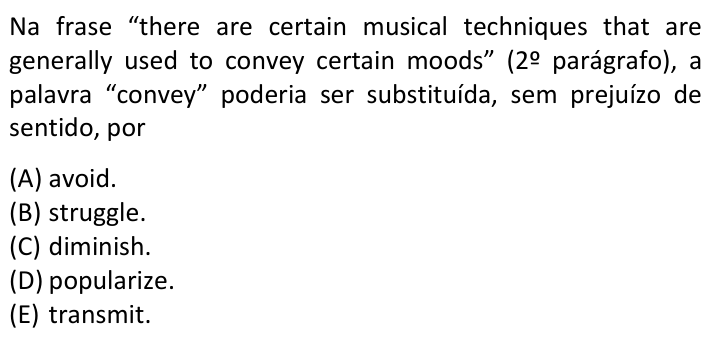
Na frase “there are certain musical techniques that are generally used to convey certain moods” (2o parágrafo), a palavra “convey” poderia ser substituída, sem prejuízo de sentido, por
- Aavoid.
- Bstruggle.
- Cdiminish.
- Dpopularize.
- Etransmit.
Reportar erro na questão
Resolução comentada
"Convey" significa transmitir, comunicar uma ideia, sentimento ou mensagem. Na frase, as técnicas musicais são usadas para "convey certain moods", ou seja, para passar ao ouvinte certos climas ou emoções. O exemplo do texto confirma: a escala maior transmite um som mais brilhante e alegre, e a escala menor, um som mais sombrio e melancólico.
Agora, teste cada opção no lugar de "convey":
- avoid (evitar): técnicas usadas para evitar climas? Não faz sentido, pois o texto mostra que elas criam climas.
- struggle (lutar, esforçar-se): é um verbo intransitivo, não aceita "moods" como complemento direto.
- diminish (diminuir): o texto não fala em reduzir emoções.
- popularize (popularizar): ninguém popularizaria "moods"; o sentido é outro.
- transmit (transmitir): mantém o sentido, pois as técnicas são usadas para transmitir certos climas.
Só "transmit" preserva o sentido original da frase.
Alternativa E.
Por que as outras alternativas estão erradas
- A"avoid" significa evitar, o oposto da ideia de expressar climas por meio das técnicas musicais.
- B"struggle" é verbo intransitivo (lutar) e não combina com "moods" como complemento.
- C"diminish" significa diminuir, sentido que o texto não expressa.
- D"popularize" significa tornar popular, o que não se aplica a "moods" nem ao contexto.
Assuntos: vocabulário em contexto, interpretação de texto em inglês.
Reportar erro na resolução
Ver como caiu na prova