PRÁTICA COM QUESTÕES OFICIAIS
Questão 32 da FUVEST 2023
TEXTO PARA AS QUESTÕES DE 32 A 34
From French electronic and Japanese indie to K-pop and Spanish jazz, it’s common for people to listen to songs they don’t necessarily understand. Not knowing the language of the lyrics, it seems, doesn’t stop people from liking—and sometimes even singing along to—a song. Unless the listener is looking up the dictionary meaning of the lyrics, then the dictionary meaning of the lyrics doesn’t make or break their appreciation of a song. But why?
“It’s a complicated answer,” said musicologist Lisa Decenteceo, adding that it all starts with what’s called “sound symbolism.” Sound symbolism refers to the study of the relationships between utterances and their meaning. This doesn’t have to do only with music. Marketers, for example, can tune into sound symbolism as part of their strategy in coming up with appealing brand names. In music as well as in branding, Decenteceo explained, there’s something about the appeal of words as sounds, beyond their meaning in a language. While things like culture and personal experiences affect people’s responses to different kinds of music, she explained there are certain musical techniques that are generally used to convey certain moods. One of which is scale. “Songs in a major scale usually have brighter, happier sounds, while minor scales usually have the slightly darker, melancholic feel,” explains Thea Tolentino, a music teacher.
The human brain is wired to respond to sound, she added. In a process called entrainment, the brain “synchronizes our breathing, our movement, even neural activities with the sounds we hear.” This is why fast-paced music is so popular for running, for example, or why some yoga teachers play rhythmic and melodic tracks in their classes. And there are also the things that accompany the words. “Elements of sound and music like pitch, melody, harmony, timbre, and amplitude have an affective, emotional, psychological, cognitive, and even physical impact on listeners. Music adds so much meaning and dimension to texts through a complex of these avenues,” said Decenteceo. What all these things do, she added, is liberate the words. “Song frees the voice from any burden of saying anything meaningful”. It’s important, then, to understand music as a discourse between musical elements. But all in all, Decenteceo said there’s value in whatever immediate appeal people find in the music they listen to, whether or not they understand the words. Music, after all, is the universal language.
Disponível em https://www.vice.com/. March, 2022. Adaptado.
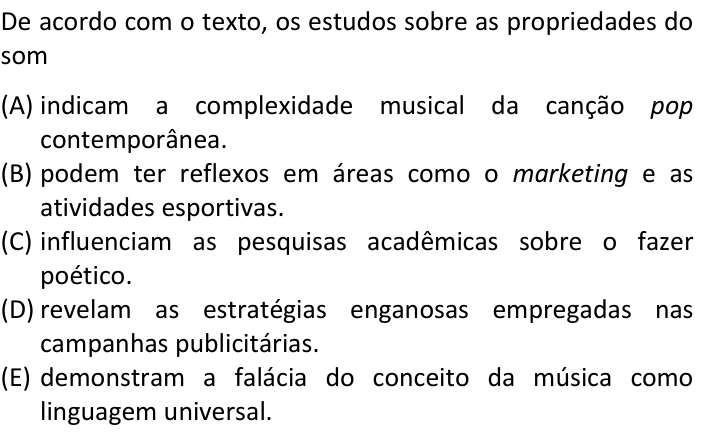
De acordo com o texto, os estudos sobre as propriedades do som
- Aindicam a complexidade musical da canção pop contemporânea.
- Bpodem ter reflexos em áreas como o marketing e as atividades esportivas.
- Cinfluenciam as pesquisas acadêmicas sobre o fazer poético.
- Drevelam as estratégias enganosas empregadas nas campanhas publicitárias.
- Edemonstram a falácia do conceito da música como linguagem universal.
Você já respondeu questões neste aparelho. Crie sua conta grátis para guardar o histórico e refazer as que errou.
Resposta salva no seu histórico.
Reportar erro na questão
Resolução comentada
A questão pede o que o texto diz sobre os estudos das propriedades do som, ou seja, o "sound symbolism" e a forma como o cérebro reage ao som.
Veja os trechos que importam:
-
No segundo parágrafo, o texto diz que o sound symbolism não se restringe à música: "Marketers, for example, can tune into sound symbolism as part of their strategy in coming up with appealing brand names". Ou seja, profissionais de marketing usam o apelo sonoro das palavras para criar nomes de marcas.
-
No terceiro parágrafo, a "entrainment" (sincronização do cérebro com o som) explica por que a música rápida é popular para corrida e por que professores de ioga usam faixas rítmicas. Isso é aplicação em atividades físicas e esportivas.
Assim, o estudo do som tem reflexos no marketing e nas atividades esportivas, o que corresponde à alternativa B.
As demais não têm apoio no texto: ele não trata da complexidade do pop, de pesquisas sobre o fazer poético, de publicidade enganosa, e ainda conclui que a música é a "universal language", sem contestar essa ideia.
Alternativa B.
Por que as outras alternativas estão erradas
- AO texto não fala de complexidade do pop; cita gêneros variados só como exemplo de músicas que se ouve sem entender a letra.
- CNão há menção a pesquisas acadêmicas sobre o fazer poético; a música é que liberta as palavras do peso de significar.
- DO marketing é citado como uso do apelo sonoro na criação de nomes de marcas, sem qualquer ideia de engano.
- EO texto reafirma a música como linguagem universal, em vez de chamá-la de falácia.
Assunto: Informações explícitas e detalhes.
Reportar erro na resolução
Ver como caiu na prova