Questão 73 da FUVEST 2014
TEXTO PARA AS QUESTÕES DE 71 A 73
To live the longest and healthiest life possible, get smarter. Institute for Health Metrics and Evaluation (IHME) data show that past a certain threshold, health and wealth are just weakly correlated. However, overall health is closely tied to how many years people spend in school. Mexico, for instance, has a fifth the per capita gross domestic product (GDP) of the United States, but, for women, more than 50 percent of the latter’s schooling.
In line with the trend, Mexico’s female adult mortality rate is only narrowly higher. Vietnam and Yemen have roughly equivalent per capita GDP. Yet Vietnamese women average 6.3 more years in school and are half as likely to die between the ages of 15 and 60. “Economic growth is also significantly associated with child mortality reductions, but the magnitude of the association is much smaller than that of increased education,” comments Emmanuela Gakidou, IHME’s director of education and training. “One year of schooling gives you about 10 percent lower mortality rates, whereas with a 10 percent increase in GDP, your mortality rate would go down only by 1 to 2 percent.”
Discover, May 31, 2013. Adaptado.
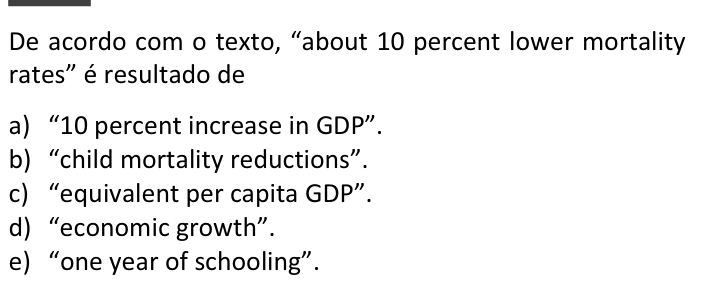
De acordo com o texto, “about 10 percent lower mortality rates” é resultado de
- A“10 percent increase in GDP”.
- B“child mortality reductions”.
- C“equivalent per capita GDP”.
- D“economic growth”.
- E“one year of schooling”.
Reportar erro na questão
Resolução comentada
O trecho citado vem da fala de Emmanuela Gakidou: "One year of schooling gives you about 10 percent lower mortality rates, whereas with a 10 percent increase in GDP, your mortality rate would go down only by 1 to 2 percent".
A frase tem duas partes contrastadas pela conjunção whereas ("enquanto que"):
- Primeira parte: one year of schooling gives you about 10 percent lower mortality rates, ou seja, "um ano de escolaridade traz cerca de 10% menos mortalidade".
- Segunda parte: with a 10 percent increase in GDP, your mortality rate would go down only by 1 to 2 percent, ou seja, um aumento de 10% no PIB reduz a mortalidade em apenas 1 a 2%.
Portanto, a redução de cerca de 10% na mortalidade é consequência de um ano a mais de escolaridade. O aumento do PIB, que aparece na alternativa A, produz efeito bem menor, de 1 a 2%.
O verbo gives indica a relação de causa e efeito: a escolaridade é o sujeito que "dá" a redução.
Alternativa E.
Pegadinha: A alternativa A engana porque repete o número 10% do trecho ("10 percent increase in GDP"), mas esse aumento do PIB reduz a mortalidade só em 1 a 2%.
Por que as outras alternativas estão erradas
- AO aumento de 10% no PIB reduz a mortalidade em apenas 1 a 2%, segundo o texto, e não em 10%.
- B"Child mortality reductions" é o efeito associado ao crescimento econômico, não a causa da queda de 10%.
- C"Equivalent per capita GDP" foi usado para comparar Vietnã e Yemen, sem relação com a redução de 10%.
- DO crescimento econômico tem associação muito menor com a redução da mortalidade, como diz o próprio texto.
Assuntos: interpretação de texto em inglês, relações de causa e efeito, conjunção whereas.
Reportar erro na resolução
Ver como caiu na prova