PRÁTICA COM QUESTÕES OFICIAIS
Questão 31 (1º exame) da FUVEST 2001
Texto para as questões de 30 a 36 · V
It is a nice irony, given that scientific genetics started with the manipulation of a crop plant, the pea, that the most vehement public opposition to it in recent years has come from those who object to the genetic manipulation of crops.
At the moment, so-called genetically modified (GM) crops are in disgrace. Consumers, particularly in Europe, are wary of buying food that may contain them. Environmental activists are ripping up fields where they are being tested experimentally. And companies that design them are selling off their GM subsidiaries, or even themselves, to anyone willing to take on the risk.
Yet the chances are that this is just a passing fad. No trial has shown a health risk from a commercially approved GM crop (or, more correctly, a transgenic crop, as all crop plants have been genetically modified by selective breeding since time immemorial). And while the environmental risks, such as cross-pollination with wild species and the promotion of insecticide-resistant strains of pest, look more plausible, they also look no worse than the sorts of environmental havoc wreaked by more traditional sorts of agriculture.
THE ECONOMIST JULY 1ST 2000
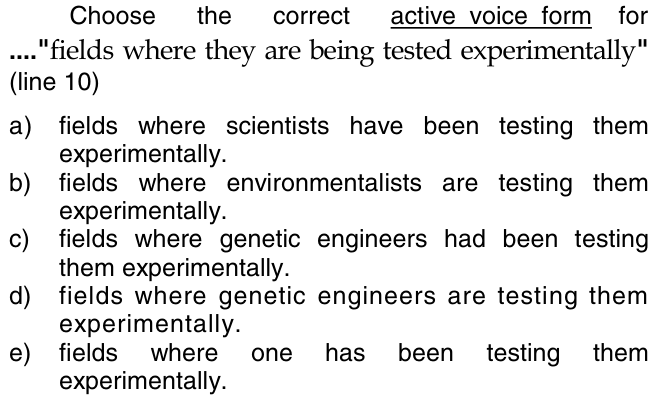
Choose the correct active voice form for ...."fields where they are being tested experimentally" (line 10)
- Afields where scientists have been testing them experimentally.
- Bfields where environmentalists are testing them experimentally.
- Cfields where genetic engineers had been testing them experimentally.
- Dfields where genetic engineers are testing them experimentally.
- Efields where one has been testing them experimentally.
Você já respondeu questões neste aparelho. Crie sua conta grátis para guardar o histórico e refazer as que errou.
Resposta salva no seu histórico.
Reportar erro na questão
Resolução comentada
A questão pede a voz ativa equivalente a "are being tested", que é a voz passiva no presente contínuo (present continuous passive): verbo to be no presente + being + particípio.
Para passar da passiva para a ativa, o tempo verbal precisa ser mantido:
- Passiva: they are being tested (presente contínuo).
- Ativa: sujeito + am/is/are + verbo no gerúndio + objeto, ou seja, are testing them.
Portanto a forma ativa correta deve ter are testing. Veja o que cada opção traz:
- have been testing: presente perfeito contínuo, tempo diferente.
- had been testing: passado perfeito contínuo, tempo diferente.
- are testing: presente contínuo, tempo mantido.
Só as alternativas B e D usam are testing. A escolha do sujeito decide entre elas: no texto, quem arranca as plantações em teste são os environmental activists, mas o sujeito de are testing seria quem realiza os testes, e o texto diz que as empresas projetam as plantas e as testam experimentalmente. Os ativistas não testam os campos, eles os destroem. Logo, environmentalists (B) muda o sentido, e genetic engineers (D) é o agente plausível.
Alternativa D.
Pegadinha: A alternativa B engana porque o tempo verbal está correto (are testing), mas o sujeito environmentalists contradiz o texto, que os apresenta como opositores dos testes.
Por que as outras alternativas estão erradas
- AUsa have been testing (presente perfeito contínuo), mudando o tempo verbal da passiva original.
- BO tempo está certo, mas atribui os testes aos ambientalistas, que no texto são os que destroem os campos, não os que testam.
- CHad been testing é passado perfeito contínuo, tempo diferente do presente contínuo original.
- EHas been testing é presente perfeito contínuo, não mantém o presente contínuo, e o sujeito one é indefinido e artificial.
Assunto: Tempos verbais e verbos modais.
Reportar erro na resolução
Ver como caiu na prova
Fonte: FUVEST 2001 · 1º exame. Prova oficial ↗