PRÁTICA COM QUESTÕES OFICIAIS
Questão 71 (1º exame) da FUVEST 1998
Texto-base das questões 67 a 72 · V
LETTERS
Science talent redirected
“Is Science Talent Squandered?” (SN: 5/31/97, p. 338) sent me into a reverie of my precollege days. Having achieved, at 10 years of age, minor celebrity status in Nation’s Business by inventing a “new” cotton picker, having burned holes in my parents’ basement ceiling with my huge Gilbert chemistry set, and having been given a key to the high school lab to conduct my own experiments on weekends, I knew I would be a scientist.
Then came college and the public denigration (in an introductory chemistry class) of my poetic expression of the practical application of combustion. Literary and artistic teachers and friends enjoyed my “weird” presentation, so I joined their ranks instead, achieving modest adult recognition as a writer but still finding my real reading interest in science.
If I had found a Carl Sagan some 40 years ago, I might be in a different college in my university today, but perhaps with different regrets.
F. Richard Thomas, Professor of American Thought and Language,
Michigan State University, East Lansing, Mich.
[Science News, 26 July 1997, vol. 152]
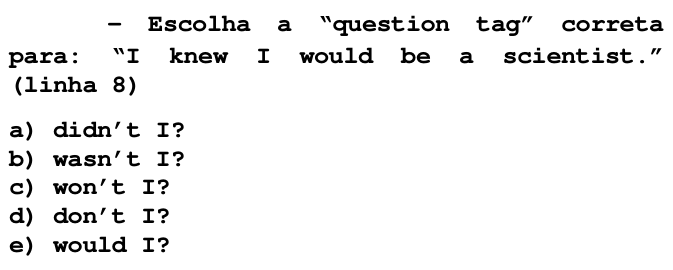
– Escolha a “question tag” correta para: “I knew I would be a scientist.” (linha 8)
- Adidn’t I?
- Bwasn’t I?
- Cwon’t I?
- Ddon’t I?
- Ewould I?
Você já respondeu questões neste aparelho. Crie sua conta grátis para guardar o histórico e refazer as que errou.
Resposta salva no seu histórico.
Reportar erro na questão
Resolução comentada
Uma question tag é a perguntinha curta no fim da frase ("não é?", "não foi?"). Ela segue duas regras:
- Usa o mesmo auxiliar (ou verbo) da oração principal, no mesmo tempo verbal.
- Tem polaridade oposta: frase afirmativa pede tag negativa, e frase negativa pede tag afirmativa.
Na frase "I knew I would be a scientist", a oração principal é "I knew". Ela está no passado simples (knew), é afirmativa e não tem auxiliar. Nesse caso a tag usa o auxiliar did, que é o auxiliar do passado simples, na forma negativa: didn't. O sujeito é I, então a tag fica "didn't I?".
A oração subordinada ("I would be a scientist") não decide a tag, porque a tag acompanha a oração principal. Por isso would não aparece na tag.
A tag completa fica: "I knew I would be a scientist, didn't I?".
Alternativa A.
Pegadinha: A alternativa C engana porque o aluno olha para "would be" e usa o auxiliar da subordinada, quando a tag deve seguir a oração principal ("I knew").
Por que as outras alternativas estão erradas
- B"wasn't I?" usa o verbo to be, mas a oração principal "I knew" não tem esse verbo.
- C"won't I?" concorda com o "would" da subordinada e usa o futuro, mas a tag deve seguir a oração principal, no passado.
- D"don't I?" está no presente, e o verbo principal (knew) está no passado.
- E"would I?" é afirmativa, o que repete a polaridade da frase, e ainda segue a subordinada em vez da principal.
Assunto: Tempos verbais e verbos modais.
Reportar erro na resolução
Ver como caiu na prova
Fonte: FUVEST 1998 · 1º exame. Prova oficial ↗