PRÁTICA COM QUESTÕES OFICIAIS
Questão 88 (CFS 1) da EEAR 2026
Read the text and answer questions 85, 86, 87, 88, 89 and 90. · CFS 1
What is a friend?
Márcio Paulo Barbosa Pena Mascarenhas
Laurie: To me, a friend is someone who stands by you when you need them, someone who cares. Not like your parents, ________. Parents are either picking on you or telling you off, so sometimes it’s a pain. To a friend you can always open up.
Angela: I agree with Laurie but personally, I don’t think a friend has to be physically around all the time. I have friends that I haven’t seen in years, but I know if we get together, we’ll pick up right where we left off.
Fran: I think a friend is that old pal you’ve always gotten on with. I often look back on my schooldays and I think of the funny things my friends and I did together. As I see it, the friends you make in youth are friends to keep for a lifetime.
Gary: If you ask me, a friend is a person you have fun and relax with. My friends and I talk about movies, sports or politics. I don’t go round telling them my troubles and I don’t particularly want to hear theirs. I believe that if you don’t expect too much from people, you won’t be let down.
Grade 1, Student’s book, Belo Horizonte, 14th edition.
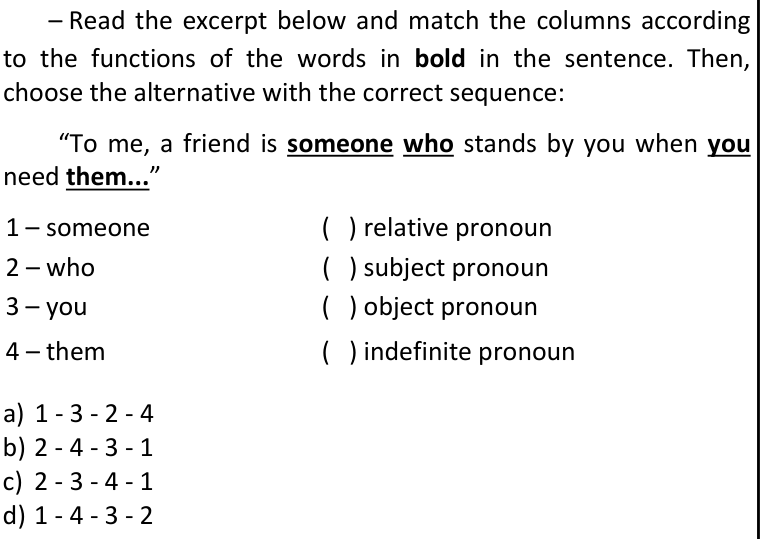
– Read the excerpt below and match the columns according to the functions of the words in bold in the sentence. Then, choose the alternative with the correct sequence:
“To me, a friend is someone who stands by you when you need them...”
| 1 – someone | ( ) relative pronoun |
| 2 – who | ( ) subject pronoun |
| 3 – you | ( ) object pronoun |
| 4 – them | ( ) indefinite pronoun |
- A1 - 3 - 2 - 4
- B2 - 4 - 3 - 1
- C2 - 3 - 4 - 1
- D1 - 4 - 3 - 2
Reportar erro na questão
Resolução comentada
Cada palavra em negrito tem uma função gramatical. Vamos classificá-las e depois ligar às colunas.
- someone: é pronome indefinido, pois não identifica uma pessoa específica ("alguém"). Corresponde ao item 1, que vai na quarta linha.
- who: introduz a oração "who stands by you" e retoma "someone", que vem antes. Isso o torna pronome relativo. Corresponde ao item 2, que vai na primeira linha.
- you (em "when you need"): é o sujeito do verbo need, ou seja, pronome sujeito (subject pronoun). Corresponde ao item 3, que vai na segunda linha.
- them: é o complemento de need e retoma "someone" (usado como "they/them" neutro). Logo, é pronome objeto (object pronoun). Corresponde ao item 4, que vai na terceira linha.
Montando a sequência na ordem das linhas da coluna da direita:
- pronome relativo → 2
- pronome sujeito → 3
- pronome objeto → 4
- pronome indefinido → 1
Sequência: 2 - 3 - 4 - 1.
Alternativa C.
Por que as outras alternativas estão erradas
- AClassifica "someone" como relativo e "who" como objeto, e ainda coloca "you" como pronome relativo, o que é incoerente.
- BTrata "them" como sujeito e "you" como objeto, invertendo as funções de sujeito e objeto.
- DChama "someone" de relativo e "who" de indefinido, trocando as funções das duas palavras.
Assuntos: Referência pronominal e pronomes, Classes de palavras.
Reportar erro na resolução
Ver como caiu na prova
Fonte: EEAR 2026 · CFS 1. Prova oficial ↗