PRÁTICA COM QUESTÕES OFICIAIS
Questão 87 (CFS 1) da EEAR 2026
Read the text and answer questions 85, 86, 87, 88, 89 and 90. · CFS 1
What is a friend?
Márcio Paulo Barbosa Pena Mascarenhas
Laurie: To me, a friend is someone who stands by you when you need them, someone who cares. Not like your parents, ________. Parents are either picking on you or telling you off, so sometimes it’s a pain. To a friend you can always open up.
Angela: I agree with Laurie but personally, I don’t think a friend has to be physically around all the time. I have friends that I haven’t seen in years, but I know if we get together, we’ll pick up right where we left off.
Fran: I think a friend is that old pal you’ve always gotten on with. I often look back on my schooldays and I think of the funny things my friends and I did together. As I see it, the friends you make in youth are friends to keep for a lifetime.
Gary: If you ask me, a friend is a person you have fun and relax with. My friends and I talk about movies, sports or politics. I don’t go round telling them my troubles and I don’t particularly want to hear theirs. I believe that if you don’t expect too much from people, you won’t be let down.
Grade 1, Student’s book, Belo Horizonte, 14th edition.
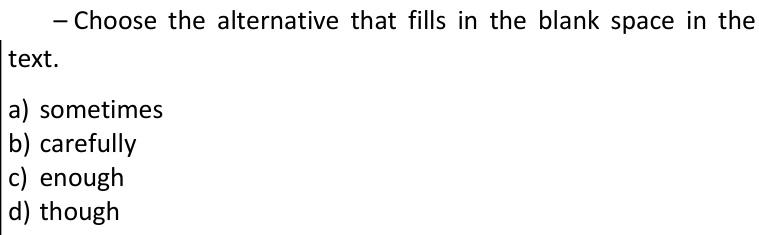
– Choose the alternative that fills in the blank space in the text.
- Asometimes
- Bcarefully
- Cenough
- Dthough
Reportar erro na questão
Resolução comentada
A lacuna está em "Not like your parents, ________. Parents are either picking on you or telling you off, so sometimes it's a pain." Laurie diz que amigo é alguém que apoia e se importa, e em seguida contrasta com os pais: eles ficam implicando ou dando bronca.
Precisamos de uma palavra que, no fim da frase, marque contraste ou ressalva, com sentido de "mas" ou "embora". Essa é a função de though quando fica no final da oração: "Not like your parents, though." Em português: "Mas não como seus pais, é claro / só que não como os pais".
Veja as demais:
- sometimes ("às vezes") não faz sentido nesse ponto e repetiria a ideia da frase seguinte, que já tem "sometimes".
- carefully ("cuidadosamente") é advérbio de modo e não combina com "Not like your parents".
- enough ("suficiente") exigiria um adjetivo ou verbo a que se ligar, e não há nenhum.
Portanto, só though dá a ideia de contraste entre amigos e pais.
Alternativa D.
Por que as outras alternativas estão erradas
- A"Sometimes" não marca contraste e repetiria o "sometimes" da frase seguinte.
- B"Carefully" é advérbio de modo e não faz sentido após "Not like your parents".
- C"Enough" precisa modificar um adjetivo, advérbio ou verbo, o que não existe ali.
Assuntos: Classes de palavras, Conectivos e relações lógicas.
Reportar erro na resolução
Ver como caiu na prova
Fonte: EEAR 2026 · CFS 1. Prova oficial ↗