PRÁTICA COM QUESTÕES OFICIAIS
Questão 84 (CFS 2) da EEAR 2026
Read the text and answer questions 81, 82, 83 and 84. · CFS 2
Digital habits across generations
Today’s grandparents are joining their grandchildren on social media, but the different generations’ online habits couldn’t be more different. In the UK the over-55s are joining Facebook in increasing numbers, meaning that they will soon be the site’s second biggest user group, with 3.5 million users aged 55–64 and 2.9 million over-65s.
Sheila, aged 59, says, ‘I joined to see what my grandchildren are doing, as my daughter posts videos and photos of them. It’s a much ______ way to see what they’re doing than waiting for letters and photos in the post. That’s how we did it when I was a child, but I think I’m lucky I get to see so much more of their lives than my grandparents did.’
Ironically, Sheila’s grandchildren are less likely to use Facebook themselves. Children under 17 in the UK are leaving the site – only 2.2 million users are under 17 – but they’re not going far from their smartphones. Chloe, aged 15, even sleeps with her phone. ‘It’s my alarm clock so I have to,’ she says. ‘I look at it before I go to _____ and as soon as I ________.’
https://learnenglish.britishcouncil.org/skills/reading/b1-reading/digital-habits-across-generations
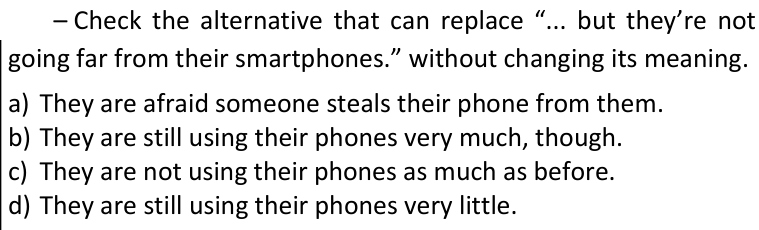
– Check the alternative that can replace “... but they’re not going far from their smartphones.” without changing its meaning.
- AThey are afraid someone steals their phone from them.
- BThey are still using their phones very much, though.
- CThey are not using their phones as much as before.
- DThey are still using their phones very little.
Reportar erro na questão
Resolução comentada
A frase diz que as crianças estão deixando o Facebook, mas "não estão indo longe de seus smartphones" (they're not going far from their smartphones). Em sentido figurado, isso significa que elas continuam muito ligadas ao celular: saem da rede social, não do aparelho. O exemplo de Chloe, que dorme com o telefone e o olha antes de dormir e ao acordar, confirma essa leitura.
Agora, compare as alternativas:
- (A) fala de medo de roubo, algo que o texto não menciona.
- (B) diz que ainda usam muito o celular, "embora" (though) tenham saído do Facebook. Mantém o contraste e o sentido original.
- (C) diz que usam menos que antes, o oposto da ideia de permanência.
- (D) diz que usam pouco, o que contradiz o texto.
A alternativa que preserva o significado é a que indica uso continuado e intenso do celular.
Alternativa B.
Por que as outras alternativas estão erradas
- AInventa o medo de roubo do celular, que não aparece no texto.
- CDiz que o uso diminuiu, mas a frase indica que continuam muito conectados aos smartphones.
- DAfirma que usam o celular pouco, contrariando o sentido de não se afastarem dele.
Assunto: Vocabulário em contexto e falsos cognatos.
Reportar erro na resolução
Ver como caiu na prova
Fonte: EEAR 2026 · CFS 2. Prova oficial ↗