PRÁTICA COM QUESTÕES OFICIAIS
Questão 85 (CFS 2) da EEAR 2026
Read the text and answer questions 85, 86 and 87 · CFS 2
Simple Man
Lynyrd Skynyrd (1973)
Mama told me when I was young
“Come sit beside me, my only son
And listen closely to what I say
And if you do this it’ll help you
Some sunny day”
Oh, yeah
Oh, take your time, don’t live too fast
Troubles will come and they will pass
You’ll find a woman, yeah, and you’ll find love
And don’t forget son there is someone up above
And be a simple kind of man
Oh, be something you love and understand
Baby, be a simple kind of man
Oh, won’t you do this for me son, if you can?
Forget your lust for the rich man’s gold
All that you need is in your soul
And you can do this, oh, baby, if you try
All that I want for you, my son, is to be satisfied
And be a simple kind of man
Oh, be something you love and understand
Baby, be a simple kind of man
Oh, won’t you do this for me son, if you can?
Oh, yes, I will
Boy, don’t you worry, you’ll find yourself
Follow your heart and nothing else
And you can do this, oh, baby, if you try
All that I want for you, my son, is to be satisfied
And be a simple kind of man
Oh, be something you love and understand
Baby, be a simple kind of man
Oh, won’t you do this for me son, if you can?
www.musixmatch.com
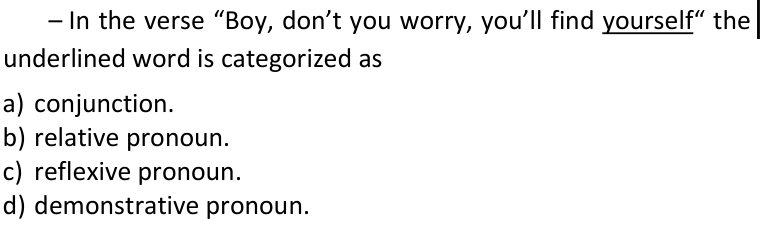
– In the verse “Boy, don’t you worry, you’ll find yourself“ the underlined word is categorized as
- Aconjunction.
- Brelative pronoun.
- Creflexive pronoun.
- Ddemonstrative pronoun.
Reportar erro na questão
Resolução comentada
Em inglês, os pronomes terminados em -self (singular) ou -selves (plural) são os pronomes reflexivos. Eles aparecem quando o objeto do verbo é a mesma pessoa que o sujeito, ou seja, a ação "volta" para quem a pratica.
No verso "you'll find yourself":
- O sujeito da oração é you.
- O verbo é find ("encontrar").
- O objeto é yourself, que se refere à mesma pessoa que o sujeito (you).
Como sujeito e objeto são a mesma pessoa, yourself é um pronome reflexivo. Tradução do verso: "Garoto, não se preocupe, você vai se encontrar".
Os outros tipos não cabem aqui. Uma conjunção (and, but) liga orações e não substitui um nome. Um pronome relativo (who, which, that) introduz uma oração subordinada e retoma um termo anterior. Um pronome demonstrativo (this, that, these, those) aponta ou indica algo, e yourself não faz isso.
Alternativa C.
Por que as outras alternativas estão erradas
- AConjunções ligam orações ou termos (and, but); yourself é um pronome que funciona como objeto do verbo.
- BPronomes relativos (who, which, that) introduzem orações subordinadas; yourself não introduz oração alguma.
- DPronomes demonstrativos (this, that, these, those) apontam algo; yourself retoma o sujeito.
Assunto: Referência pronominal e pronomes.
Reportar erro na resolução
Ver como caiu na prova
Fonte: EEAR 2026 · CFS 2. Prova oficial ↗