PRÁTICA COM QUESTÕES OFICIAIS
Questão 29 (CFS 2) da EEAR 2022
Read the text and answer questions 28, 29 and 30. · CFS 2
Human-induced global heating ‘causes over a third of heat deaths’
More than a third of all heat-related deaths around the world between 1991 and 2018 can be attributed to human-induced global heating, research has found.
Climate breakdown has a range of effects ranging from wildfires to extreme weather. As the temperatures rise, more intense and frequent heatwaves disproportionately affect elderly people and those with underlying chronic conditions such as asthma, making them more vulnerable to disease and premature death.
A study, published in the journal Nature Climate Change, used data from 732 locations in 43 countries to calculate the number of deaths attributed to heat levels higher than the ideal temperature for human health, which varies across locations.
The researchers examined past weather conditions simulated under scenarios with and without emissions triggered by human activity – allowing them to separate the warming and related health impact linked with human activity from natural trends.
Overall, they found 37% of all heat-related deaths in the locations studied were attributable to human activity – but the largest climate change-induced contributions (more than 50%) were in southern and western Asia (Iran and Kuwait), south-east Asia (the Philippines and Thailand) and Central and South America.
Adapted from: https://www.theguardian.com/environment/2021/may/31/human-induced-global-heating-causes-over-third-heat-deaths
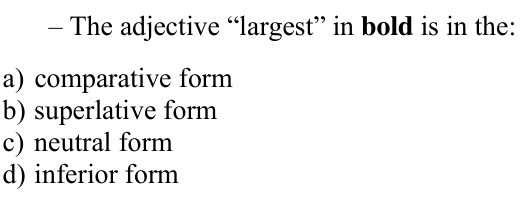
– The adjective “largest” in bold is in the:
- Acomparative form
- Bsuperlative form
- Cneutral form
- Dinferior form
Reportar erro na questão
Resolução comentada
Em inglês, o adjetivo tem três graus: o positivo (large), o comparativo (larger, more intense) e o superlativo (the largest, the most intense).
Para identificar o grau, veja o que a frase faz:
- O comparativo põe dois elementos lado a lado: "larger than".
- O superlativo destaca um elemento acima de todos os de um grupo, e costuma vir com the e o sufixo -est (adjetivos curtos) ou the most (adjetivos longos).
No texto, "the largest climate change-induced contributions (more than 50%)" aponta as maiores contribuições entre todos os locais estudados: sul e oeste da Ásia, sudeste asiático e América Central e do Sul. Não há "than" nem comparação entre dois itens; há destaque do máximo dentro do conjunto.
Além disso, "largest" é formado por large + -est, o sufixo típico do superlativo (de superioridade).
Portanto, "largest" está no grau superlativo.
Alternativa B.
Por que as outras alternativas estão erradas
- AO comparativo seria "larger" (com "than"), comparando dois elementos; aqui se destaca o maior de todo o grupo.
- C"Neutral form" não é um grau do adjetivo; o grau sem comparação seria o positivo ("large").
- D"Inferior form" não existe como grau; o sufixo -est indica superioridade máxima, não inferioridade.
Assunto: Classes de palavras.
Reportar erro na resolução
Ver como caiu na prova
Fonte: EEAR 2022 · CFS 2. Prova oficial ↗