PRÁTICA COM QUESTÕES OFICIAIS
Questão 30 (CFS 2) da EEAR 2022
Read the text and answer questions 28, 29 and 30. · CFS 2
Human-induced global heating ‘causes over a third of heat deaths’
More than a third of all heat-related deaths around the world between 1991 and 2018 can be attributed to human-induced global heating, research has found.
Climate breakdown has a range of effects ranging from wildfires to extreme weather. As the temperatures rise, more intense and frequent heatwaves disproportionately affect elderly people and those with underlying chronic conditions such as asthma, making them more vulnerable to disease and premature death.
A study, published in the journal Nature Climate Change, used data from 732 locations in 43 countries to calculate the number of deaths attributed to heat levels higher than the ideal temperature for human health, which varies across locations.
The researchers examined past weather conditions simulated under scenarios with and without emissions triggered by human activity – allowing them to separate the warming and related health impact linked with human activity from natural trends.
Overall, they found 37% of all heat-related deaths in the locations studied were attributable to human activity – but the largest climate change-induced contributions (more than 50%) were in southern and western Asia (Iran and Kuwait), south-east Asia (the Philippines and Thailand) and Central and South America.
Adapted from: https://www.theguardian.com/environment/2021/may/31/human-induced-global-heating-causes-over-third-heat-deaths
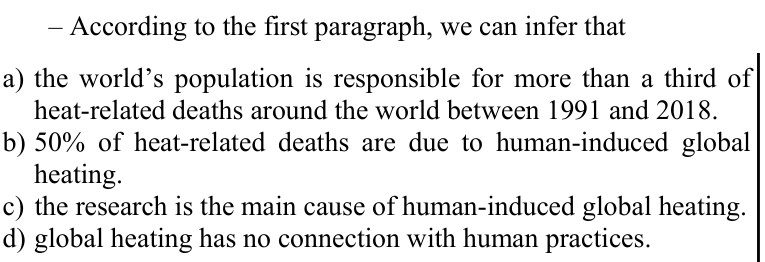
– According to the first paragraph, we can infer that
- Athe world’s population is responsible for more than a third of heat-related deaths around the world between 1991 and 2018.
- B50% of heat-related deaths are due to human-induced global heating.
- Cthe research is the main cause of human-induced global heating.
- Dglobal heating has no connection with human practices.
Reportar erro na questão
Resolução comentada
O primeiro parágrafo diz: "More than a third of all heat-related deaths around the world between 1991 and 2018 can be attributed to human-induced global heating". Em português: mais de um terço de todas as mortes ligadas ao calor no mundo, entre 1991 e 2018, pode ser atribuído ao aquecimento global causado pelo ser humano.
A ideia central é que a atividade humana, ao provocar o aquecimento, gera mais de um terço dessas mortes. Vamos testar cada alternativa:
- Em (A), "a população mundial é responsável por mais de um terço das mortes" é uma paráfrase razoável: a ação humana ("human-induced") causa o aquecimento, que causa as mortes. É a única coerente com o trecho.
- Em (B), 50% não aparece no primeiro parágrafo. O número maior que 50% surge só no último parágrafo e se refere a regiões específicas, não ao total.
- Em (C), a pesquisa ("research") apenas descobriu o dado ("has found"); ela não causa o aquecimento.
- Em (D), o texto afirma justamente o contrário: há ligação entre o aquecimento e as práticas humanas.
Portanto, a inferência correta é a de que a ação humana responde por mais de um terço das mortes por calor no período.
Alternativa A.
Por que as outras alternativas estão erradas
- BTroca "mais de um terço" por 50%, número que o texto só cita para algumas regiões, no último parágrafo.
- CConfunde a pesquisa, que apenas revelou o dado, com a causa do aquecimento.
- DContradiz o texto, que atribui o aquecimento à ação humana ("human-induced").
Assunto: Inferência e ponto de vista do autor.
Reportar erro na resolução
Ver como caiu na prova
Fonte: EEAR 2022 · CFS 2. Prova oficial ↗