PRÁTICA COM QUESTÕES OFICIAIS
Questão 28 (CFS 2) da EEAR 2022
Read the text and answer questions 28, 29 and 30. · CFS 2
Human-induced global heating ‘causes over a third of heat deaths’
More than a third of all heat-related deaths around the world between 1991 and 2018 can be attributed to human-induced global heating, research has found.
Climate breakdown has a range of effects ranging from wildfires to extreme weather. As the temperatures rise, more intense and frequent heatwaves disproportionately affect elderly people and those with underlying chronic conditions such as asthma, making them more vulnerable to disease and premature death.
A study, published in the journal Nature Climate Change, used data from 732 locations in 43 countries to calculate the number of deaths attributed to heat levels higher than the ideal temperature for human health, which varies across locations.
The researchers examined past weather conditions simulated under scenarios with and without emissions triggered by human activity – allowing them to separate the warming and related health impact linked with human activity from natural trends.
Overall, they found 37% of all heat-related deaths in the locations studied were attributable to human activity – but the largest climate change-induced contributions (more than 50%) were in southern and western Asia (Iran and Kuwait), south-east Asia (the Philippines and Thailand) and Central and South America.
Adapted from: https://www.theguardian.com/environment/2021/may/31/human-induced-global-heating-causes-over-third-heat-deaths
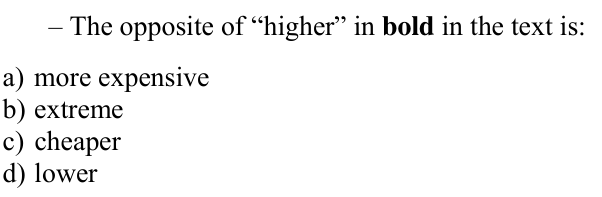
– The opposite of “higher” in bold in the text is:
- Amore expensive
- Bextreme
- Ccheaper
- Dlower
Reportar erro na questão
Resolução comentada
A questão pede o antônimo (opposite) da palavra em destaque, "higher", que aparece no trecho "heat levels higher than the ideal temperature" (níveis de calor mais altos que a temperatura ideal).
- "Higher" é o comparativo de "high" (alto), e indica algo em nível maior.
- O oposto de "high" é "low" (baixo), e o comparativo de "low" é "lower" (mais baixo).
- Conferindo as demais opções: "more expensive" (mais caro) e "cheaper" (mais barato) tratam de preço, e o texto fala de temperatura; "extreme" (extremo) não é antônimo de "higher".
Portanto, o antônimo de "higher" é "lower".
Alternativa D.
Por que as outras alternativas estão erradas
- A"More expensive" é sobre preço e não é oposto de "higher" no contexto de temperatura.
- B"Extreme" (extremo) não expressa o contrário de "higher"; é até compatível com níveis altos.
- C"Cheaper" é o oposto de "more expensive" (preço), não de "higher" referente a temperatura.
Assunto: Vocabulário em contexto e falsos cognatos.
Reportar erro na resolução
Ver como caiu na prova
Fonte: EEAR 2022 · CFS 2. Prova oficial ↗