PRÁTICA COM QUESTÕES OFICIAIS
Questão 43 (CFS 2) da EEAR 2021
Read the text and answer questions 43 and 44. · CFS 2
The Importance of the English Language
Nowadays, more and more people are dedicating time to studying English as a second language. Many countries include English in their school syllabus and children are starting to learn English at a younger and younger age. Do you know why learning English is so important? Here are five good reasons to take an English Language Course.
- English is the most commonly spoken language in the world. One out of five people can speak or at least understand English!
- Studying English can help you get a job.
- English is the language of the Internet.
- Travelling is a lot easier with a good knowledge of English.
- English gives you access to multiple cultures.
Adapted from https://www.british-study.com/en/importance-of-english-language/
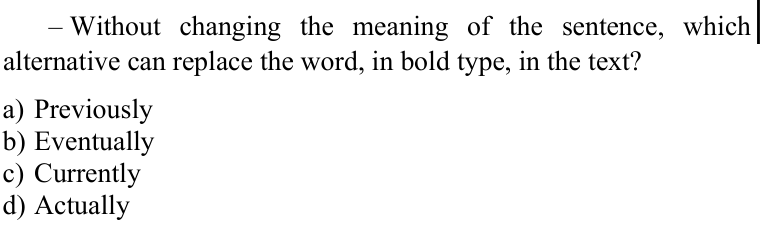
– Without changing the meaning of the sentence, which alternative can replace the word, in bold type, in the text?
- APreviously
- BEventually
- CCurrently
- DActually
Reportar erro na questão
Resolução comentada
A palavra em negrito é Nowadays, que significa "hoje em dia", "atualmente". Ela indica algo que acontece no período presente, em contraste com o passado. No texto, a frase diz que cada vez mais pessoas estão dedicando tempo ao estudo do inglês, ou seja, uma tendência atual.
Veja o sentido de cada opção:
- Previously = anteriormente, no passado. Contraria o presente da frase.
- Eventually = eventualmente, no fim das contas, com o tempo. Não indica o momento atual.
- Currently = atualmente, no momento presente. É sinônimo direto de nowadays.
- Actually = na verdade, de fato. Serve para corrigir ou enfatizar, não para marcar tempo.
O verbo are dedicating (presente contínuo) reforça a ideia de ação em curso agora, o que combina com currently.
Substituindo: "Currently, more and more people are dedicating time to studying English as a second language." O sentido original é mantido.
Alternativa C.
Pegadinha: A alternativa D engana porque actually parece com "atualmente" em português, mas significa "na verdade" (falso cognato).
Por que as outras alternativas estão erradas
- APreviously significa "anteriormente", remetendo ao passado, e não ao presente.
- BEventually significa "com o tempo/por fim", e não "atualmente".
- DActually significa "na verdade", é falso cognato de "atualmente" e não marca tempo.
Assunto: Vocabulário em contexto e falsos cognatos.
Reportar erro na resolução
Ver como caiu na prova
Fonte: EEAR 2021 · CFS 2. Prova oficial ↗