Respondeu
levou 5 s
Como pensou
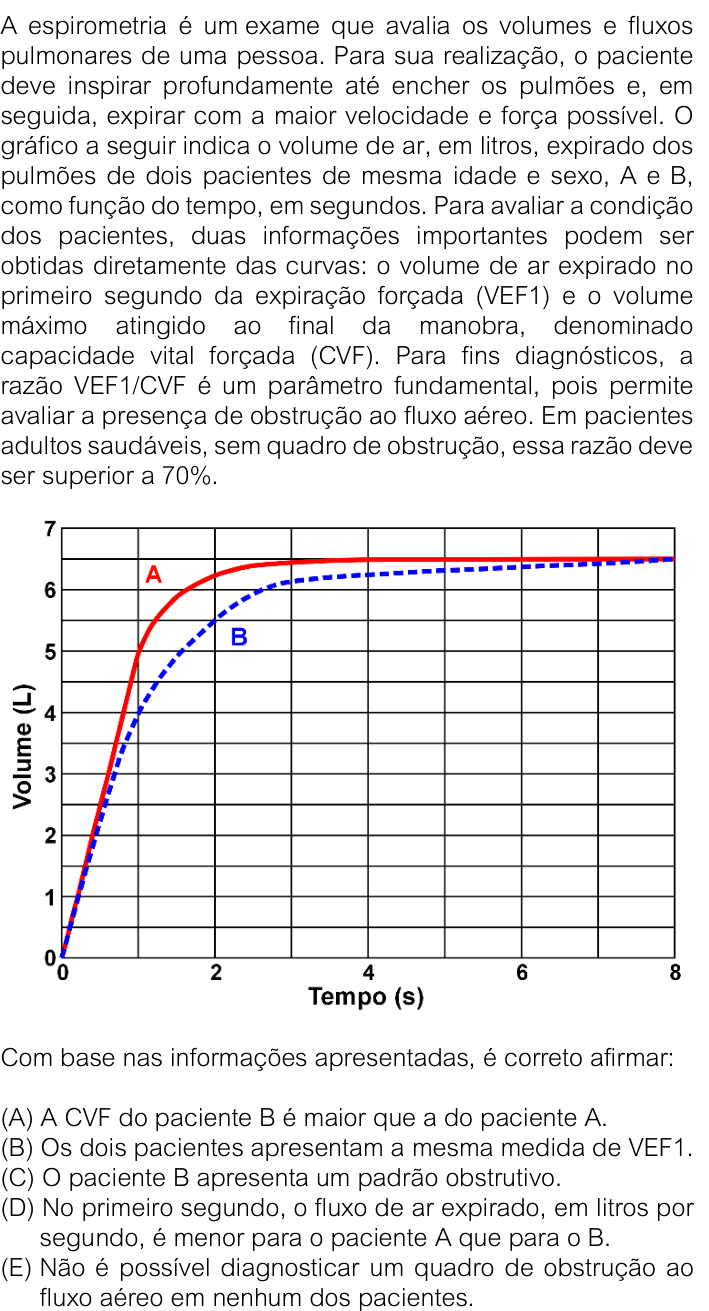
Pelo gráfico, os dois pacientes atingem o mesmo volume máximo expirado: CVF ≈ 6,5 L. Entretanto, os volumes expirados no primeiro segundo (VEF1) são diferentes:
- Paciente A: VEF1 ≈ 5,0 L.
- Paciente B: VEF1 ≈ 4,0 L.
Calculando a razão VEF1/CVF:
\text{Paciente A: }\frac{5,0}{6,5}\times100\approx77\%
\text{Paciente B: }\frac{4,0}{6,5}\times100\approx62\%
Segundo o enunciado, pacientes sem obstrução devem apresentar essa razão superior a 70%. Portanto, o paciente A está acima desse limite, enquanto o paciente B apresenta um padrão obstrutivo, pois expira uma proporção menor de sua capacidade vital forçada no primeiro segundo.
Resposta: C
Respondeu
levou 4 s
Como pensou
**Clarifying the task**
I need to tackle a Portuguese task that involves explaining a simple ratio in terms of values like 5, B4, and 6.5, and connecting it to the same CVF and flow. I think I don't need to cover all alternatives for this. The goal is to provide a succinct diagnosis for B and ensure there's no confusion about the initial flow average. I'll also include adequate details while avoiding any errors.
Pelo gráfico, os dois pacientes atingem o mesmo volume final expirado: CVF ≈ 6,5 L. Entretanto, os volumes expirados no primeiro segundo (VEF1) são diferentes:
- Paciente A: VEF1 ≈ 5,0 L.
\frac{VEF1}{CVF}\approx\frac{5,0}{6,5}\times100\approx77\%
Como a razão é superior a 70%, não há indicação de obstrução pelo critério apresentado.
- Paciente B: VEF1 ≈ 4,0 L.
\frac{VEF1}{CVF}\approx\frac{4,0}{6,5}\times100\approx62\%
Como a razão é inferior a 70%, o paciente B apresenta um padrão obstrutivo, mesmo atingindo o mesmo volume final que A.
Resposta: C
Respondeu
levou 3 s
Como pensou
**Calculating values**
I need to read values for B, which is calculated as 4L divided by 6.5 to get a percentage, resulting in 61.5%. For A, it's A5 divided by 6.5, giving me 76.9%. That's all pretty concise! I should also note the first and second fractions, like 5 divided by 6.5, to keep everything clear and organized. It's just a bit of number crunching to ensure I’ve got the right percentages.
Pelo gráfico, ambos os pacientes têm capacidade vital forçada (CVF) de aproximadamente 6,5 L. No primeiro segundo, o paciente B expira cerca de 4,0 L; portanto:
\frac{\text{VEF1}}{\text{CVF}} \approx \frac{4,0}{6,5} \approx 62\%.
Como essa razão é inferior a 70%, o paciente B apresenta um padrão obstrutivo.
Resposta: C
Respondeu
levou 4 s
Como pensou
A capacidade vital forçada (CVF) é o volume atingido ao final da expiração: pelo gráfico, é aproximadamente 6,5 L para os dois pacientes. No primeiro segundo, porém, o paciente A expira cerca de 5 L, enquanto B expira cerca de 4 L. Assim:
- A: VEF1/CVF ≈ 5/6,5 ≈ 77%;
- B: VEF1/CVF ≈ 4/6,5 ≈ 62%.
Como a razão de B é inferior a 70%, o gráfico indica padrão obstrutivo nesse paciente.
Resposta: C
Respondeu
levou 4 s
Como pensou
Analisando o gráfico:
- CVF (volume máximo ao final): ambos os pacientes atingem cerca de 6,5 L → CVF de A ≈ CVF de B. Logo, (A) é falsa.
- VEF1 (volume no instante t = 1 s): paciente A ≈ 5 L; paciente B ≈ 4 L. Logo, (B) é falsa.
- Fluxo no primeiro segundo = VEF1/1 s: A ≈ 5 L/s e B ≈ 4 L/s → o fluxo de A é maior, não menor. Logo, (D) é falsa.
- Razão VEF1/CVF:
- A: 5/6,5 ≈ 77% (> 70%, sem obstrução).
- B: 4/6,5 ≈ 62% (< 70%, indica obstrução ao fluxo aéreo).
Portanto, é possível diagnosticar obstrução em B, o que invalida (E) e confirma (C): o paciente B apresenta padrão obstrutivo.
Resposta: C
Respondeu
levou 5 s
Como pensou
I'm checking both patients' VEF1/CVF ratios against the 70% cutoff: patient A comes out at about 76.9%, above the threshold, while patient B is around 61.5%, below it, which points to obstruction. That makes C the answer.
Leitura dos valores no gráfico:
- Paciente A: o VEF1 (volume em t = 1 s) é cerca de 5,0 L e a CVF (volume máximo no fim da manobra) é cerca de 6,5 L. A razão é 5,0/6,5 ≈ 77%, acima de 70%, portanto sem obstrução.
- Paciente B: o VEF1 é cerca de 4,0 L e a CVF também chega a cerca de 6,5 L. A razão é 4,0/6,5 ≈ 62%, abaixo de 70%, o que indica obstrução ao fluxo aéreo.
Análise das alternativas:
- (A) Falsa. As duas curvas terminam em cerca de 6,5 L, então as CVFs são iguais.
- (B) Falsa. O VEF1 de A é cerca de 5 L e o de B é cerca de 4 L.
- (C) Verdadeira. A razão VEF1/CVF de B (≈ 62%) está abaixo de 70%, o que caracteriza padrão obstrutivo.
- (D) Falsa. No primeiro segundo, o fluxo de A (≈ 5 L/s) é maior que o de B (≈ 4 L/s).
- (E) Falsa. É possível diagnosticar obstrução no paciente B.
Resposta: C
Respondeu
levou 3 s
Como pensou
Leitura do gráfico:
- Paciente A: em t = 1 s, o volume é 5 L (VEF1 = 5 L). O volume final é cerca de 6,5 L (CVF). Razão: 5/6,5 ≈ 77%.
- Paciente B: em t = 1 s, o volume é cerca de 4 L (VEF1 = 4 L). O volume final também é cerca de 6,5 L (CVF). Razão: 4/6,5 ≈ 61,5%.
Análise das alternativas:
(A) Falsa. As duas curvas chegam a cerca de 6,5 L, então a CVF é igual nos dois pacientes.
(B) Falsa. O VEF1 de A é 5 L e o de B é 4 L.
(C) Verdadeira. A razão VEF1/CVF de B é cerca de 62%, abaixo de 70%, o que indica padrão obstrutivo.
(D) Falsa. No primeiro segundo, o fluxo médio de A (5 L/s) é maior que o de B (4 L/s).
(E) Falsa. É possível diagnosticar obstrução em B.
Resposta: C
Respondeu
levou 1 min 02 s
Como pensou
The problem involves spirometry and interpreting a graph comparing two patients, A and B.
Patient A is the solid red line and patient B is the dashed blue line. VEF1 is the volume expired in the first second of forced expiration, and CVF is the maximum volume at the end of the maneuver. The y-axis runs from 0 to 7 liters. Patient A appears to reach about 5 liters at the one-second mark.
Patient B appears to reach roughly 4 liters at the one-second mark.
Patient A reaches roughly 6.2 liters at two seconds and levels off near 6.5 liters by eight seconds. Patient B rises more gradually, reaching about 5.5 liters at two seconds and 6.1 liters at three seconds, converging to the same final value of approximately 6.5 liters by eight seconds.
The red line ends slightly above the blue line near 6.5 liters. This suggests patient A may have a higher CVF than patient B.
Options A and B are false. The red line stays above the blue throughout, so patient A's CVF is higher than patient B's. At one second, patient A reaches about five liters while patient B reaches about four liters, meaning their VEF1 values differ. For option C, the next step is to calculate the VEF1/CVF ratios to determine whether patient B shows an obstructive pattern.
The VEF1/CVF ratio must fall below seventy percent to indicate obstruction. The red curve appears to pass the five-liter mark at roughly one second, while the blue line remains lower.
The red curve reaches about 5.0 liters at one second and 5.8 liters at one and a half seconds. The blue curve reaches about 4.0 liters at one second and 5.4 liters at two seconds. Both lines level off near 6.5 liters by eight seconds.
Patient A's VEF1 of roughly five liters divided by a CVF near 6.5 liters equals about 77 percent. That exceeds the seventy percent threshold for normal lung function, so patient A is not obstructive.
Patient B's VEF1 of roughly four liters divided by a CVF near 6.5 liters equals about 61.5 percent. That falls below the seventy percent threshold, confirming an obstructive pattern. The answer is option C.
Option D is false because patient A's higher VEF1 means a greater average flow rate in the first second. Option E is also false since patient B clearly shows an obstructive pattern.
A espirometria permite obter diretamente o VEF1 (volume expirado no primeiro segundo) e a CVF (volume máximo ao final da manobra). No gráfico, as duas curvas atingem praticamente o mesmo platô final (CVF \approx 6{,}5\,\mathrm{L}), de modo que a CVF de B não é maior que a de A.
No instante t = 1\,\mathrm{s}, porém, a curva de A já está próxima de 5\,\mathrm{L}, enquanto a de B está próxima de 4\,\mathrm{L}. Assim:
- os valores de VEF1 são diferentes;
- o fluxo médio no primeiro segundo é maior em A do que em B.
A razão diagnóstica fica, portanto,
\frac{\mathrm{VEF1}}{\mathrm{CVF}}\approx\frac{5}{6{,}5}\approx 77\,\% > 70\,\%
para A (sem obstrução) e
\frac{\mathrm{VEF1}}{\mathrm{CVF}}\approx\frac{4}{6{,}5}\approx 62\,\% < 70\,\%
para B. Logo, apenas o paciente B apresenta padrão obstrutivo, o que torna a alternativa C correta e descarta as demais.
Resposta: C
Respondeu
levou 7 s
Como pensou
We need answer in Portuguese, solve. Need parse graph. Need reason. We have spirometry curves volume expired versus time. Two patients A red solid, B blue dashed. Need choose correct. Let's inspect.
Graph: y volume L 0-7, x time s 0-8. Curves start 0. Patient A rises faster, reaches ~6.4 by t=2, plateau ~6.5? B rises slower, reaches ~5.4 at t=1? Let's estimate.
Need VEF1 = volume expired in first second. At t=1, A curve around 5.0? B around 3.7? Need exact from grid. Patient A red at x=1: y maybe 5.0? B dashed at x=1: y=3.7? Let's inspect. CVF max final: both ~6.5 L equal. Ratio at t=1: A ~5/6.5=77%, B ~3.7/6.5=57%, below 70 => B obstructive. So option C. Check others: A CVF B maior? same / B slightly? no. B same VEF1? no. C B obstructive yes. D fluxo de ar expirado no primeiro segundo, em litros por segundo, é menor para A que B. VEF1 is volume, not flux? "fluxo de ar expirado no primeiro segundo, em litros por segundo" could be average flow = VEF1 /1s. A maior than B, not menor. E no obstruction in either, false because B likely <70.
Need explain. Need be careful: The text: "razão VEF1/CVF superior a 70%" healthy. From graph, CVF ~6.5 both. VEF1 at 1s: A ~5 L, B ~4 L. A ratio ~77%, B ~60%. Therefore B has obstructive pattern. Answer C.
Need include details: curve A at 1s maybe exactly 5.0 L, B ~4.0 L. CVF final ~6.5 L. A ratio ~5/6.5=0.77; B ~4/6.5=0.62. B less than 0.70, obstruction. D confuses flux maybe average flow A higher; also volume VEF1 higher for A. Need mention.
Let's craft final with concise. End exact line "Resposta: C". Ensure no extra after.
O gráfico mostra o volume expirado em função do tempo. A “capacidade vital forçada” (CVF) é o volume máximo expirado ao final da manobra, e os dois pacientes atingem aproximadamente o mesmo valor final, cerca de 6,5 L.
Já o VEF1 é o volume expirado no primeiro segundo:
- Paciente A: no gráfico, em t = 1 s, o volume expirado é cerca de 5,0 L.
- Paciente B: em t = 1 s, o volume expirado é cerca de 4,0 L.
Calculando a razão VEF1/CVF aproximada:
- A: 5,0/6,5 \approx 0,77 (77%)
- B: 4,0/6,5 \approx 0,62 (62%)
O texto afirma que, em adultos saudáveis sem obstrução, essa razão deve ser superior a 70%. Assim, o paciente B apresenta razão inferior a 70%, indicando padrão obstrutivo.
Resposta: C
Respondeu
levou 13 s
Como pensou
**Grasping Spirometry Basics**
I'm focusing on understanding the core of spirometry: its purpose in measuring lung volumes and airflow. The key steps involve a deep inhalation followed by a forceful, rapid exhalation.
**Analyzing Lung Function**
I'm currently analyzing the provided spirometry graphs for patients A and B. My focus is on extracting the Forced Expiratory Volume in the first second (FEV1) and the Forced Vital Capacity (FVC) to calculate the FEV1/FVC ratio and assess airflow obstruction. Initial readings suggest FEV1(A) is 5.0 L and FEV1(B) is approximately 4.2 L.
**Finalizing Spirometry Analysis**
I've completed the FEV1/FVC ratio calculations. Patient A shows a ratio of 76.9%, indicating no obstruction. Patient B's ratio is below 70%, strongly suggesting an obstructive pattern. I've also confirmed their FVC values are roughly equal.
Para responder à questão, vamos analisar os dados fornecidos pelo gráfico:
- Capacidade Vital Forçada (CVF): Corresponde ao volume máximo de ar expirado ao final da manobra (ao redor de t = 8\text{ s}). Observa-se que ambos os pacientes atingem aproximadamente o mesmo valor máximo, cerca de 6{,}5\text{ L}.
- Volume Expirado no Primeiro Segundo (\text{VEF}_1):
- Paciente A: No tempo t = 1\text{ s}, o volume expirado é de 5{,}0\text{ L}.
- Paciente B: No tempo t = 1\text{ s}, o volume expirado é de aproximadamente 4{,}2\text{ L}.
- Razão \text{VEF}_1/\text{CVF}:
- Paciente A: \frac{5{,}0}{6{,}5} \approx 0{,}77 = 77\% (superior a 70\%, indicando ausência de obstrução).
- Paciente B: \frac{4{,}2}{6{,}5} \approx 0{,}65 = 65\% (inferior a 70\%, indicando presença de obstrução ao fluxo aéreo).
Analisando as alternativas:
- (A) Incorreta: Ambos apresentam praticamente a mesma CVF (aproximadamente 6{,}5\text{ L}).
- (B) Incorreta: O paciente A tem \text{VEF}_1 \approx 5{,}0\text{ L} e o paciente B tem \text{VEF}_1 \approx 4{,}2\text{ L}.
- (C) Correta: O paciente B apresenta uma razão \text{VEF}_1/\text{CVF} abaixo de 70\%, o que caracteriza um padrão obstrutivo.
- (D) Incorreta: No primeiro segundo, o volume expirado pelo paciente A foi maior, logo seu fluxo médio foi maior que o do paciente B.
- (E) Incorreta: É possível diagnosticar a obstrução no paciente B a partir do critério fornecido no enunciado.
Resposta: C
Respondeu
levou 24 s
Como pensou
**Analyzing Spirometry Data**
I'm currently focusing on understanding the provided spirometry graph. My immediate goal is to decipher the visual representation of lung volumes and flows presented in the image to accurately address the multiple-choice question.
**Reading Spirometry Values**
I'm now meticulously extracting the specific volume and time data points from both patient curves, paying close attention to the indicated seconds for $\text{VEF}_1$ and the final plateau for $\text{CVF}$.
**Calculating Ratios**
I've now calculated the $\text{VEF}_1/\text{CVF}$ ratios for both patients. Patient A shows a ratio of approximately 76.9%, indicating no obstruction. Patient B's ratio is around 61.5%, which suggests airflow obstruction.
**Evaluating Patient Data**
I've now reviewed the provided options and determined their validity based on the calculated spirometry values. Option (C) is the only true statement, confirming airflow obstruction in patient B.
**Confirming Obstruction Patterns**
I've confirmed that patient B's $\text{VEF}_1/\text{CVF}$ ratio of approximately 61.5% indeed indicates airflow obstruction, satisfying the criterion of being less than 70%. Other options have been definitively disproven.
Para resolver a questão, devemos extrair do gráfico os valores de \text{VEF}_1 (volume expirado no primeiro segundo, ou seja, em t = 1\text{ s}) e de \text{CVF} (volume máximo atingido ao final da manobra, em t = 8\text{ s}) para cada paciente:
-
Paciente A (curva contínua vermelha):
- \text{VEF}_1: Em t = 1\text{ s}, o volume atingido é de 5,0\text{ L}.
- \text{CVF}: O volume máximo ao final do exame é de 6,5\text{ L}.
- Razão \text{VEF}_1/\text{CVF}:
\frac{5,0}{6,5} \approx 0,769 \text{ (ou } 76,9\%)
Como o valor é superior a 70\%, o paciente A não apresenta obstrução ao fluxo aéreo.
-
Paciente B (curva tracejada azul):
- \text{VEF}_1: Em t = 1\text{ s}, o volume atingido é de 4,0\text{ L}.
- \text{CVF}: O volume máximo ao final do exame também atinge 6,5\text{ L}.
- Razão \text{VEF}_1/\text{CVF}:
\frac{4,0}{6,5} \approx 0,615 \text{ (ou } 61,5\%)
Como o valor é inferior ao limite de 70\% esperado para adultos saudáveis, conclui-se que o paciente B apresenta obstrução ao fluxo aéreo (padrão obstrutivo).
Análise das alternativas:
- (A) Incorreta: A CVF é igual para ambos os pacientes (6,5\text{ L}).
- (B) Incorreta: O \text{VEF}_1 do paciente A é 5,0\text{ L}, enquanto o do paciente B é 4,0\text{ L}.
- (C) Correta: A razão \text{VEF}_1/\text{CVF} do paciente B é de aproximadamente 61,5\% (menor que 70\%), caracterizando um padrão obstrutivo.
- (D) Incorreta: No primeiro segundo, o fluxo médio de ar do paciente A (5\text{ L/s}) é maior que o do paciente B (4\text{ L/s}).
- (E) Incorreta: Os dados fornecidos pelo gráfico permitem diagnosticar o quadro de obstrução no paciente B.
Resposta: C