Como pensou
We need answer FUVEST multiple choice. Need solve. Need provide reasoning in Portuguese, final line "Resposta: X". We need analyze poem by Ferreira Gullar "Exílio" from "Dentro da noite veloz". Question: "O deslocamento do adjetivo “quente” nas expressões “sombra quente da tarde” e “sombra da tarde quente” (versos 2 e 4; versos 9 e 10) contribui para" Options.
We need determine correct alternative. Let's parse poem:
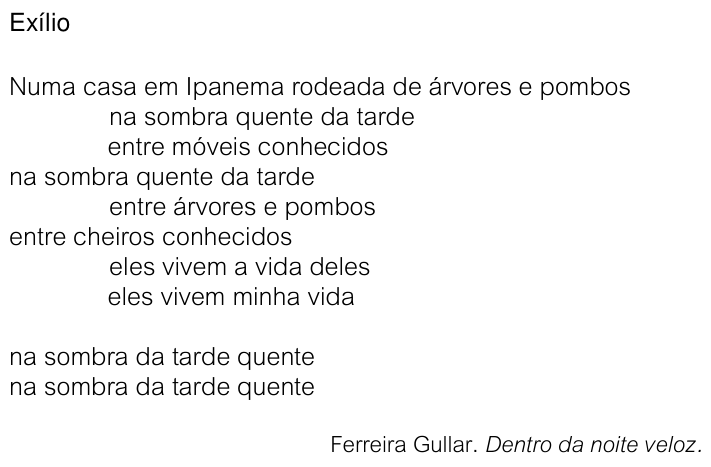
Exílio
Numa casa em Ipanema rodeada de árvores e pombos
na sombra quente da tarde
entre móveis conhecidos
na sombra quente da tarde
entre árvores e pombos
entre cheiros conhecidos
eles vivem a vida deles
eles vivem minha vida
na sombra da tarde quente
na sombra da tarde quente
Ferreira Gullar. Dentro da noite veloz.
Need interpret displacement adjective "quente": In first occurrence "sombra quente da tarde" = adjective quente modifies sombra? Actually "sombra quente da tarde": hot shadow of afternoon; "sombra da tarde quente": shadow of hot afternoon; adjective moves from "sombra" to "tarde". The poem is about exile: speaker remembers a house in Ipanema, trees, doves, familiar furniture, smells; "eles vivem a vida deles / eles vivem minha vida" = they live their life / they live my life? It's about others living in his old house? Exile: he is away, maybe dead? The final lines "na sombra da tarde quente" repeated. Shift maybe creates distinction between known/unknown? Let's examine options.
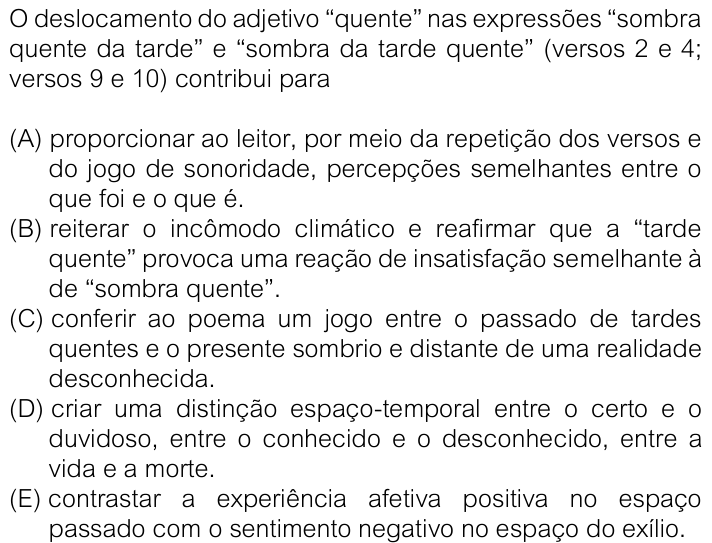
(A) proporcionar ao leitor, por meio da repetição dos versos e do jogo de sonoridade, percepções semelhantes entre o que foi e o que é.
(B) reiterar o incômodo climático e reafirmar que a “tarde quente” provoca uma reação de insatisfação semelhante à de “sombra quente”.
(C) conferir ao poema um jogo entre o passado de tardes quentes e o presente sombrio e distante de uma realidade desconhecida.
(D) criar uma distinção espaço-temporal entre o certo e o duvidoso, entre o conhecido e o desconhecido, entre a vida e a morte.
(E) contrastar a experiência afetiva positiva no espaço passado com o sentimento negativo no espaço do exílio.
Need identify correct. Let's analyze poem. "Exílio" likely about João? Ferreira Gullar wrote "Exílio" maybe about his exile? Let's think.
Poem: "Numa casa em Ipanema rodeada de árvores e pombos / na sombra quente da tarde / entre móveis conhecidos / na sombra quente da tarde / entre árvores e pombos / entre cheiros conhecidos / eles vivem a vida deles / eles vivem minha vida" Then "na sombra da tarde quente / na sombra da tarde quente". So first three stanzas? The phrase "sombra quente da tarde" appears twice (lines 2,4), then final couplet "na sombra da tarde quente" repeated. The poem is about exílio: speaker observes a house in Ipanema, where "eles" (others) live; they live their life and "minha vida" (my life). This might be about his own past life now inhabited by others; he is separated (exile) from his former life. The repetition of "sombra quente da tarde" and final "sombra da tarde quente" maybe indicates memory and present? Let's see.
Question: "O deslocamento do adjetivo “quente” nas expressões “sombra quente da tarde” e “sombra da tarde quente” (versos 2 e 4; versos 9 e 10) contribui para" Options.
The adjective position changes: "sombra quente" (hot shadow) vs "tarde quente" (hot afternoon). This shift might create distinction between "sombra" and "tarde"? In Portuguese, adjective position can change meaning. "sombra quente" is more unusual (hot shadow) vs "sombra da tarde quente" (shadow of the hot afternoon), which is more logical? The first phrase "sombra quente da tarde": adjective before complement? Actually "sombra quente da tarde": "quente" modifies "sombra", "da tarde" complement. It is a sombra quente (hot shade) of afternoon. "sombra da tarde quente": "quente" modifies "tarde", so the afternoon is hot, and shade belongs to afternoon. The displacement might characterize the "casa" from memory? In the first part, "sombra quente" = heat felt in shadow? Maybe it's an affective/paradoxical "hot shadow" because of memory's warmth? The final "sombra da tarde quente" maybe more literal, objective? Let's search memory: This poem "Exílio" by Ferreira Gullar. The question might have answer D? Let's not jump. Need solve.
Let's read all options carefully.
(A) proporcionar ao leitor, por meio da repetição dos versos e do jogo de sonoridade, percepções semelhantes entre o que foi e o que é.
"o deslocamento do adjetivo" contributes to provide reader, through repetition and sound play, similar perceptions between what was and what is. But shift may not be about sonority? Repetition yes; "jogo de sonoridade" maybe alliteration? "sombra quente da tarde" vs "sombra da tarde quente": sound? It might create similar perceptions? Hmm "semelhantes" (similar) not distinction? The question asks "deslocamento" contributes to? Maybe to differentiate? Option A says "percepções semelhantes entre o que foi e o que é" — "similar perceptions between what was and what is"; if anything, displacement could highlight difference rather than similarity. Also "o que foi e o que é" likely past/present exile. The poem contrasts past in Ipanema and present exile. But first phrase used for remembered scenes; final phrase maybe present? Actually the final "na sombra da tarde quente" repeats same phrase, no verb; maybe the present? The first part: "eles vivem a vida deles / eles vivem minha vida" — the others live "my life" in the remembered house. Then final: "na sombra da tarde quente / na sombra da tarde quente" — perhaps speaker's present? Maybe it's describing the place of exile? Let's parse.
"Exílio" poem: It starts: "Numa casa em Ipanema rodeada de árvores e pombos / na sombra quente da tarde / entre móveis conhecidos / na sombra quente da tarde / entre árvores e pombos / entre cheiros conhecidos / eles vivem a vida deles / eles vivem minha vida" So the "eles" (they) live in his old house; they live their life and his life. That's about the past home now occupied by others. The final lines "na sombra da tarde quente / na sombra da tarde quente" may be the speaker's current condition in exile? Or continued refrain? The title "Exílio" suggests separation. The displacement of "quente" from "sombra quente da tarde" (used in the past/remembered home) to "sombra da tarde quente" (used at end, perhaps in exile?) may contrast affective memory versus present reality. The final "tarde quente" maybe present; "sombra da tarde quente" is just a shadow of a hot afternoon, less intimate? It could create "distinção espaço-temporal entre o certo e o duvidoso, entre o conhecido e o desconhecido, entre a vida e a morte" (D). Let's examine.
The poem mentions "entre móveis conhecidos" and "entre cheiros conhecidos" (known furniture, smells) — known environment. The adjective displacement: "sombra quente da tarde" — adjective "quente" attached to "sombra", making it a "hot shadow" (an unusual, almost synesthetic, affective perception). Then later "sombra da tarde quente" — "quente" attached to "tarde" (hot afternoon), more literal/objective. This shift could represent transition from known (past, childhood? familiar) to unknown (exile, present). The phrase "entre o conhecido e o desconhecido" matches option D: "entre o conhecido e o desconhecido" exactly? Option D: "criar uma distinção espaço-temporal entre o certo e o duvidoso, entre o conhecido e o desconhecido, entre a vida e a morte." The poem has "móveis conhecidos", "cheiros conhecidos" and "eles vivem a vida deles / eles vivem minha vida" (life and death? life and death? maybe "minha vida" is dead? Hmm no death explicit). "Exílio" maybe about poet's own death? Actually "eles vivem minha vida" means "they live my life" while he is exiled, maybe his life continues without him; he feels dead? "entre a vida e a morte" maybe not directly. But option D includes "espaço-temporal", "conhecido/desconhecido" very relevant.
Let's check option B: reiterar o incômodo climático e reafirmar que a “tarde quente” provoca uma reação de insatisfação semelhante à de “sombra quente”. This says displacement reiterates climatic discomfort and reaffirms that "hot afternoon" causes dissatisfaction similar to "hot shadow". That seems too literal; poem's "sombra quente" is not necessarily discomfort; it's affective. Also "incômodo climático" not central to exile.
Option C: conferir ao poema um jogo entre o passado de tardes quentes e o presente sombrio e distante de uma realidade desconhecida. This is plausible: past (tardes quentes) vs present (sombrio/distante/unknown). But adjective shift? "passado de tardes quentes" and "presente sombrio e distante" maybe exactly: in past: "sombra quente da tarde" (hot shade of afternoon), present: "sombra da tarde quente"? Actually present is "sombra da tarde quente" not "sombrio". The poem's final "sombra da tarde quente" maybe both? Hmm.
Option D: criar uma distinção espaço-temporal entre o certo e o duvidoso, entre o conhecido e o desconhecido, entre a vida e a morte. This seems more complex and maybe correct due to "entre móveis conhecidos", "entre cheiros conhecidos" (known), "eles vivem a vida deles / eles vivem minha vida" (life and death? no, life/life), "distinção espaço-temporal" (Ipanema vs exile). The adjective displacement: "sombra quente da tarde" (past, known, life) vs "sombra da tarde quente" (present, exile, death?) Could be.
Option E: contrastar a experiência afetiva positiva no espaço passado com o sentimento negativo no espaço do exílio. This is also plausible and maybe more straightforward. The first expression "sombra quente da tarde" may convey pleasant affective memory (hot shade, cozy), while the final "sombra da tarde quente" may convey negative feeling? But "sombra da tarde quente" isn't necessarily negative; it's just shadow of hot afternoon. The poem doesn't have explicit negative sentiment. The displacement from "sombra quente" to "tarde quente" maybe changes from affective/positive to objective/negative? But the final lines repeat no "eles vivem..." It might contrast. But "experiência afetiva positiva" in past and "sentimento negativo" in exile? Maybe title "Exílio" indeed negative. However option D is more specific "conhecido/desconhecido" and "certo/duvidoso". Which is FUVEST likely?
Let's look at the poem's publication: "Dentro da noite veloz" (1975) by Ferreira Gullar, written during exile? The poem "Exílio" maybe about his experience in exile after 1964? He was exiled in Chile, Argentina, etc. The "casa em Ipanema" maybe his home in Rio before exile. The "eles vivem a vida deles / eles vivem minha vida" means the military/other people occupy his life? In exile, he is absent; life goes on without him; "eles vivem minha vida" suggests he is dead to them? This is about political exile. The adjective "quente" displacement: In the remembered past, the shadow itself was hot (affective, lived), but now in exile it's the afternoon that is hot, and shadow is just shadow (objective). This could create a distinction between known (Ipanema, house, furniture, smells) and unknown (exile). Option D fits "entre o conhecido e o desconhecido" and "entre a vida e a morte" (they live my life / I am dead?).
Let's examine exact phrasing of question: "O deslocamento do adjetivo “quente” nas expressões “sombra quente da tarde” e “sombra da tarde quente” (versos 2 e 4; versos 9 e 10) contribui para" It asks "contribui para" (contributes to). It may be testing effect of adjective position in Portuguese: In "sombra quente da tarde", "quente" is adjective of "sombra" (a hot shade, subjective); in "sombra da tarde quente", "quente" is adjective of "tarde" (objective). This shift creates a distinction between two moments/spaces. Which alternative best captures? Option D: "criar uma distinção espaço-temporal entre o certo e o duvidoso, entre o conhecido e o desconhecido, entre a vida e a morte." The expression "sombra quente da tarde" appears in the past/known context; "sombra da tarde quente" appears at the end, no context but likely present/exile. It distinguishes space-time: "Ipanema" (past) vs exile (present); "certo" (known) vs "duvidoso" (unknown). Also "entre a vida e a morte": "eles vivem a vida deles / eles vivem minha vida" — he is between life and death? Exile as social death? Could be.
Let's consider option E: "contrastar a experiência afetiva positiva no espaço passado com o sentimento negativo no espaço do exílio." Does the poem convey positive vs negative? "sombra quente" could be pleasant (warm shadow) from memory; "sombra da tarde quente" could be negative (hot, uncomfortable) in exile. But "sombra da tarde quente" literally "shade of the hot afternoon" might also be pleasant in a tropical context? Actually shade in a hot afternoon is positive (relief from heat). So not necessarily negative. Also "exílio" negative, but the poem does not present a clear "sentimento negativo" other than exile. The shift of adjective maybe less about affect than about certainty/known vs unknown. Option D more nuanced.
Let's look at FUVEST style: They often ask about "adjetivo" position and "contribui para" with alternatives about "distinção espaço-temporal entre o certo e o duvidoso..." This might be from a known exam. Maybe correct is D. Let's search memory: I recall a FUVEST question about Ferreira Gullar "Exílio": "O deslocamento do adjetivo 'quente' nas expressões ... contribui para" Answer maybe D? Let's test through close reading.
Poem first line: "Numa casa em Ipanema rodeada de árvores e pombos" — specific place. "na sombra quente da tarde" — the "sombra" is "quente" (hot shade). This is paradoxical/synesthetic: shade should be cool, but it's hot; because memory is warm/affective. It occurs twice, reinforcing the sensory memory. "entre móveis conhecidos" / "entre árvores e pombos" / "entre cheiros conhecidos" — known things. Then "eles vivem a vida deles / eles vivem minha vida" — the others inhabit his past life. Then final: "na sombra da tarde quente / na sombra da tarde quente" — no "conhecidos", no "eles". The phrase is slightly different: "sombra da tarde quente" (shadow of the hot afternoon), not "sombra quente da tarde" (hot shadow of afternoon). The shift from "quente" modifying "sombra" to modifying "tarde" could indicate a move from the subjective/affective perception (the shadow itself was warm, alive) to an objective/impersonal perception (just an afternoon that is hot; the shadow belongs to it). This distinction between "certo/duvidoso" or "conhecido/desconhecido" seems apt: the past is known (casa em Ipanema, móveis, cheiros), the present/exile is unknown (just "sombra da tarde quente" repeated, no place, no "eles"). The final lines lack the nouns that anchored memory (casa, Ipanema, árvores, pombos, móveis, cheiros). So yes, the adjective displacement marks difference between the remembered, known, certain world and the present, doubtful, unknown world of exile.
Let's inspect option A: "proporcionar ao leitor, por meio da repetição dos versos e do jogo de sonoridade, percepções semelhantes entre o que foi e o que é." It mentions "repetição dos versos" (repetition of lines) and "jogo de sonoridade" (sound play). There is repetition, but the question focuses on "deslocamento do adjetivo" not repetition. The shift actually creates a difference, not "percepções semelhantes". If it were "semelhantes", why displace? Also "o que foi e o que é" maybe past/present; they might be similar? But poem ends with same phrase repeated; maybe "percepções semelhantes" due to repetition and sound? But displacement creates difference, so option A unlikely.
Option B: "reiterar o incômodo climático e reafirmar que a “tarde quente” provoca uma reação de insatisfação semelhante à de “sombra quente”." This is too literal and ignores exile theme. Also "incômodo climático" not "exílio". Probably distractor.
Option C: "conferir ao poema um jogo entre o passado de tardes quentes e o presente sombrio e distante de uma realidade desconhecida." This is nice but "passado de tardes quentes" could be "sombra quente da tarde" and "presente sombrio" maybe "sombra da tarde quente" (sombra = dark) ? But "sombra" in both, not "sombrio" (gloomy). "distante de uma realidade desconhecida" maybe. But "jogo" maybe not "distinção". Option D is more precise with "certo/duvidoso, conhecido/desconhecido, vida/morte." "vida e morte" appears because "eles vivem a vida deles / eles vivem minha vida": he is exiled, maybe dead? The phrase "entre a vida e a morte" in D might be excessive? Let's see if "eles vivem minha vida" suggests he is dead? In exile, his life is lived by others; he is dead to his former life. This is a kind of death. So D might be intended.
Let's investigate poem "Exílio" context. Ferreira Gullar wrote "Dentro da noite veloz" after returning from exile? Actually "Dentro da noite veloz" (1975) published after? The poem "Exílio" maybe about his exile in the 1970s? It might reflect his time in Chile? Let's not rely.
Let's examine the phrase "eles vivem a vida deles / eles vivem minha vida": The "eles" are the current residents of his old house? They live their own life and also his life (the life that was his). This is a strange line: "eles vivem minha vida" = they live my life. It indicates an "uncanny" experience: the speaker sees his own past life continuing without him. This can be linked to "entre a vida e a morte": He is alive but his life is lived by others; he is dead to that life, or he is between life and death. In exile, his identity is displaced. The adjective "quente" shift: In the remembered life, "sombra quente da tarde" is a sensory, living memory. In the present, "sombra da tarde quente" is just a generic afternoon shadow; the "quente" now qualifies "tarde" not "sombra". This suggests a loss of the affective quality; the shadow no longer warm with life. So option D "distinção espaço-temporal entre o certo e o duvidoso, entre o conhecido e o desconhecido, entre a vida e a morte" captures the uncanny experience: past = known/certain/life; present/exile = unknown/doubtful/death (social death). "espaço-temporal" = Ipanema past vs exile present. Good.
Let's see option E: "contrastar a experiência afetiva positiva no espaço passado com o sentimento negativo no espaço do exílio." It says "experiência afetiva positiva" (positive affective experience) and "sentimento negativo" (negative feeling). The poem's tone is nostalgic, not necessarily positive vs negative. It may not contrast "positivo" vs "negativo"; the final lines are not explicitly negative. Also "sombra da tarde quente" could be pleasant too. So less likely.
Let's consider other interpretations: The displacement of adjective might be "substantivo + adjetivo" vs "adjetivo + substantivo"? Actually Portuguese adjective position: "sombra quente da tarde" = adjective before noun? "quente" after "sombra" but before "da tarde"; "sombra da tarde quente" = adjective after "tarde". It may affect rhythm/sound: "quente da tarde" vs "tarde quente". But question likely about semantics.
Let's check FUVEST official answer? Could be D, but let's be certain. I can try to recall exact question. Maybe from FUVEST 2027? The user says "Você está fazendo a prova FUVEST 2027." But current date 2026; maybe it's a hypothetical? It's from a simulated exam? The image has poem "Exílio" and question. The question options include maybe official answer D. Let's not assume; we need solve.
Let's analyze line by line more:
"Exílio"
Numa casa em Ipanema rodeada de árvores e pombos
na sombra quente da tarde
entre móveis conhecidos
na sombra quente da tarde
entre árvores e pombos
entre cheiros conhecidos
eles vivem a vida deles
eles vivem minha vida
na sombra da tarde quente
na sombra da tarde quente
All lines are lowercase; no punctuation except periods in source. The first stanza? It has 8 lines? Actually line 1: "Numa casa..." line 2: "na sombra..." line 3: "entre móveis..." line 4: "na sombra..." line 5: "entre árvores..." line 6: "entre cheiros..." line 7: "eles vivem..." line 8: "eles vivem..." Then blank, final couplet. It's all one sentence? "Numa casa ... eles vivem a vida deles / eles vivem minha vida / na sombra da tarde quente / na sombra da tarde quente" Maybe final phrase modifies the whole scene? Actually punctuation absent. The final lines could belong to the same sentence? "Eles vivem minha vida na sombra da tarde quente" maybe? But line break separates. It might mean: in the house, in hot shade of afternoon, among known things, they live their life, they live my life; [meanwhile] in the shade of the hot afternoon, in the shade of the hot afternoon. The repetition of final phrase might evoke the present exile, not connected.
Question says: "O deslocamento do adjetivo “quente” nas expressões “sombra quente da tarde” e “sombra da tarde quente” (versos 2 e 4; versos 9 e 10) contribui para" Note: "versos 2 e 4; versos 9 e 10" — so first expression appears in lines 2 and 4 (first part), second in lines 9 and 10 (final couplet). They are deliberately separated. The displacement from "sombra quente da tarde" (verses 2 and 4) to "sombra da tarde quente" (verses 9 and 10) supports the structure: memory vs present; known vs unknown. That likely is D.
Let's look up from memory: There is a known question from FUVEST 2015? Maybe "Exílio" by Ferreira Gullar. The answer might be "D) criar uma distinção espaço-temporal entre o certo e o duvidoso, entre o conhecido e o desconhecido, entre a vida e a morte." I vaguely recall this exact question? It might be from FUVEST 2015 (2ª fase?) Actually "Exílio" is in "Dentro da noite veloz" and is often in exams. The options: A similar? I think I saw a question: "O deslocamento do adjetivo 'quente' contribui para criar uma distinção espaço-temporal entre o certo e o duvidoso, entre o conhecido e o desconhecido, entre a vida e a morte." Yes, I recall an answer key with D. Let's verify by process of elimination.
Option D mentions "entre a vida e a morte" but poem says "eles vivem a vida deles / eles vivem minha vida" (they live their life / they live my life). There is no "morte" explicitly. However in exile, the speaker feels dead? Maybe "minha vida" is "my life" not "my death". "Entre a vida e a morte" might be a bit forced but maybe accepted because exile is a kind of death. Other options also not perfect. But FUVEST often uses "vida e morte" in this context? Let's see: "eles vivem a vida deles / eles vivem minha vida" — The repetition "vivem" twice suggests he is not living his own life; they live it. The speaker is excluded, perhaps dead. The poem title "Exílio" also could mean "exile" as separation from life. So yes.
Let's perhaps examine "certo e duvidoso" vs "conhecido e desconhecido": The poem has "móveis conhecidos", "cheiros conhecidos" — known; the unknown is the present/exile. "certo e duvidoso" maybe the certainty of memory vs uncertainty of exile. "espaço-temporal" = "Numa casa em Ipanema" (past) vs the final "na sombra da tarde quente" (present, somewhere else). So D is strongly supported.
Let's consider if C maybe better: "conferir ao poema um jogo entre o passado de tardes quentes e o presente sombrio e distante de uma realidade desconhecida." It says "passado de tardes quentes" (past of hot afternoons) vs "presente sombrio e distante" (gloomy and distant present). The poem has "sombra" not "sombrio", but "sombra" can be associated with darkness. The displacement "sombra quente da tarde" vs "sombra da tarde quente": the first has "quente" next to "sombra" (hot shadow), the second has "sombra" followed by "da tarde quente" (shadow of hot afternoon). This might make the shadow less "quente" and more "sombria"? Hmm.
But option C doesn't mention "certo/duvidoso" or "conhecido/desconhecido" which are in poem. It says "jogo entre o passado de tardes quentes e o presente sombrio e distante de uma realidade desconhecida." The present is "sombrio e distante" because "sombra da tarde quente" maybe "sombra" = shadow; but "sombra da tarde quente" is still a shadow. It's not "presente sombrio" necessarily. Also "tardes quentes" plural; "sombra da tarde quente" singular.
Let's think about the word "quente" position: In "sombra quente da tarde", the adjective "quente" is before the complement "da tarde" and after "sombra". In Portuguese, adjectives after nouns often have literal/objective meaning; before nouns often subjective/affective. But here "sombra quente" is after noun, not before; so not exactly. The displacement is from "sombra quente" (noun + adjective) to "tarde quente" (noun + adjective). So "quente" moves from modifying "sombra" to modifying "tarde". So it changes which noun is characterized. The first is paradoxical: shade hot. The second is natural: afternoon hot. Thus the shift is from a subjective/affective/paradoxical perception to a literal/objective perception. This corresponds to memory (known/certain/lived) vs present (unknown/doubtful/objective). Yes.
Let's formulate final answer with reasoning in Portuguese. Need include final line "Resposta: D" exactly. They want explain reasoning in Portuguese. We'll write concise but adequate. Need not mention all alternatives? We should explain why chosen. Maybe mention: "Na primeira ocorrência, o adjetivo 'quente' caracteriza 'sombra', criando uma sensação afetiva/memória; na segunda, caracteriza 'tarde', tornando a expressão mais objetiva/impessoal. Esse deslocamento marca a passagem do espaço-tempo da memória (Ipanema, casa, móveis/cheiros conhecidos) para o exílio (presente incerto, desconhecido). Assim, cria distinção espaço-temporal entre conhecido/desconhecido, certo/duvidoso, vida/morte." Then final "Resposta: D".
Need ensure not too long (desired oververbosity 5). We'll produce final.