Respondeu
levou 6 s
Como pensou
**Calculating combinations clearly**
I need to solve the simple combination: 28 - 4 + 70 - 6 = 88. I want to provide a Portuguese explanation, ensuring I mention the condition of four pairs counting to six. It's essential to clarify how legs distinguish combinations and that rotations are counted. I can represent this as eight equally spaced with four diametrical pairs. So, two combinations from eight, then we adjust for overlaps and sums to get to 88. I want to keep it clear and concise.
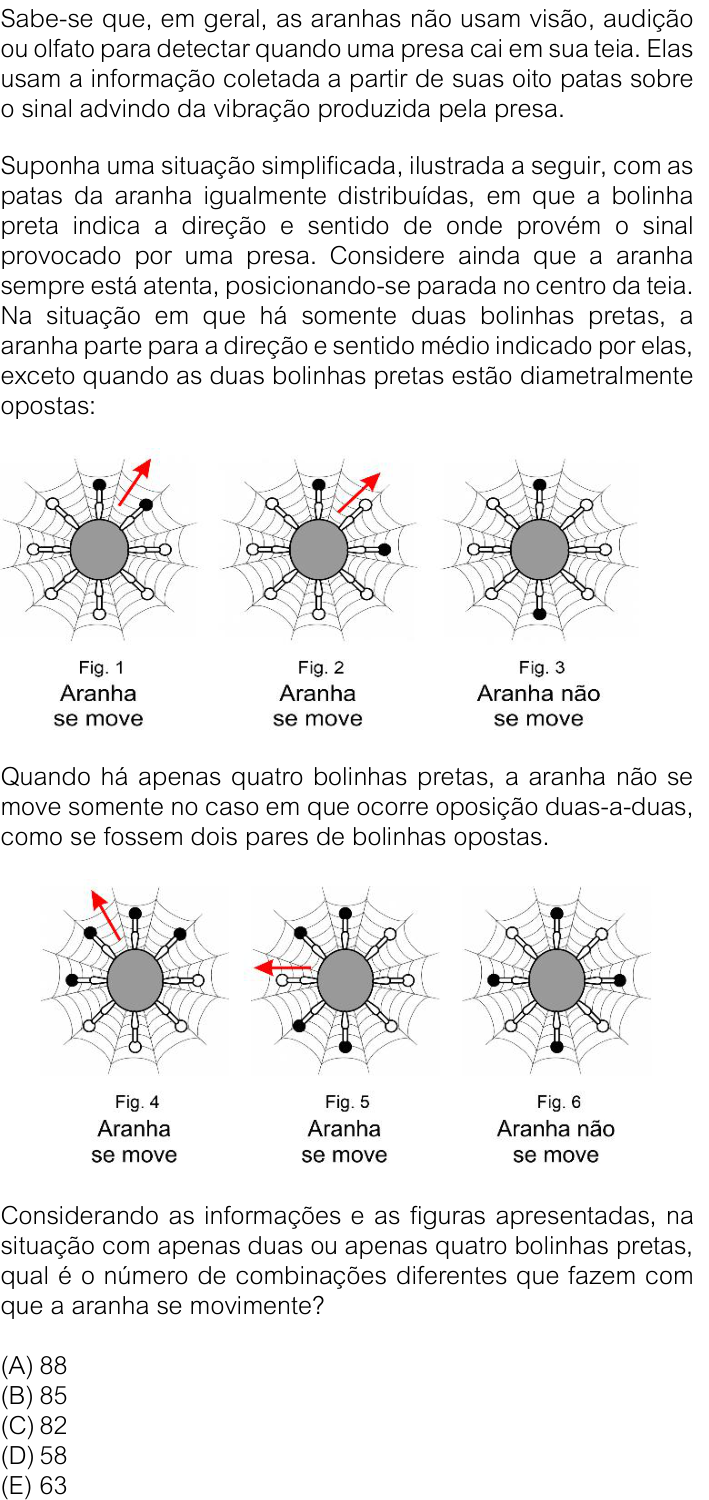
As oito posições das patas formam quatro pares diametralmente opostos. Vamos contar as configurações em que a aranha se move.
Com duas bolinhas pretas: há
\binom{8}{2}=28
maneiras de escolher suas posições. A aranha não se move nos 4 casos em que elas ocupam um par de posições opostas. Portanto, move-se em
28-4=24
configurações.
Com quatro bolinhas pretas: há
\binom{8}{4}=70
maneiras de escolher suas posições. A aranha não se move quando as bolinhas formam dois pares opostos. Escolhendo dois dos quatro pares disponíveis, temos
\binom{4}{2}=6
casos de imobilidade. Assim, ela se move em
70-6=64
configurações.
Somando os dois casos:
24+64=\boxed{88}.
Resposta: A
Respondeu
levou 4 s
Como pensou
**Solving equations and clarifying positions**
I’m working on solving the equations: 28 - 4 = 24 and 70 - 6 = 64, which relates to 88 in some way. I need to explain how to make selections without rotating the quotient, which should be clear and straightforward. The Portuguese equations total needs attention too, ensuring I understand four opposite pairs and how to choose 2 out of 6. I want to be concise but also thorough with my explanations.
As oito posições das patas formam quatro pares de posições diametralmente opostas. Vamos contar os casos com duas e com quatro bolinhas pretas separadamente.
Com duas bolinhas pretas:
Existem \binom{8}{2}=28 maneiras de escolher suas posições. A aranha não se move nos 4 casos em que elas estão em posições opostas. Logo, ela se move em
28-4=24 \text{ casos}.
Com quatro bolinhas pretas:
Existem \binom{8}{4}=70 maneiras de escolher suas posições. A aranha não se move quando as quatro bolinhas formam dois pares de posições opostas. Como há 4 pares disponíveis, isso ocorre em
\binom{4}{2}=6 \text{ casos}.
Portanto, ela se move em
70-6=64 \text{ casos}.
Somando as duas situações, obtemos
24+64=\boxed{88}.
Resposta: A
Respondeu
levou 4 s
Como pensou
**Calculating combinations and differences**
I'm working on calculating combinations here. First, I have C8,2, which gives me a value, and then I subtract 4 from that result. Next, for C8,4, I subtract the value of C4,2, and that ends up being 64. Finally, I want to sum these results to equal 88. I need to make sure I explain these calculations clearly! Each step seems straightforward, but I want to ensure everything is correct as I go.
As oito posições formam 4 pares de posições diametralmente opostas.
- Com duas bolinhas, há \binom{8}{2}=28 combinações. Em 4 delas, as bolinhas estão em posições opostas. Logo, a aranha se move em 28-4=24 casos.
- Com quatro bolinhas, há \binom{8}{4}=70 combinações. A aranha não se move quando as bolinhas formam dois pares opostos; há \binom{4}{2}=6 maneiras de escolher esses pares. Portanto, ela se move em 70-6=64 casos.
O total é 24+64=88 combinações.
Resposta: A
Respondeu
levou 12 s
Como pensou
**Analyzing spider movement**
I need to solve a problem related to a spider moving based on black dot signals. Each black dot represents a direction, and with eight possible directions, I want to interpret their average vector to determine the spider's movement. For two dots, there are no movements, except when they signal opposite directions. With four dots, I need to count configurations where their vector sums equal zero. It seems likely that I can categorize the directions into antipodal pairs but need to double-check my calculations.**Exploring zero-sum vectors**
I’m wondering about the possibility of other zero-sum combinations with four distinct vectors. The idea of using a root-of-unity polygon suggests that these could form a regular square or two pairs of vectors. By calculating the total selections from eight options, I find 70 minus 24 leaves 46 potential moves. It seems that directions related to the spider's legs—or perhaps its arms—could factor into this. I need to clarify how various combinations of black dots could signal movement or lack thereof.**Considering movement combinations**
I'm trying to figure out the number of combinations that can cause a movement with only two or four black balls. When I add the different movement counts, I get 20 from two dots and 46 from four dots, totaling 66. It seems I should also consider that the figure has eight legs, which might relate to pairs of signals. I need to refine my understanding of how these black balls indicate movement direction among possibly eight positions.
Cada bolinha preta pode estar em uma das oito direções das patas. A aranha se move quando a soma das direções dos sinais não é zero.
- Duas bolinhas: há \binom{8}{2}=28 pares possíveis. Os 4 pares diametralmente opostos fazem a soma ser zero; portanto, a aranha se move em 28-4=24 casos.
- Quatro bolinhas: há \binom{8}{4}=70 combinações. Para a soma ser zero, as bolinhas precisam formar dois pares opostos. Como há 4 pares diametralmente opostos disponíveis, isso pode ocorrer de \binom{4}{2}=6 maneiras. Logo, a aranha se move em 70-6=64 casos.
Somando: 24+64=88.
Resposta: A
Respondeu
levou 5 s
Como pensou
Temos 8 patas igualmente distribuídas (8 posições), formando 4 pares de posições diametralmente opostas.
Caso com exatamente duas bolinhas pretas:
Total de escolhas: C(8,2) = 28.
A aranha não se move quando as duas estão diametralmente opostas: 4 pares.
Combinações em que se move: 28 − 4 = 24.
Caso com exatamente quatro bolinhas pretas:
Total de escolhas: C(8,4) = 70.
A aranha não se move somente quando as quatro formam dois pares de bolinhas opostas, ou seja, quando escolhemos 2 dos 4 pares diametrais: C(4,2) = 6.
Combinações em que se move: 70 − 6 = 64.
Total: 24 + 64 = 88.
Resposta: A
Respondeu
levou 7 s
Como pensou
I'm counting the cases for two and four black legs, getting 24 and 64 moving combinations for a total of 88. Now I'm wondering whether four black legs could ever sum to zero in some other arrangement, checking the unit vectors at multiples of 45 degrees.
I'm confirming that four unit vectors summing to zero must split into two opposite pairs, so the count stays at 64 and the total at 88.
Resposta: (A) 88
A teia tem 8 patas igualmente espaçadas, ou seja, 8 posições a 45° uma da outra. Há 4 pares de posições diametralmente opostas.
Caso 1 – duas bolinhas pretas
- Total de escolhas: C(8,2) = 28.
- A aranha não se move só quando as duas bolinhas são opostas, o que acontece em 4 casos.
- Combinações em que ela se move: 28 − 4 = 24.
Caso 2 – quatro bolinhas pretas
- Total de escolhas: C(8,4) = 70.
- A aranha não se move só quando as quatro bolinhas formam dois pares opostos. Basta escolher 2 dos 4 pares: C(4,2) = 6 casos.
- Não há outra forma de os quatro sinais se anularem: quatro vetores unitários no plano só somam zero quando formam dois pares opostos.
- Combinações em que ela se move: 70 − 6 = 64.
Total: 24 + 64 = 88
Resposta: A
Respondeu
levou 5 s
Como pensou
I'm counting the spider's configurations: with two black dots there are 28 pairs, 4 of them diametrically opposite, leaving 24 that move. With four dots there are 70 choices, and I'm checking whether the 6 cases of two opposite pairs are the only ones that stay still, or whether other arrangements also give a zero average.
I'm checking the four-dot case for any zero-sum arrangements beyond the two-opposite-pairs ones, such as squares, and concluding that the rectangle configurations are already covered, which gives 88 moving configurations in total.
Raciocínio
As 8 patas estão igualmente distribuídas, formando 4 pares de patas diametralmente opostas.
Duas bolinhas pretas
- Total de combinações: C(8,2) = 28.
- A aranha não se move quando as duas bolinhas estão opostas. Há 4 pares assim.
- Combinações em que ela se move: 28 − 4 = 24.
Quatro bolinhas pretas
- Total de combinações: C(8,4) = 70.
- A aranha não se move somente quando as bolinhas formam dois pares de opostas. Isso equivale a escolher 2 dos 4 pares diametrais: C(4,2) = 6.
- Combinações em que ela se move: 70 − 6 = 64.
Total
24 + 64 = 88
Resposta: A
Respondeu
levou 2 min 01 s
Como pensou
The problem concerns a spider detecting prey through vibrations on its web using its eight legs.
I'm mapping the eight leg positions as points on a circle. Two black dots trigger movement in the average direction, except when they are diametrically opposite.
There are 28 ways to choose two dots from eight. Four pairs are diametrically opposite, so 24 combinations make the spider move.
Now I'm analyzing the four-dot case. The spider stays still only when the dots form two pairs of diametrically opposite legs. I need to count how many ways to pick four positions out of eight avoid this paired opposition.
There are 70 ways to choose four dots from eight. Six of these form two pairs of diametrically opposite legs, so the spider stays still in those cases. The remaining 64 combinations make it move.
The total number of combinations that make the spider move is 88. This equals 24 two-dot cases plus 64 four-dot cases, matching option A.
I'm reconsidering whether the spider only stays still when the sum of unit vectors is exactly zero. The problem might be asking for all cases where that sum is non-zero, rather than just the exceptions noted.
The problem explicitly states that the spider only stays still when four dots form two pairs of diametrically opposite legs. This eliminates any doubt about whether other zero-sum configurations exist. The answer remains 88.
I'm solving the four-dot case algebraically. Because 1 and √2/2 are linearly independent over Q, the x and y components of the vector sum must each be zero separately. This forces pairs of indices to be equal: a0 = a4 and a2 = a6. The remaining variables must also satisfy two additional equations. This confirms that only the six paired configurations yield a zero vector sum.
A aranha possui oito patas em posições fixas e igualmente espaçadas. As combinações relevantes são, portanto, os subconjuntos de posições das bolinhas pretas.
Para exatamente duas bolinhas, o total de combinações é \binom{8}{2}=28. Dentre elas, existem precisamente quatro pares de patas diametralmente opostas. A aranha se move em todas as demais, ou seja, em 28-4=24 combinações.
Para exatamente quatro bolinhas, o total de combinações é \binom{8}{4}=70. A aranha permanece imóvel somente quando as quatro posições formam dois pares de patas diametralmente opostas. Há quatro pares diametrais possíveis e escolhem-se dois deles, o que produz \binom{4}{2}=6 configurações. Logo, a aranha se move em 70-6=64 combinações.
(O mesmo resultado pode ser obtido observando que os oito vetores unitários nas direções das patas são linearmente independentes sobre \mathbb{Q} quando separados em partes racionais e irracionais; a única maneira de quatro deles somarem zero é serem união de dois pares opostos.)
Somando os dois casos, obtêm-se 24+64=88 combinações em que a aranha se movimenta.
Resposta: A
Respondeu
levou 9 s
Como pensou
We need solve in Portuguese. Need parse problem. Need count number of different combinations with only two or four black dots that make spider move. Need infer from 8 legs equally distributed. There are 8 positions around? Spider has eight legs, dots can be on some legs? Figures show black dots at endpoints? We need count combinations of 2 or 4 black dots (among 8 positions) such that spider moves. It doesn't move only if two dots diametrically opposite, or four dots occur in pairwise opposition (two opposite pairs). Need count "number of different combinations" among situations with only two or only four black dots that make spider move. Need know if combinations considered up to rotation/reflection? Wording "diferentes" likely subsets of 8 legs. Count subsets of size 2 not opposite plus size 4 not two opposite pairs? But alternatives 88 etc not matching? Let's calculate: total C(8,2)=28. Opposite pairs = 4. Moving pairs =24. Total C(8,4)=70. Nonmoving four = choose 2 opposite pairs among 4 = C(4,2)=6. Moving four=64. Sum=88. Option A. Wait if counting both two and four moving: 24+64=88. Exactly option A. So likely.
Need explain. But let's ensure no nuance: "situação com apenas duas bolinhas pretas ou apenas quatro bolinhas pretas" and asks "qual é o número de combinações diferentes que fazem com que a aranha se movimente?" Could mean separately? But alternatives include 88 = sum. They likely ask total of possibilities with 2 or 4 black dots where moves. Count as above.
Need present reasoning in Portuguese. Let's craft final moderate. Mention 8 positions. For 2: total C8,2=28; nonmoving = 4 pairs diametrically opposite; moving=24. For 4: total C8,4=70; nonmoving = ways choose two pairs of opposite legs among 4 pairs = C4,2=6; moving=64. Sum=24+64=88. Alternative A. Need final line "Resposta: A".
Há 8 pés/posições igualmente distribuídos ao redor da aranha.
1) Com apenas duas bolinhas pretas:
Total de escolhas possíveis:
\binom{8}{2}=28
A aranha não se move quando as duas bolinhas estão diametralmente opostas. Como há 8 posições, existem 4 pares opostos.
Logo, o número de casos em que ela se move é:
28-4=24
2) Com apenas quatro bolinhas pretas:
Total de escolhas possíveis:
\binom{8}{4}=70
A aranha não se move quando as bolinhas formam dois pares de posições opostas. Há 4 pares opostos possíveis, e devemos escolher 2 deles:
\binom{4}{2}=6
Assim, os casos em que ela se move são:
70-6=64
Total de combinações que fazem a aranha se mover:
24+64=88
Portanto, a alternativa correta é a A.
Resposta: A
Respondeu
levou 21 s
Como pensou
**Analyzing Image Content**
I'm currently processing an image of a FUVEST exam question. My next step is to meticulously read and comprehend the provided text, focusing on how spiders detect prey.
**Interpreting Spider Movement Rules**
I'm analyzing the rules governing spider movement based on prey signals. My focus is on determining the number of movement combinations for two or four prey indicators, specifically when pairs are diametrically opposed.
**Calculating Spider Movement Combinations**
I'm delving into the mathematical breakdown of spider movement. My current focus is on calculating the number of ways to place two black dots on the spider's legs, and specifically, when these dots do *not* trigger movement.
**Resolving Movement Exceptions**
I've determined that the spider doesn't move when two black dots are diametrically opposed. There are 4 such pairs among the 8 positions, so 24 movement cases exist for two dots. Now, I'm analyzing the four-dot exception where two pairs are oppositely positioned.
**Calculating Final Combinations**
I've completed the analysis for four dots, identifying 6 configurations that don't trigger movement. This leads to 64 moving cases for four dots, and a total of 88 moving combinations across two and four dots, matching an answer choice. I'm now carefully rereading the question to confirm no subtle conditions were missed.
**Confirming Four-Dot Logic**
I'm re-evaluating the four-dot scenario, specifically how to select two diametrically opposed pairs. My current focus is on ensuring this selection process correctly reflects the problem's constraints and leads to the correct exclusion count.
Para resolver a questão, devemos calcular o número de maneiras em que a aranha se move em cada uma das duas situações (com duas bolinhas pretas ou com quatro bolinhas pretas) e somá-las.
A aranha possui 8 patas igualmente distribuídas ao redor do corpo. Cada pata representa uma posição possível para uma bolinha preta. Numerando as patas de 1 a 8 em ordem circular, as posições diametralmente opostas formam 4 pares:
\{1, 5\}, \{2, 6\}, \{3, 7\} \text{ e } \{4, 8\}
1. Situação com apenas duas bolinhas pretas:
-
O número total de maneiras de escolher 2 patas entre as 8 é dado pela combinação:
C(8, 2) = \frac{8 \times 7}{2} = 28
-
De acordo com o enunciado, a aranha não se move apenas quando as duas bolinhas estão diametralmente opostas. Como existem 4 pares de posições opostas, há 4 combinações em que ela permanece parada.
-
Logo, o número de combinações em que a aranha se move é:
N_2 = 28 - 4 = 24
2. Situação com apenas quatro bolinhas pretas:
-
O número total de maneiras de escolher 4 patas entre as 8 é:
C(8, 4) = \frac{8 \times 7 \times 6 \times 5}{4 \times 3 \times 2 \times 1} = 70
-
A aranha não se move somente quando há "oposição duas-a-duas, como se fossem dois pares de bolinhas opostas". Ou seja, devemos escolher 2 dos 4 pares diametralmente opostos:
C(4, 2) = \frac{4 \times 3}{2} = 6
-
Logo, o número de combinações em que a aranha se move é:
N_4 = 70 - 6 = 64
Total:
O número total de combinações que fazem com que a aranha se movimente (com duas ou com quatro bolinhas) é:
N_{\text{total}} = N_2 + N_4 = 24 + 64 = 88
Resposta: A
Respondeu
levou 24 s
Como pensou
**Analyzing Exam Question**
I'm currently parsing the provided text to understand the user's request. The core task involves deciphering a multiple-choice question from a Brazilian exam, likely FUVEST 2027, and the initial focus is on its introductory statement regarding spider sensory perception.
**Mapping Spider Behavior**
I'm analyzing the rules for how the spider reacts to prey vibrations. My current focus is on translating the Portuguese descriptions of how it uses its legs to detect prey direction and how it responds to two or four signals, especially in opposing configurations.
**Calculating Spider Combinations**
I'm refining the combinatorics for spider leg movements. Having established that leg positions are distinct and not rotationally equivalent, I'm now calculating the specific combinations that result in the spider *not* moving, aiming to subtract this from the total to find the movement triggers.
**Calculating Non-Movement Combinations**
I've completed the calculation for two black dots, determining there are 24 moving combinations. Now, I'm analyzing the four-dot scenario, specifically identifying the six non-moving configurations where the dots form two pairs of diametrically opposite legs.
Para determinar o número de combinações diferentes que fazem com que a aranha se movimente, devemos analisar separadamente os dois casos mencionados (apenas duas bolinhas pretas e apenas quatro bolinhas pretas) e somar os resultados possíveis.
As 8 patas da aranha definem 8 posições distintas ao redor da teia, que formam 4 pares de posições diametralmente opostas.
1º Caso: Situação com apenas 2 bolinhas pretas
-
Total de combinações possíveis:
Escolhendo 2 posições dentre as 8 disponíveis, temos:
C_{8,2} = \frac{8!}{2!(8-2)!} = \frac{8 \times 7}{2} = 28 \text{ combinações}
-
Combinações em que a aranha NÃO se move:
A aranha não se move quando as duas bolinhas estão diametralmente opostas. Como existem 8 patas igualmente distribuídas, há exatamente 4 pares de patas diametralmente opostas (4 combinações).
-
Combinações em que a aranha SE MOVE:
28 - 4 = 24 \text{ combinações}
2º Caso: Situação com apenas 4 bolinhas pretas
-
Total de combinações possíveis:
Escolhendo 4 posições dentre as 8 disponíveis, temos:
C_{8,4} = \frac{8!}{4!(8-4)!} = \frac{8 \times 7 \times 6 \times 5}{4 \times 3 \times 2 \times 1} = 70 \text{ combinações}
-
Combinações em que a aranha NÃO se move:
A aranha não se move quando as 4 bolinhas formam dois pares de bolinhas diametralmente opostas. Como existem ao todo 4 pares de posições opostas, basta escolher 2 desses 4 pares:
C_{4,2} = \frac{4!}{2!(4-2)!} = \frac{4 \times 3}{2} = 6 \text{ combinações}
-
Combinações em que a aranha SE MOVE:
70 - 6 = 64 \text{ combinações}
Conclusão
Somando os casos em que a aranha se movimenta com apenas duas ou apenas quatro bolinhas pretas, obtemos:
\text{Total} = 24 + 64 = 88 \text{ combinações}
Resposta: A