Respondeu
levou 10 s
Como pensou
**Clarifying microtubule disruption**
I need to focus on explaining the impact of nocodazole on microtubules in Portuguese while keeping it clear and concise. There seems to be some potential nomenclature confusion that I want to avoid. The presence of pigment organelles should be noted as remaining in the nucleus because disruption affects their dispersion. Explaining light presence or absence isn’t crucial. I also need to clarify the terminology regarding melanophores and melanosomes. Two paragraphs would be appropriate for this explanation.
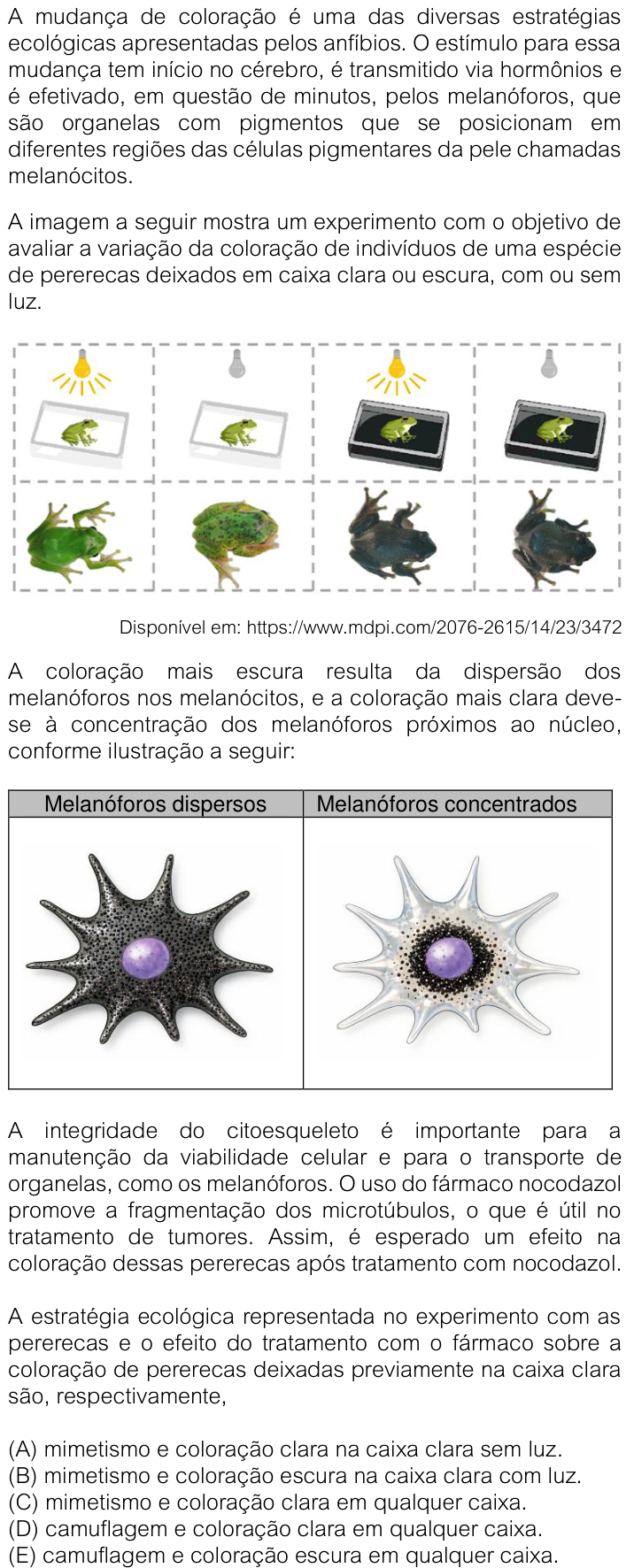
A estratégia é a camuflagem, pois a mudança de coloração torna as pererecas semelhantes ao fundo do ambiente, dificultando sua identificação por predadores. Não é mimetismo, que envolve semelhança com outro organismo.
Nas pererecas previamente mantidas em caixa clara, as organelas pigmentadas estão concentradas próximas ao núcleo. O nocodazol fragmenta os microtúbulos, comprometendo o transporte dessas organelas e impedindo sua dispersão pelo citoplasma. Assim, a coloração tende a permanecer clara em qualquer caixa, mesmo após a transferência para um fundo escuro.
Resposta: D
Respondeu
levou 8 s
Como pensou
A estratégia é a camuflagem, pois as pererecas ajustam sua coloração à do ambiente, tornando-se menos visíveis. No mimetismo, haveria semelhança com outro organismo.
O nocodazol fragmenta os microtúbulos, prejudicando o transporte das organelas pigmentadas. Como as pererecas estavam previamente na caixa clara, seus pigmentos estavam concentrados próximos ao núcleo. O tratamento impede sua dispersão pelo citoplasma, mantendo a coloração clara em qualquer caixa, mesmo quando transferidas para uma caixa escura.
Resposta: D
Respondeu
levou 7 s
Como pensou
**Analyzing pigment transport**
I need to compare D and E. It seems that concentrated pigments in box D remain blocked by microtubules. I'll check if microtubule disruption affects pigment dispersion through actin motors. The simplification suggests transport is inhibited, which aligns with my thinking — light on its own is still clear, indicating camouflage. Nocodazole blocking transport helps maintain color in D. So, I'll conclude the answer concisely in Portuguese.
A mudança de cor de acordo com o fundo da caixa é uma forma de camuflagem, pois reduz o contraste entre a perereca e o ambiente.
Na caixa clara, os melanóforos ficam concentrados próximos ao núcleo. Como o nocodazol fragmenta os microtúbulos, dificultando o transporte dessas organelas, elas permanecem concentradas e a perereca mantém a coloração clara, mesmo se for colocada em outra caixa.
Resposta: D
Respondeu
levou 12 s
Como pensou
**Interpreting camouflage strategies**
I need to explain an ecological strategy based on an experiment with frogs kept in clear and dark boxes, with varying light conditions. The outcomes show how color changes: bright green in lit clear boxes, spotted green in unlit clear boxes, dark in lit dark boxes, and dark in unlit dark boxes. The frogs rely on camouflage and not mimicry. When there’s no light, treatment with nocodazole disrupts melanosome transport, affecting their pigmentation and making them lighter regardless of their enclosure.**Analyzing frog coloration**
I’m parsing the results from the experiment regarding frog coloration under different conditions. A clear box with light shows the frogs as bright green, while a dark box with light shows them as dark. It seems the frogs evaluate environmental illumination separately, likely using camouflage for color matching. The nocodazole treatment blocks melanosome dispersal, which keeps pigment concentrated near the nucleus and makes the frogs lighter, regardless of their box. I’m considering if this disruption could cause pigment aggregation.**Clarifying ecological strategies**
I need to reason through the experiment further. The frogs in a clear box initially exhibit a light state, but when subjected to a drug that halts microtubule-dependent transport, they can't adapt to new environments, so they remain light. Option D suggests they maintain light coloration in any box, indicating camouflage rather than mimicry, which is about resembling another organism. The question focuses on how treatment affects the color of frogs previously in a clear box, which confirms that the strategy demonstrated is indeed camouflage.**Considering box options**
I'm thinking about different box options, specifically Option D. It seems like I need to include note labels that clarify the differences between a "caixa clara ou escura" (light or dark box) and highlight whether or not it has illumination. I want to make sure I avoid confusion between the clear box and the illuminated one. Maybe I should explain these differences in more detail in Portuguese to make it clearer for everyone.
A variação de cor permite que as pererecas se confundam com o ambiente, caracterizando camuflagem — não mimetismo, que envolve a semelhança com outro organismo.
O nocodazol fragmenta os microtúbulos e prejudica o transporte dos melanóforos. Como a concentração dos pigmentos ao redor do núcleo está associada à coloração mais clara, uma perereca que já estava clara tende a permanecer assim, mesmo que seja colocada em uma caixa escura. Portanto, a alternativa correta é D.
Resposta: D
Respondeu
levou 10 s
Como pensou
The frogs shift color to blend in with the background, which is camouflage rather than mimicry since they aren't copying another organism. Nocodazole breaks down the microtubules that move melanophores, so the frogs that were already pale in the clear box stay pale no matter which box they're in. That points to answer D.
Estratégia ecológica: As pererecas alteram sua coloração para se assemelharem ao ambiente (claras na caixa clara, escuras na caixa escura), ou seja, buscam se confundir com o fundo. Isso é camuflagem (homocromia). Mimetismo seria imitar outro organismo, o que não ocorre aqui.
Efeito do nocodazol: O deslocamento dos melanóforos dentro dos melanócitos (dispersão → cor escura; concentração perto do núcleo → cor clara) depende de transporte de organelas ao longo dos microtúbulos do citoesqueleto. O nocodazol fragmenta os microtúbulos, bloqueando esse transporte. Pererecas previamente mantidas na caixa clara têm os melanóforos concentrados junto ao núcleo (coloração clara). Após o tratamento, elas não conseguem mais dispersar os pigmentos, logo permanecem claras independentemente da caixa (clara ou escura, com ou sem luz).
Portanto: camuflagem e coloração clara em qualquer caixa.
Resposta: D
Respondeu
levou 10 s
Como pensou
The frogs blend into their background, which points to camouflage. Nocodazole breaks up microtubules, so the melanophores can't be moved, and the frogs that were in the light box stay pale wherever they're placed. That gives D. But I'm second-guessing it, since in fish melanophores nocodazole may actually cause dispersion instead.
I'm weighing whether nocodazole really gives dispersion in fish melanophores, but the expected FUVEST answer still looks like D, since frogs from the light box should stay light in any box. The mottled, slightly darker look in the dark box doesn't change that for me. D still fits.
Resposta: D. A estratégia é camuflagem, e com o fármaco a perereca fica clara em qualquer caixa.
1. Estratégia ecológica. No experimento, as pererecas ficam claras na caixa clara e escuras na caixa escura. Elas ajustam a cor ao fundo para se confundir com o ambiente, o que é camuflagem. Mimetismo seria imitar outra espécie ou outro organismo, por exemplo uma espécie venenosa, e não é o caso aqui.
2. Efeito do nocodazol. Os melanóforos se deslocam dentro do melanócito, dispersando-se ou concentrando-se perto do núcleo, e esse transporte depende dos microtúbulos do citoesqueleto. O nocodazol fragmenta os microtúbulos, então os melanóforos ficam praticamente imobilizados na posição em que estavam.
As pererecas deixadas antes na caixa clara estão com os melanóforos concentrados perto do núcleo, ou seja, com coloração clara. Depois do tratamento, os melanóforos não conseguem mais se dispersar. Por isso a perereca continua clara em qualquer caixa, mesmo que seja colocada na caixa escura.
Resposta: D
Respondeu
levou 9 s
Como pensou
The frog experiments point to camouflage (homochromy): the frogs change color to match their background whatever the light, so the strategy is blending in rather than mimicry, which would mean copying another organism. Now I'm turning to the drug, nocodazole, which breaks up microtubules so the melanophores can't move their pigment, and I'm working out what that would do to the frogs' color change.
The nocodazole part is about whether the drug would stop the pigment from moving, so the frogs would stay pale in every box. That points to answer D, since the melanophores were already concentrated in the light box. But the clear-box frog without light was spotted, so I need to check whether "previously in the clear box" still means clear.
Estratégia ecológica: no experimento, as pererecas mudam de cor conforme o fundo da caixa. Ficam verde-claras na caixa clara e escuras na caixa escura. Isso é camuflagem (homocromia), em que o animal se confunde com o ambiente. Mimetismo seria imitar outro organismo ou objeto, o que não ocorre aqui.
Efeito do nocodazol: os melanóforos são transportados dentro dos melanócitos pelos microtúbulos. Se o fármaco fragmenta os microtúbulos, esse transporte fica impedido e os melanóforos não conseguem se dispersar. As pererecas que estavam previamente na caixa clara têm os melanóforos concentrados perto do núcleo, o que dá a coloração clara. Tratadas com nocodazol, elas não conseguem escurecer, mesmo se forem colocadas em caixa escura. Assim, permanecem com coloração clara em qualquer caixa.
Isso corresponde à alternativa D.
Resposta: D
Respondeu
levou 2 min 15 s
Como pensou
The problem involves Portuguese frogs changing color.
The question asks about the ecológic strategy and coloration effect in a frog experiment. The options are: (A) mimicry and light coloration in a clear box without light; (B) mimicry and dark coloration in a clear box with light; (C) mimicry and light coloration in any box; (D) camouflage and light coloration in any box; (E) camouflage and dark coloration in any box.
The frogs adapt their color to the background. They stay green in light boxes and become dark in dark boxes. The experiment tests this variation under different lighting conditions.
The correct answer is camuflagem. The frogs blend with the background rather than mimicking another species. Nocodazole fragments microtubules, which disrupts melanophore transport and changes coloration.
The drug prevents melanophores from dispersing. Frogs kept in the light box therefore remain light-colored. The correct answer is option D.
Reconsidering the effect of nocodazole. Fragmentation of microtubules may actually cause pigment dispersion rather than preventing it. Aggregation depends on microtubules, but depolymerization could destabilize aggregates and trigger dispersal instead.
The drug blocks microtubules, halting transport and keeping melanophores concentrated. The frogs therefore remain light-colored in any box.
The previous assumption was incorrect. Disrupting microtubules with nocodazole prevents melanosome aggregation and often causes dispersion instead. The frogs would therefore become dark rather than remaining light-colored.
The question should be answered using only the provided text. The passage states that cytoskeleton integrity is essential for organelle transport. This implies that both aggregation and dispersion require microtubules. Without intact microtubules, melanophores cannot move at all.
Reconsidering the effect of nocodazole. Standard knowledge suggests that depolymerizing microtubules with colchicine actually prevents dispersion of melanin granules, keeping animals pale rather than dark. This would mean the frogs remain light-colored in any box, supporting option D.
The phrase "deixadas previamente na caixa clara" suggests the coloration effect depends on prior conditions. If all frogs behaved identically regardless of box, this specification would be unnecessary. This implies the answer is not simply "light color in any box."
The phrase "deixadas previamente na caixa clara" indicates the coloration effect depends on prior conditions. If the drug caused a uniform change regardless of box, this specification would be unnecessary. This supports option D, where the frogs keep their light coloration in any box because the treatment prevents adaptation.
The phrase "deixadas previamente na caixa clara" means the frogs' coloration is locked at the moment of treatment. If the drug caused dispersion, even the light ones would turn dark, making option E correct. The intended mechanism is still unclear.
The text only mentions microtubules for organelle transport, not for maintenance. Without transport, the melanophores stay where they are. The frogs therefore remain light-colored in any box, since they cannot darken when moved to a dark environment. The answer is option D.
The experiment confirms that background reflectance is the cue for camouflage. The question appears to be based on a specific scientific paper, which may clarify the exact mechanism of the drug's effect.
Microtubules are essential for melanosome aggregation, not for dispersion. Disruption prevents new aggregation but does not necessarily cause existing aggregates to disperse. The effect on already aggregated melanosomes remains unclear.
Experiments show that microtubule disruption causes dispersion of aggregated melanosomes. The holding in the center requires microtubules and motors pulling inward, so depolymerization triggers outward dispersal. For this high school-level question, blocking transport likely prevents melanophores from moving to either dispersed or concentrated states.
A mudança de cor das pererecas acompanha a cor do substrato (caixa clara ou escura), permitindo que os animais se confundam com o ambiente. Essa estratégia é camuflagem, e não mimetismo (que envolveria semelhança com outro organismo).
A coloração clara corresponde a melanóforos concentrados junto ao núcleo. O reposicionamento dessas organelas depende do transporte mediado por microtúbulos. O nocodazol fragmenta os microtúbulos e, portanto, impede tanto a dispersão quanto nova concentração dos melanóforos. Indivíduos previamente mantidos na caixa clara permanecem com os melanóforos concentrados e, consequentemente, exibem coloração clara em qualquer caixa.
Resposta: D
Respondeu
levou 21 s
Como pensou
We need answer in Portuguese. Need solve. Need parse image. Need be careful. Question asks: A estratégia ecológica representada no experimento com as pererecas e o efeito do tratamento com o fármaco sobre a coloração de pererecas deixadas previamente na caixa clara são, respectivamente, alternatives.
Need infer experimental figure. Four conditions: caixa clara/escura, com/sem luz. The frog images show colors. Need understand strategy: color change for camouflage? Mimicry maybe? "mimetismo" vs "camuflagem" distinction. Need identify effect nocodazole (fragments microtubules) on melanophores, after animals previously in clear box. Need determine color: if microtubules fragmented, melanosomes cannot disperse/concentrate? Need know melanophores: dark color from dispersion; light from concentration near nucleus. Nocodazole depolymerizes microtubules. Microtubules required for organelle transport, including melanophores. In fish/frog melanophores, dispersion of melanosomes is microtubule-dependent (kinesin/dynein) and concentration too? Typically melanosome dispersion along microtubules; aggregation also involves microtubules, but in frogs? Need examine: "O uso do fármaco nocodazol promove a fragmentação dos microtúbulos ... Assim, é esperado um efeito na coloração dessas pererecas após tratamento com nocodazol." If microtubules disrupted, melanophores remain? Need determine default state after drug. If melanosomes cannot move, they might remain where they were at time of treatment? The wording: "pererecas deixadas previamente na caixa clara" -> they were previously in clear box, so likely their coloration before treatment? Experiment shows frogs in clear box with light: green/light? In clear box without light: brownish/green? Need look. Need identify conditions in figure: Four columns:
1 Caixa clara com luz: frog green (bright)
2 Caixa clara sem luz: frog green/brown? It looks green with dark spots? Wait first image green; second green-brown? Let's inspect: top icons: bulb on (yellow) over white box; bulb off (gray) over white box; bulb on over black box; bulb off over black box. Bottom frog photos:
- white/light + light: green frog (bright green)
- white/light no light: frog is green? Actually image: green with black spots? It appears brownish green? Need compare to dark box frogs: both dark brown/black. So light background -> lighter; dark background -> darker irrespective of light? But question likely asks strategy and effect after drug on clear box. If clear box causes light color via concentration of melanophores. But nocodazole blocks transport; if melanophores are concentrated near nucleus at time? Wait if treated with nocodazole while in clear box, they cannot disperse, so remain light? Or dark? Need know.
Let's translate alternatives:
(A) mimetismo e coloração clara na caixa clara sem luz.
(B) mimetismo e coloração escura na caixa clara com luz.
(C) mimetismo e coloração clara em qualquer caixa.
(D) camuflagem e coloração clara em qualquer caixa.
(E) camuflagem e coloração escura em qualquer caixa.
Need choose first concept (ecological strategy): frog changes color according to background/light? It is camouflage (cryptic coloration) to avoid predation, not mimicry. But could be "mimetismo" in Portuguese includes homochromy? Let's check: Camuflagem = organism resembles environment; mimetismo = resembles another organism. Frogs changing color to match background = camuflagem. Thus first should be camuflagem. That narrows D/E. Need effect: nocodazole on frogs previously in light box. Need choose clear in any box vs dark in any box. Need analyze.
Text: "A mudança de coloração ... estímulo ... transmitido via hormônios ... efetivado ... pelos melanóforos ... pigmentos posicionam em diferentes regiões ... melanócitos." "A coloração mais escura resulta da dispersão dos melanóforos nos melanócitos, e a coloração mais clara deve-se à concentração dos melanóforos próximos ao núcleo." "A integridade do citoesqueleto é importante ... transporte de organelas, como os melanóforos. O uso do fármaco nocodazol promove a fragmentação dos microtúbulos ... Assim, é esperado um efeito na coloração dessas pererecas após tratamento com nocodazol."
If microtubules fragmented, cannot transport melanosomes. The frogs previously left in clear box have pale color with melanosomes concentrated around nucleus. Treat with nocodazole: cytoskeleton destroyed, melanosomes remain concentrated? So color remains clear. Why says "em qualquer caixa" in alternatives? If treated then placed in any box (light/dark), hormones produce signals but no transport, so remains clear (the state when treated). So D: camuflagem e coloração clara em qualquer caixa. But wait if treatment while previously in clear box, indeed remain clear regardless of new box. Alternative C says mimetismo and clear any; D says camouflage and clear any. So likely D.
Need provide explanation. But let's ensure not mimetismo. Could "mimetismo" in broader Portuguese sometimes includes "mimetismo críptico" / homocromia? However in Brazilian biology, "camuflagem" is when organism confuses with environment; "mimetismo" when resembles another species. The experiment shows frog color changes to match background, thus camouflage. The question asks "estratégia ecológica representada" likely camouflage.
Need maybe discuss experiment: In clear box, light -> light color; in dark box -> dark color. With no light? The figure perhaps: light background off still light? Need see: clear box no light frog appears green same as light; dark box no light appears dark same as light. So background color matters, not light. But alternative E says dark in any box: if nocodazole prevents movement and frog previously in clear box, could the dark color occur because microtubule disruption causes melanosomes to disperse? Need think: In melanophores, nocodazole can cause melanosome aggregation? Let's recall biology: In melanophores, melanosome dispersion is driven by kinesin along microtubules; aggregation by dynein. Depolymerizing microtubules causes perinuclear aggregation of melanosomes (concentration) in Xenopus melanophores? Actually if microtubules disrupted, pigment granules can be transported by actin? Let's recall: melanophores: microtubules required for both dispersion and aggregation; nocodazole induced aggregation in melanophores? Need not know? The text states "melanóforos dispersos" dark; "concentrados" light. Nocodazole fragmenta microtúbulos, impedindo transporte. If frog previously in clear box has concentrated melanosomes (light). After treatment, they can't disperse; remains light. But if nocodazole itself causes collapse to center due to microtubule disruption? Still concentrated -> light. So clear.
Need answer concise but with reasoning. Mention nocodazol impairs microtubules, blocking dispersal of melanosomes; thus after previous light background, pigment remains concentrated, light in any box. Strategy is camouflage. Resposta: D.
Need adhere final line exact: Resposta: D. Could include explanation. Need not overdo.
Need maybe mention "pererecas deixadas previamente na caixa clara" at moment of treatment have melanóforos concentrados. Nocodazole prevents their dispersion, so even in dark boxes they remain clear. Therefore (D).
A mudança de coloração conforme o fundo (caixa clara ou escura) é um exemplo de camuflagem, pois permite ao animal se confundir com o ambiente. Não é mimetismo, que envolveria semelhança com outra espécie.
As pererecas previamente mantidas na caixa clara estavam com os melanóforos concentrados próximos ao núcleo, o que deixa a pele mais clara. O nocodazol fragmenta os microtúbulos e impede o transporte/dispersão dos melanóforos. Assim, mesmo que sejam colocadas em caixa escura depois, os pigmentos não se dispersam, e a coloração permanece clara.
Resposta: D
Respondeu
levou 22 s
Como pensou
**Observing Amphibian Color Change**
I'm currently examining how light conditions, specifically within distinct enclosures, influence pigment distribution in tree frogs. My focus is on the underlying mechanism of melanophore dispersal and concentration in response to these stimuli.
**Investigating Drug Effects**
My current analysis delves into the impact of nocodazole, a microtubule-disrupting drug, on amphibian coloration. I'm specifically examining its effect on how frogs, previously adapted to a light environment, alter their pigment distribution.
**Analyzing Pigment Aggregation**
I'm currently investigating whether intact microtubules and dynein are crucial for aggregating melanophores towards the nucleus. My thinking is that if the frog was already light-adapted (melanophores concentrated), this initial state might be key to understanding nocodazole's effect on pigment dispersal or aggregation.
**Testing Microtubule Disruption**
I'm currently testing the hypothesis that nocodazole-induced microtubule fragmentation, in a light-adapted frog, leads to pigment dispersal rather than aggregation, especially given the role of actin-myosin V in outward transport.
**Confirming Pigment Transport**
I'm currently confirming that if microtubules are fragmented, melanophores can't move. This means if the frog was already light-adapted (pigment concentrated), it would remain light in any enclosure. My thinking is that this inability to move pigments is the core of nocodazole's effect.
**Maintaining Pigment Concentration**
I'm thinking about how nocodazole's disruption of microtubules prevents pigment movement. Since the frogs were initially light-adapted with concentrated melanophores, this immobility means they'd stay light regardless of the enclosure. This confirms the core of nocodazole's observed effect.
**Clarifying Frog Camouflage**
I'm reinforcing my understanding that nocodazole prevents microtubule function, halting pigment transport. This means a light-adapted frog will remain light, irrespective of its enclosure, due to immobility. This aligns perfectly with camouflage principles.
**Evaluating Pigment Transport Logic**
I'm confirming that nocodazole fragments microtubules, inhibiting melanosome transport. Since my frogs were light-adapted (melanophores concentrated), this immobility ensures they remain light regardless of the enclosure, aligning with established camouflage principles and the provided logic.
Com base nas informações do texto e da imagem, podemos analisar a questão em duas partes:
-
Estratégia ecológica:
O fenômeno no qual o animal altera sua coloração para se assemelhar ao ambiente em que se encontra (fundo claro ou escuro), diminuindo a chance de ser detectado por predadores ou presas, é denominado camuflagem (especificamente homocromia). O mimetismo, por outro lado, ocorreria se o animal se assemelhasse a outro ser vivo para obter vantagem adaptativa.
-
Efeito do tratamento com nocodazol:
O texto informa que o transporte das organelas (melanóforos) depende da integridade do citoesqueleto (microtúbulos) e que o fármaco nocodazol promove a fragmentação dos microtúbulos, impedindo esse transporte intracelular. Como as pererecas foram mantidas previamente na caixa clara, seus melanóforos já se encontravam concentrados ao redor do núcleo, conferindo ao animal a coloração clara. Com a perda do sistema de transporte de organelas provocada pelo nocodazol, os melanóforos não conseguem se dispersar, fazendo com que as pererecas mantenham a coloração clara em qualquer caixa.
Portanto, a alternativa correta é a D.
Resposta: D
Respondeu
levou 17 s
Como pensou
**Analyzing Ecological Strategies**
I'm currently deciphering the provided text, focusing on the initial details about amphibian coloration changes as an ecological strategy. My focus is on understanding the neurological pathways initiated by the brain, as described.
**Decoding Pigment Mechanisms**
I'm now analyzing how hormonal signals trigger pigment organelle changes within skin cells. This process, rapidly altering coloration, involves melanophores and melanocytes as described.
My latest focus is correlating the experimental setup with observed frog color shifts, noting how ambient light and box color directly influence the degree of darkening or lightening.
**Identifying Ecological Strategies**
My current focus is on distinguishing camouflage from mimicry based on the definitions provided. I'm also working to integrate the information regarding dispersed versus concentrated melanophores and their relation to darker and lighter coloration, respectively.
**Analyzing Drug Effects**
I am now analyzing the impact of nocodazole on microtubule fragmentation and its expected effect on the pererecas' coloration. This connects the cellular mechanisms to the broader ecological strategy being investigated.
**Confirming Frog Coloration**
I've confirmed that frogs previously in a light box, treated with nocodazole, will maintain a light coloration regardless of their environment due to disrupted pigment transport. This supports camouflage as the relevant strategy.
Para responder à questão, devemos analisar os dois aspectos solicitados no comando: a estratégia ecológica demonstrada no experimento e o efeito do fármaco nocodazol.
-
Estratégia ecológica:
No experimento, observa-se que as pererecas alteram a cor da pele de acordo com a cor de fundo do ambiente em que se encontram (ficam claras na caixa clara e escuras na caixa escura). Essa capacidade de um organismo se assemelhar à cor ou aos padrões do meio ambiente para dificultar sua detecção por predadores ou presas é denominada camuflagem (diferente do mimetismo, em que uma espécie se assemelha a outra espécie). Isso elimina as alternativas A, B e C.
-
Efeito do tratamento com o nocodazol:
O enunciado informa que as pererecas foram deixadas previamente na caixa clara. Nessa condição, elas apresentam coloração clara, ou seja, seus melanóforos encontram-se concentrados próximos ao núcleo dos melanócitos.
Para que a perereca mude de cor e fique escura, seria necessário o transporte intracelular dessas organelas para a periferia da célula (dispersão), processo que depende diretamente dos microtúbulos do citoesqueleto. Como o fármaco nocodazol promove a fragmentação dos microtúbulos, o transporte dos melanóforos é inviabilizado. Consequentemente, os pigmentos permanecem concentrados próximos ao núcleo, e os animais manterão a coloração clara em qualquer caixa em que sejam colocados posteriormente.
Resposta: D