Correção FUVEST 2027 · 1ª faseAcompanhe a resolução de cada questão da 1ª fase, ao vivoAcompanhar
IA ao vivo / FUVEST 2027 · 1ª fase

COMPARE OS RACIOCÍNIOS

Questão 35

Gabarito oficial: A. ← 34 36 →

A questão

Questão 35

Respostas das IAs

GPT-6 Astra

A

Respondeu

levou 7 s

Como pensou

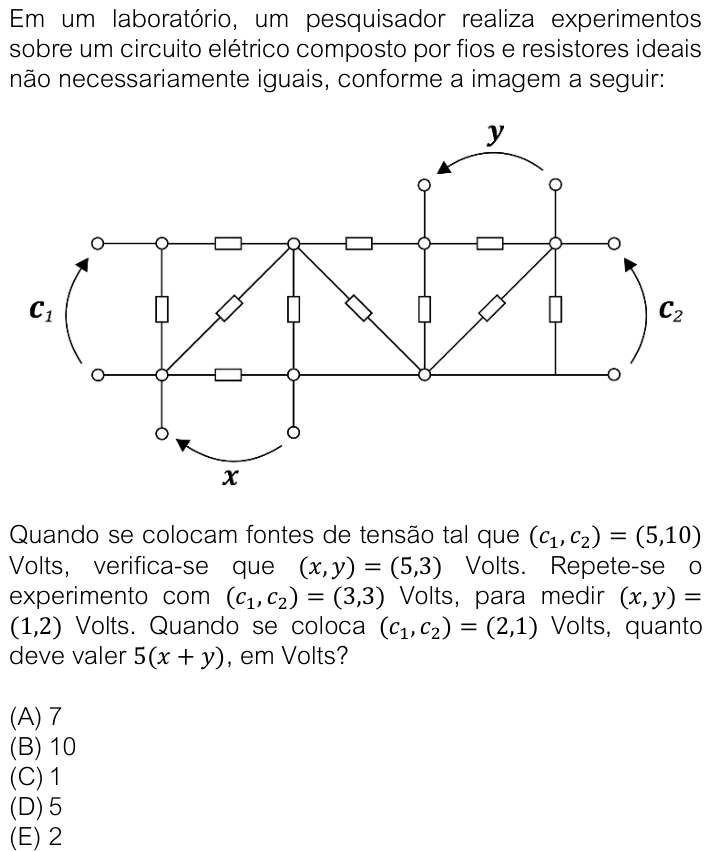
Como o circuito contém apenas resistores e fios ideais, as leis de Ohm e de Kirchhoff garantem que as tensões medidas dependem linearmente das tensões das fontes. Assim, podemos aplicar o princípio da superposição.

Observe que a nova configuração das fontes pode ser escrita como:

(2,1)=(3,3)-\frac15(5,10).

Portanto, a mesma combinação vale para as tensões (x,y) medidas nos experimentos:

(x,y)=(1,2)-\frac15(5,3) =\left(0,\frac75\right).

Logo,

5(x+y)=5\left(0+\frac75\right)=7\ \text{V}.

Resposta: A

GPT-6.1 Sol

A

Respondeu

levou 11 s

Como pensou
**Solving linear response equations** I’m working through a linear response problem using given bases. It looks like (2,1) can be expressed as a combination of (5,10) and (3,3) through some coefficients, with calculations leading to specific outputs. I need to clarify ideal resistors' role in linear superposition and mention potential issues, especially regarding current direction in circuit configurations. I must also prepare a concise response in Portuguese that incorporates all the equations and outputs I've derived.**Clarifying circuit principles** I think it's essential to include x and y values individually for clarity. I also want to explain that since the circuit is made up of ideal wires and resistors, the measured voltages depend linearly on the applied voltages according to the principle of superposition. I plan to present the equations and final results while ensuring there are no issues with the source, especially concerning negative factors, to validate my answer.

Como o circuito contém apenas fios e resistores ideais, vale o princípio da superposição: as tensões x e y dependem linearmente das tensões aplicadas c_1 e c_2.

Observe que a nova entrada pode ser escrita como

(2,1)=(3,3)-\frac15(5,10).

Portanto, fazemos a mesma combinação com as medidas dos dois experimentos:

(x,y)=(1,2)-\frac15(5,3) =\left(0,\frac75\right).

Assim,

5(x+y)=5\left(0+\frac75\right)=7\ \text{V}.

Resposta: A

GPT-6.1 Terra

A

Respondeu

levou 3 s

Como pensou

Como o circuito contém apenas resistores ideais, as tensões obedecem ao princípio da superposição: uma combinação linear das tensões das fontes produz a mesma combinação linear das tensões medidas.

Temos

(2,1)=(3,3)-\frac15(5,10).

Logo,

(x,y)=(1,2)-\frac15(5,3) =\left(0,\frac75\right).

Portanto,

5(x+y)=5\cdot\frac75=7\text{ V}.

Resposta: A

GPT-6 Luna

A

Respondeu

levou 12 s

Como pensou
**Parsing circuit measurements** I need to analyze the circuit with linear resistors, focusing on voltage differences and the orientation of arrows that indicate direction. I’m thinking x and y could represent terminal voltage and the arrows suggest the voltage drop from lower to higher points. Establishing equations through the linear network is essential, with unknown resistors being fixed. It's important to determine the coefficients for each output based on careful orientation and signs. The diagrams for c1 and c2 will help clarify voltage relationships.**Inspecting terminal connections** I need to check the x terminals at the lower nodes. The left x terminal comes from the bottom-left, while the right x terminal is from the bottom middle. The curved arrow beneath points from the right to left, with its head near the left terminal. This indicates that x = V(left x terminal) - V(right x terminal). For y terminals, they’re above the top nodes, with a similar relationship. I’ll be using sign conventions for these voltage measurements and ensuring that the network topology with wires and resistors is accurately represented.**Determining terminal node IDs** I need to identify the terminal node IDs. For the c1 circuit, the top node is labeled A and the bottom is B, while for c2, C is at the upper right and the bottom wire node is at the lower right. I'll analyze the output from node B (bottom left) to node D (bottom central). For y, I'll look at the output between top node E and top-right node F. I plan to use linear responses, setting relationships for x and y based on the voltage differences.**Solving equations** I’m trying to figure out how to solve the equations involving γ and δ. First, I divide 5 in the equation γ + 2δ = 3/5. Then I work on the second equation by dividing by 3: γ + δ = 2/3. After some calculations, I subtract to find δ = -1/15 and find γ = 11/15. Ultimately, I derive a final result of 7. It seems I’ve got it sorted out!

Como o circuito é formado por resistores ideais, as tensões x e y dependem linearmente das tensões aplicadas c_1 e c_2.

Escrevemos x=ac_1+bc_2. Pelos dois experimentos:

5a+10b=5,\qquad 3a+3b=1.

Daí, a=-\frac13 e b=\frac23. Para (c_1,c_2)=(2,1),

x=2\left(-\frac13\right)+\frac23=0.

Do mesmo modo, escrevemos y=dc_1+ec_2. Então:

5d+10e=3,\qquad 3d+3e=2.

Logo, d=\frac{11}{15} e e=-\frac1{15}. Para (c_1,c_2)=(2,1),

y=2\left(\frac{11}{15}\right)-\frac1{15}=\frac75.

Assim,

5(x+y)=5\left(0+\frac75\right)=7.

Resposta: A

Claude Fable 5.1

A

Respondeu

levou 9 s

Como pensou
I'm treating the circuit as linear, so each output is a sum of weighted inputs. Using the two known input-output pairs, I want to write (2,1) as a combination of (5,10) and (3,3), which gives me two equations in the unknown weights. Solving for the weights gives α = -1/5 and β = 1, and both equations check out. Plugging these into the circuit gives x = 0 and y = 7/5, so 5(x+y) = 7, which is answer A.

Raciocínio:

O circuito é formado apenas por fios e resistores ideais, ou seja, é um circuito linear. Pelo princípio da superposição, as tensões medidas x e y são combinações lineares das tensões das fontes c_1 e c_2:

x = a\,c_1 + b\,c_2, \qquad y = d\,c_1 + e\,c_2

Não precisamos nem conhecer os resistores: basta escrever a nova configuração (c_1,c_2)=(2,1) como combinação linear das configurações já medidas.

Procuramos \alpha,\beta tais que \alpha(5,10)+\beta(3,3)=(2,1):

\begin{cases}5\alpha+3\beta=2\\10\alpha+3\beta=1\end{cases}

Subtraindo: 5\alpha=-1 \Rightarrow \alpha=-\tfrac15. Então 3\beta = 2+1 = 3 \Rightarrow \beta=1.

Verificação: 5(-\tfrac15)+3(1)=2 ✓ e 10(-\tfrac15)+3(1)=1 ✓.

Pela linearidade, as leituras (x,y) seguem a mesma combinação:

(x,y) = -\tfrac15(5,3) + 1\cdot(1,2) = (-1,-\tfrac35)+(1,2) = \left(0,\ \tfrac75\right)

Logo x+y=\tfrac75 e

5(x+y)=5\cdot\tfrac75 = 7 \text{ V}

Resposta: A

Claude Opus 5.5

A

Respondeu

levou 5 s

Como pensou
I'm solving for the coefficients that express (2,1) as a combination of (5,10) and (3,3), which gives a = -1/5 and b = 1. Then I'm plugging those back into the circuit's matrix to get the output (x,y), and the second component comes out to 7 I'm working out the sum from those components: the (x,y) result is (0, 7/5), so x+y is 7/5, which means 5(x+y) comes to 7, and that matches answer A.

Resposta: (A) 7

Ideia: o circuito tem apenas resistores ideais e fontes. Portanto é linear, e vale o princípio da superposição: as tensões medidas (x, y) dependem linearmente das tensões aplicadas (c₁, c₂). Não é preciso resolver o circuito.

1. Escrever (2, 1) como combinação dos dois experimentos dados.

Procuramos a e b tais que a·(5, 10) + b·(3, 3) = (2, 1):

  • 5a + 3b = 2
  • 10a + 3b = 1

Subtraindo a primeira equação da segunda: 5a = −1, logo a = −1/5.
Substituindo: 3b = 2 + 1 = 3, logo b = 1.

2. Aplicar a mesma combinação às respostas.

(x, y) = −1/5·(5, 3) + 1·(1, 2) = (−1, −3/5) + (1, 2) = (0, 7/5)

3. Calcular o pedido.

x + y = 7/5, portanto 5(x + y) = 7 V.

Resposta: A

Claude Sonnet 5.5

A

Respondeu

levou 6 s

Como pensou
I'm working out the linear system: x and y are each linear in c1 and c2, so I'm solving for the coefficients a, b from the first data point pair, which gives b = 2/3 and a = -1/3, and I'm setting up the same kind of equations for c and d. I'm working through the second pair of coefficients, getting d = -1/15 and c = 11/15. Plugging in (2,1) gives x = 0 and y = 7/5, so 5(x+y) = 7. Then I'm checking that superposition still holds with the voltage sources and that there's no constant offset, since the circuit has no internal sources, and I land on answer 7.

Raciocínio

O circuito contém apenas fios e resistores ideais, e as únicas fontes são as que impõem as tensões c₁ e c₂. As tensões medidas x e y são tensões em pontos de circuito aberto. Logo, pelo princípio da superposição, x e y dependem linearmente de c₁ e c₂ e não têm termo constante:

x = a·c₁ + b·c₂
y = p·c₁ + q·c₂

Cálculo de x

  • (5, 10) → x = 5: 5a + 10b = 5, ou seja, a + 2b = 1
  • (3, 3) → x = 1: 3a + 3b = 1, ou seja, a + b = 1/3

Subtraindo as duas equações, b = 2/3 e a = −1/3.

Cálculo de y

  • (5, 10) → y = 3: 5p + 10q = 3, ou seja, p + 2q = 3/5
  • (3, 3) → y = 2: 3p + 3q = 2, ou seja, p + q = 2/3

Subtraindo, q = 3/5 − 2/3 = −1/15 e p = 2/3 + 1/15 = 11/15.

Para (c₁, c₂) = (2, 1)

  • x = −2/3 + 2/3 = 0
  • y = 22/15 − 1/15 = 21/15 = 7/5

Portanto 5(x + y) = 5 · 7/5 = 7 V.

Resposta: A

Grok 4.7

A

Respondeu

levou 44 s

Como pensou
The problem is in Portuguese about an electrical circuit. The circuit is linear. Voltages x and y are linear combinations of c1 and c2. I will use the two known cases to find the coefficients. Then I will calculate 5(x + y) for c1 = 2 V and c2 = 1 V. I solved for the coefficients of x. a = -1/3 and b = 2/3. Now I am solving for d and e using the second set of equations. I found d = 11/15 and e = -1/15. The linear equations are now complete. For c1 = 2 V and c2 = 1 V, x = 0 V and y = 7/5 V. Therefore 5(x + y) = 7 V. The answer is 7.

A resposta do circuito é linear e homogênea nas tensões aplicadas, pois ele é formado apenas por resistores e fios ideais (as únicas fontes são as que são inseridas nos experimentos). Assim, existem coeficientes constantes tais que

x=a\,c_1+b\,c_2,\qquad y=d\,c_1+e\,c_2.

Os dois experimentos fornecidos determinam univocamente esses coeficientes:

a=-\frac13,\quad b=\frac23,\quad d=\frac{11}{15},\quad e=-\frac1{15}.

Substituindo o par (c_1,c_2)=(2,1) obtém-se

x=0,\qquad y=\frac75,

e portanto

5(x+y)=7.

(O mesmo valor é recuperado escrevendo (2,1) como combinação linear dos dois vetores de entrada já medidos e aplicando a mesma combinação às saídas correspondentes.)

Resposta: A

DeepSeek V4.1 Flash

A

Respondeu

levou 13 s

Como pensou
We need solve. Need parse circuit image. Need understand terminals and measurements. Need solve linear resistive network. Need identify nodes and terminals c1,c2,x,y. Need derive relation linearly. Since ideal resistors arbitrary but fixed? We need infer from experiments? Circuit composed of wires and ideal resistors not necessarily equal. Image shows network with resistors. Need compute mapping between voltage sources at c1,c2 and measured x,y. Given two experiments with (c1,c2)=(5,10) -> (x,y)=(5,3); (3,3)->(1,2). Need find (x,y) for c=(2,1), then 5(x+y). Because linear reciprocal? Need determine linear relation from two data? General linear map from c to measured x,y: x = a c1 + b c2 + x0? y = d c1 + e c2 + y0. But circuit no independent sources, so x0=y0=0. Thus two equations for coefficients? Actually each experiment gives two outputs for one input, total 4 scalars outputs, unknown a,b,d,e =4. The two experiments give exactly 4 equations. Then solve for input (2,1). So circuit topology might not be needed? Wait if measured x,y are voltages between open terminals? c1,c2 applied. Linear map from source voltages at two ports to open-circuit voltages at two ports. Need reciprocity may add constraints, but two experiments enough for 4 coefficients? Each experiment gives x,y for a known c vector. Two input vectors give two outputs vectors. If arbitrary linear map, yes need map for any input requires 2x2 matrix, 4 unknowns; two vector equations are 4 equations. Could solve. Let's denote vector v = [c1,c2]; out [x,y] = M v (assuming common reference? c1,c2 are voltage sources maybe relative? Need sign/polarities? Image arrows indicate points? Hmm). Given: M [5,10]^T = [5,3] M [3,3]^T = [1,2] Find M [2,1]^T =? then x+y. This is simple if linear. But check polarities? Measurements x,y perhaps potential differences between top/bottom open terminals with arrows. Could have sign conventions. But data as signed? likely positive values. Need verify whether linear. Let's compute. Let M = [[a,b],[c,d]]. Equations: 5a+10b=5 -> a+2b=1 5c+10d=3 -> 5c+10d=3 3a+3b=1 -> a+b=1/3 3c+3d=2 -> c+d=2/3 Solve first: a+2b=1 a+b=1/3 => subtract b? (a+2b)-(a+b)=1-1/3=2/3 => b=2/3. a=1/3 -2/3 = -1/3. Second: c+d=2/3 5c+10d=3 -> c+2d=3/5. Subtract: (c+2d)-(c+d)=d=3/5-2/3=(9-10)/15=-1/15. c = 2/3 - (-1/15)=10/15+1/15=11/15. Now input c=(2,1): x = a*2+b*1 = (-1/3)*2+2/3= -2/3+2/3=0. y = c*2+d*1 = (11/15)*2 + (-1/15)=22/15-1/15=21/15=7/5=1.4. x+y=1.4. 5(x+y)=7. Answer A. Nice. Need ensure no issue: x maybe difference between terminals x: image has two open circles at bottom, arrow arc between them. y at top. Need sign orientation: The arrow indicates from one terminal to another? Voltage difference x maybe v? Given positive. We used c1,c2 as source values, likely voltage difference with polarities perhaps arrows. If signs different, matrix adjust. But resulting A likely. Need provide explanation. However we should be careful: Did we need physical reciprocity? We solved arbitrary linear map from two experiments. But check if measurable x,y are independent? There are only 2 experiments to find four entries, yes. Need mention linear superposition. Potential hidden: Could input configuration "colocam fontes de tensão tal que (c1,c2)" means c1 and c2 are voltages at terminals? But yes. Need parse circuit maybe not needed. Could mention network purely resistive => each output voltage is linear combination of the two source voltages. Define: x = α c1 + β c2 y = γ c1 + δ c2. Use data solve. Then calculate. Let's write in Portuguese. Need final line exact "Resposta: A". We can include calculation. Need decide if coefficient naming conflicts c1 c2 c for coefficient. Use alpha beta gamma delta. Let's construct concise but clear. Given: x = a c1 + b c2 y = d c1 + e c2 No term independent. For (5,10): 5a+10b=5 5d+10e=3 For (3,3): 3a+3b=1 3d+3e=2. Solving first pair: a+2b=1, a+b=1/3 => b=2/3, a=-1/3. d+e=2/3; d+2e=3/5 => e=-1/15, d=11/15. For (2,1): x = -1/3*2 + 2/3*1=0. y = 11/15*2 -1/15*1=21/15=7/5. x+y=7/5. 5(x+y)=7. Could also solve via vector interpolation: not needed. Need maybe include "as tensões se somam linearmente (superposição)" due to ideal resistors. Good. Final.

Como o circuito é composto apenas por resistores lineares, as tensões medidas x e y são combinações lineares das tensões aplicadas c_1,c_2:

x=a c_1+b c_2,\qquad y=d c_1+e c_2

Usando os dados:

Para (c_1,c_2)=(5,10):

5a+10b=5,\qquad 5d+10e=3

Para (c_1,c_2)=(3,3):

3a+3b=1,\qquad 3d+3e=2

Resolvendo:

a+2b=1,\quad a+b=\frac13 \Rightarrow b=\frac23,\quad a=-\frac13
d+e=\frac23,\quad d+2e=\frac35 \Rightarrow e=-\frac1{15},\quad d=\frac{11}{15}

Agora, para (c_1,c_2)=(2,1):

x=-\frac13\cdot 2+\frac23\cdot 1=0
y=\frac{11}{15}\cdot 2-\frac1{15}\cdot 1 =\frac{21}{15}=\frac75

Logo:

5(x+y)=5\left(0+\frac75\right)=7

Resposta: A

Gemini 3.8 Flash

A

Respondeu

levou 9 s

Como pensou
**Analyzing Circuit Behavior** I'm currently processing the initial conditions of the electrical circuit experiment. My focus is on understanding the implications of ideal wires and non-uniform resistors as presented in the diagram, and the experiment's starting point. **Formulating Relationships** I'm now exploring the linear relationships between voltage sources and outputs. Specifically, I'm testing the principle of superposition and seeking to express the target voltage sum as a linear combination of the source voltages.

Para resolver esta questão, utilizamos o Princípio da Superposição, válido para qualquer circuito elétrico puramente linear (composto apenas por resistores ideais e fontes de tensão ideais).

Por esse princípio, as tensões medidas x e y são combinações lineares das tensões de entrada c_1 e c_2. Consequentemente, a soma (x+y) e o próprio par (x, y) comportam-se de forma linear em relação a (c_1, c_2).

Denotando as entradas por vetores \vec{c} = (c_1, c_2) e as saídas por \vec{u} = (x, y):

  • No 1º experimento: \vec{c}_1 = (5, 10) \implies \vec{u}_1 = (5, 3)
  • No 2º experimento: \vec{c}_2 = (3, 3) \implies \vec{u}_2 = (1, 2)
  • No 3º experimento: \vec{c}_3 = (2, 1) \implies \vec{u}_3 = (x, y)

Podemos escrever \vec{c}_3 como uma combinação linear de \vec{c}_1 e \vec{c}_2:

\vec{c}_3 = k_1 \vec{c}_1 + k_2 \vec{c}_2

(2, 1) = k_1 (5, 10) + k_2 (3, 3)

Montando o sistema de equações:

\begin{cases} 5k_1 + 3k_2 = 2 \quad \text{(I)} \\ 10k_1 + 3k_2 = 1 \quad \text{(II)} \end{cases}

Subtraindo a equação (I) da equação (II):

(10k_1 + 3k_2) - (5k_1 + 3k_2) = 1 - 2

5k_1 = -1 \implies k_1 = -\frac{1}{5}

Substituindo k_1 na equação (I):

5\left(-\frac{1}{5}\right) + 3k_2 = 2 \implies -1 + 3k_2 = 2 \implies 3k_2 = 3 \implies k_2 = 1

Pela linearidade, a saída \vec{u}_3 será a mesma combinação linear das saídas:

\vec{u}_3 = k_1 \vec{u}_1 + k_2 \vec{u}_2

(x, y) = -\frac{1}{5}(5, 3) + 1(1, 2)

(x, y) = \left(-1, -\frac{3}{5}\right) + (1, 2) = \left(0, \frac{7}{5}\right)

Assim, temos:

x = 0

y = \frac{7}{5}

Portanto:

x + y = \frac{7}{5}

5(x + y) = 5 \cdot \frac{7}{5} = 7\text{ V}

Resposta: A

Gemini 4 Argon

A

Respondeu

levou 28 s

Como pensou
**Analyzing Circuit Design** I'm currently evaluating the circuit's structure, focusing on how the ideal wires and resistors interact. My attention is on the two voltage inputs, $c_1$ and $c_2$, and the two corresponding voltage outputs, $x$ and $y$, as depicted in the provided image. **Leveraging Superposition Principle** The realization that the circuit's linearity allows for the application of the Superposition Principle is a significant development. I'm now focused on expressing the target input vector $(2, 1)$ as a linear combination of the given experimental inputs. My current work involves solving for the coefficients $\alpha$ and $\beta$ in this combination. **Calculating Final Output** I've successfully determined the coefficients $\alpha = -1/5$ and $\beta = 1$ for the linear combination of input vectors. Applying these coefficients to the corresponding output vectors using linearity, I've computed the final output $(x, y) = (0, 7/5)$. My final step is to calculate $5(x + y)$.

Para resolver esta questão, podemos utilizar o Princípio da Superposição (ou a propriedade de linearidade dos circuitos elétricos). Como o circuito é composto apenas por fios e resistores ideais (que obedecem à Primeira Lei de Ohm, V = R \cdot i), as tensões medidas em quaisquer partes do circuito (x e y) são combinações lineares das tensões das fontes de alimentação (c_1 e c_2).

Em termos matemáticos, existe uma transformação linear T(c_1, c_2) = (x, y) que relaciona as entradas e as saídas do circuito. Do enunciado, temos:

  1. T(5, 10) = (5, 3)
  2. T(3, 3) = (1, 2)

Queremos determinar o valor de (x, y) = T(2, 1). Para isso, podemos escrever o par (2, 1) como uma combinação linear dos pares (5, 10) e (3, 3):

\alpha \cdot (5, 10) + \beta \cdot (3, 3) = (2, 1)

Isso nos gera o seguinte sistema de equações:

\begin{cases} 5\alpha + 3\beta = 2 \quad \text{(I)} \\ 10\alpha + 3\beta = 1 \quad \text{(II)} \end{cases}

Subtraindo a equação \text{(I)} da equação \text{(II)}, obtemos:

(10\alpha - 5\alpha) + (3\beta - 3\beta) = 1 - 2

5\alpha = -1 \implies \alpha = -\frac{1}{5}

Substituindo \alpha = -\frac{1}{5} na equação \text{(I)}:

5\left(-\frac{1}{5}\right) + 3\beta = 2

-1 + 3\beta = 2 \implies 3\beta = 3 \implies \beta = 1

Pela linearidade do circuito, a saída (x, y) para a entrada (2, 1) deve obedecer à mesma combinação linear:

(x, y) = \alpha \cdot T(5, 10) + \beta \cdot T(3, 3)

(x, y) = -\frac{1}{5} \cdot (5, 3) + 1 \cdot (1, 2)

(x, y) = \left(-1, -\frac{3}{5}\right) + (1, 2)

(x, y) = \left(0, \frac{7}{5}\right)

Portanto, temos x = 0\text{ V} e y = \frac{7}{5}\text{ V}. Calculando o valor pedido pelo enunciado:

5(x + y) = 5\left(0 + \frac{7}{5}\right) = 7\text{ Volts}

Resposta: A