Respondeu
levou 7 s
Como pensou
**Clarifying exponent placement**
I need to be careful with the placement of exponent C in an equation that includes f=(2e^{x²}+C)/(3C e^{-x²/2}). The numerator should display as 2e^{x²}+C to match the original. For the denominator, it should be 3Ce^{-x²/2. I’ll have to resolve for C using f0=(2+C)/3C with C=1 being positive and even. I want to explain how positive C affects the equation, focusing on presenting everything neatly and concisely.
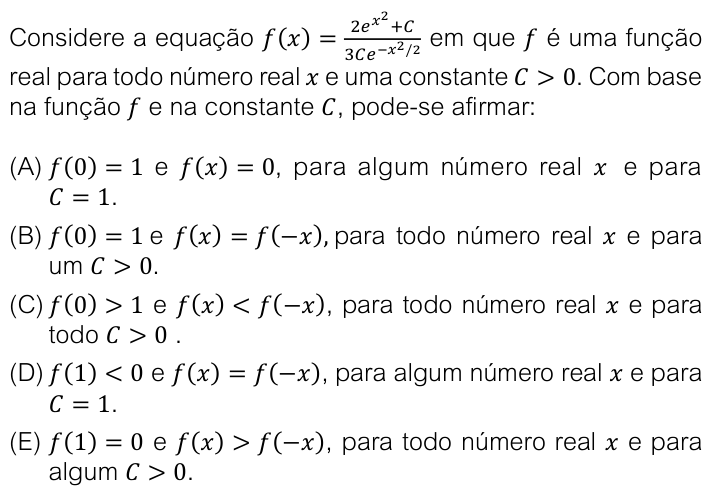
Substituindo x=0, obtemos
f(0)=\frac{2e^0+C}{3Ce^0}=\frac{2+C}{3C}.
Assim, f(0)=1 quando
2+C=3C \;\Longrightarrow\; C=1,
que satisfaz C>0.
Além disso, como x aparece apenas ao quadrado,
f(-x)=\frac{2e^{(-x)^2}+C}{3Ce^{-(-x)^2/2}}
=\frac{2e^{x^2}+C}{3Ce^{-x^2/2}}=f(x).
Portanto, f é uma função par para qualquer C>0. Em particular, para C=1, temos simultaneamente f(0)=1 e f(x)=f(-x) para todo real x, como afirma a alternativa B.
Resposta: B
Respondeu
levou 5 s
Como pensou
**Clarifying the equation**
I need to carefully read the equation, focusing on the numerator \(2e^{x^2} + C\) and the denominator \(3Ce^{-x^2/2}\). I'm confirming that the denominator is \(3Ce^{-x^2/2}\) and ensuring the numerator matches. At \(x=0\), the function simplifies to \(\frac{2+C}{3C}\), which equals \(1\) when \(C=1\). I need to explain that if \(C>0\), the function is always positive, reinforcing that \(f(1)>0\). I'll keep it concise.
A função é
f(x)=\frac{2e^{x^2}+C}{3Ce^{-x^2/2}},\qquad C>0.
Como x aparece apenas ao quadrado, temos
f(-x)=f(x)
para todo x\in\mathbb R. Portanto, f é uma função par.
Além disso,
f(0)=\frac{2+C}{3C}.
Para que f(0)=1, devemos ter
2+C=3C\quad\Longrightarrow\quad C=1,
que satisfaz C>0. Assim, existe um valor positivo de C para o qual as duas afirmações da alternativa B são verdadeiras.
Observe também que numerador e denominador são sempre positivos; logo, f(x)>0 para todo real x, descartando as afirmações de que a função se anula ou assume valor negativo.
Resposta: B
Respondeu
levou 4 s
Como pensou
**Analyzing function properties**
I'm trying to understand the expression f(x) = (2 e^{x²} + C)/(3 C e^{-x²/2}) with the constraint that C > 0. When evaluating f(0), I find that it equals 1 if C equals 1. It looks like this function is even for all values of C, and I see that B stated f(0)=1 and f(x)=f(-x) for all real x when C > 0. It seems C must indeed be 1 for the equation to hold true.
Como a expressão de f(x) depende de x apenas por meio de x^2, temos f(x)=f(-x) para todo x real e todo C>0.
Além disso,
f(0)=\frac{2+C}{3C}.
Para que f(0)=1, deve-se ter 2+C=3C, ou seja, C=1, que satisfaz C>0.
Portanto, existe um valor de C>0 para o qual as duas condições da alternativa B são verdadeiras.
Resposta: B
Respondeu
levou 5 s
Como pensou
**Parsing a formula**
I need to simplify the given function f(x) = (2e^{x^2}+C)/(3C e^{-x^2/2}). The numerator is 2e^{x²}+C, and the denominator is 3C e^{-x²/2}. This function is even, meaning f(x) = f(-x). Evaluating f(0) gives (2+C)/(3C). For the function to be greater than 1, I find that C must be less than 1. I explore options A through D for solutions, but they have various issues.
Como C>0, o denominador 3Ce^{-x^2/2} é positivo. Além disso, a expressão depende de x apenas por meio de x^2, então f(x)=f(-x) para todo x\in\mathbb{R}.
Em x=0,
f(0)=\frac{2+C}{3C}.
Tomando C=1, obtemos f(0)=1. Portanto, a afirmação da alternativa B é verdadeira.
Resposta: B
Respondeu
levou 8 s
Como pensou
I'm checking f(0): plugging in x = 0 gives (2 + C)/(3C), which equals 1 only when C = 1. I also notice f depends only on x², so it's even, and since both numerator and denominator are positive, f(x) is never zero.
I'm now checking each remaining option: (A) fails because f(x) is never zero, (B) holds since f(0)=1 at C=1 and f is even, (C) is false because f(0)>1 only when C<1, and (D) and (E) both fail. So the answer is B.
Análise da função
f(x)=\frac{2e^{x^2}+C}{3C\,e^{-x^2/2}}
-
Sinal: o numerador 2e^{x^2}+C>0 e o denominador 3Ce^{-x^2/2}>0 (pois C>0). Logo f(x)>0 para todo x real — a função nunca se anula nem fica negativa. Isso elimina (A) (f(x)=0), (D) (f(1)<0) e (E) (f(1)=0).
-
Paridade: a função depende de x apenas por meio de x^2, então f(-x)=f(x) para todo x real (função par). Isso elimina (C) e (E), que afirmam desigualdades estritas entre f(x) e f(-x).
-
Valor em 0: f(0)=\dfrac{2+C}{3C}. Temos f(0)=1 \iff 2+C=3C \iff C=1, que é um valor válido (C>0). Note que f(0)>1 só ocorre para C<1, não para todo C>0, o que também confirma a falsidade de (C).
Conclusão: para C=1 (um C>0), f(0)=1, e f(x)=f(-x) para todo x real.
Resposta: B
Respondeu
levou 7 s
Como pensou
I'm checking the candidate statements: the function is even and positive for C=1, which makes the claim that it reaches zero false, while the claim that C=1 gives f(0)=1 and evenness holds is true. I'm now starting on the third statement about f(0).
I'm ruling out the rest of the candidates: statement (C) fails because f(0) can't exceed 1 for every C, and (D) and (E) are both false since f(1) is never negative.
Resposta: B
Expressão da função:
f(x)=\frac{2e^{x^2}+C}{3C\,e^{-x^2/2}}
Duas propriedades de f:
- f é par. A variável x só aparece em x^2. Logo f(x)=f(-x) para todo x real e qualquer C.
- f é sempre positiva. Com C>0, o numerador 2e^{x^2}+C é positivo e o denominador 3Ce^{-x^2/2} também. Portanto f(x)>0 para todo x.
Valor em zero:
f(0)=\frac{2+C}{3C}
Temos
f(0)=1 quando
2+C=3C, ou seja, quando
C=1.
Análise das alternativas:
- (A) Falsa. Mesmo com f(0)=1 para C=1, a função nunca se anula, porque é sempre positiva.
- (B) Verdadeira. Com C=1, temos f(0)=1. Além disso, f(x)=f(-x) para todo x, pois f é par.
- (C) Falsa. Se f(x)<f(-x) para todo x, então em x=0 teríamos f(0)<f(0), o que é impossível. A função é par. Também não vale f(0)>1 para todo C: com C=1, f(0)=1.
- (D) Falsa. f(1) é positivo, e não negativo.
- (E) Falsa. f(1)\neq 0, e f(x)>f(-x) contradiz a paridade.
Resposta: B
Respondeu
levou 3 s
Como pensou
A função é f(x) = (2e^{x²} + C) / (3C e^{−x²/2}), com C > 0.
Paridade: f depende apenas de x², portanto f(x) = f(−x) para todo x real e todo C > 0. Isso elimina as alternativas C e E, que afirmam f(x) < f(−x) e f(x) > f(−x).
Valor em 0: f(0) = (2 + C)/(3C).
- f(0) = 1 quando 2 + C = 3C, isto é, C = 1.
- Logo, f(0) = 1 só vale para C = 1, e não para qualquer C.
Análise das alternativas:
- (A) Afirma f(x) = 0 para algum x. Como o numerador 2e^{x²} + C é sempre positivo, f(x) > 0 e nunca se anula. Falsa.
- (B) Afirma f(0) = 1 e f(x) = f(−x) para todo x e para um certo C > 0. Com C = 1, f(0) = 1, e a simetria vale para todo x. Verdadeira.
- (D) Afirma f(1) < 0. Como f > 0 sempre, é falsa.
Resposta: B
Respondeu
levou 24 s
Como pensou
I need to solve a Portuguese problem from the 2027 FUVEST exam.
I simplified the function to a sum of exponential terms. The expression is now written as f(x) = (2/3C)e^(3x²/2) + (1/3)e^(x²/2).
I verified that f(x) is always positive for real x and C > 0. I checked option (A): f(0) = 1 when C = 1, but f(x) never equals zero, so the statement is false.
I checked option (B). The condition f(0) = 1 implies C = 1. Since the function depends only on x², it is even and satisfies f(x) = f(-x) for all real x. Both parts are true for C = 1 > 0.
Options (C), (D), and (E) are all false. f(0) can be greater than or less than 1 depending on C. f(1) is always positive, so it never equals zero. The function is even, so f(x) cannot be less than f(-x) for any x.
A função pode ser reescrita como
f(x)=\frac{2}{3C}\exp\Bigl(\frac{3x^2}{2}\Bigr)+\frac13\exp\Bigl(\frac{x^2}{2}\Bigr).
Como C>0 e as exponenciais são sempre positivas, tem-se f(x)>0 para todo x\in\mathbb{R}. Além disso, a expressão depende apenas de x^2, logo f é par: f(x)=f(-x) para todo x e todo C>0.
Em particular,
f(0)=\frac{2+C}{3C}.
A igualdade f(0)=1 ocorre se e somente se C=1. Portanto existe C>0 (a saber, C=1) tal que f(0)=1 e f(x)=f(-x) para todo x\in\mathbb{R}, o que mostra que (B) é verdadeira.
As demais alternativas são falsas: f nunca se anula nem assume valores negativos, e a desigualdade estrita f(x)<f(-x) (ou >) jamais ocorre.
Resposta: B
Respondeu
levou 13 s
Como pensou
We need solve. Need parse function image: f(x) = (2 e^{x^2} + C) / (3 C e^{-x^2/2})? Let's inspect. Text: \frac{2e^{x^2}+C}{3Ce^{-x^2/2}} yes likely denominator 3 C e^{-x^2/2}. C>0. Need statements.
Simplify f(x) = [2 e^{x^2}+ C]/(3 C e^{-x^2/2}) = (1/(3C)) (2 e^{x^2}+C) e^{x^2/2} = (1/(3C)) (2 e^{3x^2/2}+ C e^{x^2/2}). Positive for all x? Numerator positive; denominator positive. So f>0 always. f(0) = (2+C)/(3C e^0)= (2+C)/(3C)=1/3 + 2/(3C). Is f(0)=1 when? (2+C)/(3C)=1 =>2+C=3C=>2=2C=>C=1. Good.
Check evenness: f(-x)=f(x) because x^2. Yes for all x, any C>0. Option B says f(0)=1 and f(x)=f(-x) for all x and for some C>0? Wording: "(B) f(0)=1 e f(x)=f(-x), para todo x e para um C>0." But f(0)=1 is not for all C; maybe condition: fixed C? Question: "Com base na função f e na constante C, pode-se afirmar:" alternatives include "para um C>0" maybe means there exists C? Need parse. B says f(0)=1 e ... para todo x e para um C>0. That would be false globally: f(0)=1 only for C=1, but f even regardless. Could mean "para C=1"? Let's examine options.
(A) f(0)=1 e f(x)=0, para algum x real e para C=1.
For C=1, f(0)=? (2+1)/(3*1)=1 yes. f(x)=0 for some real? Numerator 2e^{x^2}+1 >0, denominator positive, no. False.
(B) f(0)=1 e f(x)=f(-x), para todo x e para um C>0. Hmm if "para um C>0" maybe means "for some C>0" not for all. There exists C? For C=1 f(0)=1 and f even all x. So true if existential. But if "for a given C>0" maybe false because f(0) not necessarily 1. Wording "para um C > 0" likely in Portuguese: "for a C>0" can mean for a certain C, i.e. exists. Could be correct? But options include C.
(C) f(0)>1 e f(x)<f(-x), para todo x e para todo C>0. f(0) = 1/3+2/(3C). Is >1? For C<1? Not all C. False. f(x)<f(-x) impossible because equal. False.
(D) f(1)<0 e f(x)=f(-x), para algum x e para C=1. f positive; false.
(E) f(1)=0 e f(x)>f(-x), para todo x e para algum C>0. f positive, no; even not >. False.
Thus only plausible B if interpreted as ∃C>0 (C=1) such that f(0)=1 and evenness. But need be careful: alternate C could be false, then no correct? Let's re-evaluate. Maybe denominator is 3 C e^{-x^2/2}? yes. f(0) = (2 + C)/(3C). Option C f(0)>1 for all C>0? Actually f(0)>1 iff 1/3+2/(3C)>1 iff 2/(3C)>2/3 iff 1/C >1 iff C<1. Not all. false. f(x)<f(-x) false.
B says f(0)=1 and f(x)=f(-x), for all real x and for a C>0. If "para um C>0" = for some C, then need choose C such that f(0)=1 and evenness. C=1. True. It's the only possible.
But maybe there is nuance: The statement may mean "for every C>0" but uses "para um C >0" in alternatives B and E meaning "for a C>0" (some). Option B: "f(0)=1 e f(x)=f(-x), para todo número real x e para um C>0." This can be read: There exists a positive C such that both properties hold for all x. Since f(0)=1 only when C=1, but phrase "para um C>0" may be the quantifier. So answer B.
Need explain. Could also derive f even. Need perhaps mention C=1 satisfies f(0)=1. Let's write in Portuguese concise. Need final line exactly Resposta: B.
But let's fully reason maybe check if any other weird: The function:
f(x) = \frac{2e^{x^2}+C}{3Ce^{-x^2/2}}. Since C>0, denominator positive. f even. f(0) = (2+C)/(3C). Setting =1 gives C=1. Therefore alternative B. It says "para um C>0" i.e. existe C>0; C=1. For all C, f even but f(0) not always. If question intended "para um C >0" could mean "for a given C" not exist? But alternatives: (A) "e para C=1" (specific); B "para um C>0" (exists); C "para todo C>0"; D "para C=1"; E "para algum C>0". Yes contrast indicates B/E existential. E has f(1)=0 impossible. So B.
Need answer in Portuguese. Maybe note f(x)>0 all x so A D E false; f even so C false; B. We can mention f(0)=1 when C=1. If B says f(0)=1 and evenness, yes because take C=1. Need maybe mention "escolhendo C=1".
Need final line.
A função é
f(x)=\frac{2e^{x^2}+C}{3Ce^{-x^2/2}}.
Como aparece apenas x^2, temos:
f(-x)=\frac{2e^{(-x)^2}+C}{3Ce^{-(-x)^2/2}}
=\frac{2e^{x^2}+C}{3Ce^{-x^2/2}}=f(x).
Logo, f é uma função par para todo C>0.
Para x=0:
f(0)=\frac{2e^0+C}{3Ce^0}
=\frac{2+C}{3C}.
Queremos f(0)=1. Então:
\frac{2+C}{3C}=1 \iff 2+C=3C \iff C=1.
Assim, existe C>0 — a saber, C=1 — para o qual f(0)=1, e além disso f(x)=f(-x) para todo real x. Portanto, a alternativa correta é a B.
Resposta: B
Respondeu
levou 11 s
Como pensou
**Analyzing Function Properties**
I'm currently working through the provided equation, focusing on understanding the conditions for $f(x)$ to be a real-valued function for all real $x$. My attention is specifically on how the constant $C > 0$ influences this.
**Confirming Even Function**
I've confirmed that the function $f(x)$ is indeed an even function for all real $x$ and any $C > 0$, as $f(x) = f(-x)$. This significantly narrows down the possibilities.
**Evaluating $f(0)$**
I've calculated $f(0)$ to be $\frac{2+C}{3C}$. I then tested $C=1$, which yields $f(0)=1$. This aligns perfectly with one of the key conditions presented.
**Validating Condition B**
Based on the previous steps, I've determined that condition (B) is satisfied when $C=1$, as it requires $f(0)=1$ and $f(x)=f(-x)$ for all real $x$, both of which I've demonstrated.
**Investigating Option B**
I've now focused on confirming option (B). My analysis shows that $f(0) = 1$ specifically requires $C=1$. Crucially, $f(x) = f(-x)$ holds true for all real $x$ due to the $x^2$ term. Thus, option (B) is indeed satisfied.
Para analisar as alternativas, vamos examinar as propriedades da função dada:
f(x) = \frac{2e^{x^2} + C}{3Ce^{-x^2/2}}
com C > 0.
-
Paridade da função:
Como a variável x aparece apenas elevada ao quadrado (x^2 = (-x)^2), temos:
f(-x) = \frac{2e^{(-x)^2} + C}{3Ce^{-(-x)^2/2}} = \frac{2e^{x^2} + C}{3Ce^{-x^2/2}} = f(x)
Portanto, f(x) = f(-x) para todo x \in \mathbb{R} e qualquer C > 0 (a função é par). Isso já elimina as alternativas (C) e (E).
-
Sinal da função:
Como e^u > 0 para qualquer expoente real u, e sendo C > 0:
- O numerador 2e^{x^2} + C é estritamente positivo para todo x \in \mathbb{R}.
- O denominador 3Ce^{-x^2/2} também é estritamente positivo para todo x \in \mathbb{R}.
Logo, f(x) > 0 para todo x \in \mathbb{R}. Isso torna falsas as alternativas (A) (pois f(x) nunca se anula) e (D) (pois f(1) > 0).
-
Cálculo de f(0):
f(0) = \frac{2e^0 + C}{3Ce^0} = \frac{2 + C}{3C}
Para que f(0) = 1:
\frac{2 + C}{3C} = 1 \implies 2 + C = 3C \implies 2C = 2 \implies C = 1
Como C = 1 > 0, existe um valor de C > 0 para o qual f(0) = 1 e, simultaneamente, f(x) = f(-x) para todo x \in \mathbb{R}.
Portanto, a alternativa correta é a B.
Resposta: B
Respondeu
levou 23 s
Como pensou
**Analyzing Exam Question**
I'm currently reviewing the initial details of a math problem from a Brazilian exam, specifically FUVEST. My immediate focus is to thoroughly understand the given equation and the context of the problem as presented in the image.
**Confirming Function's Evenness**
I've confirmed that the function is indeed even, meaning $f(x) = f(-x)$ for all real numbers. This simplifies the problem significantly, allowing me to discard options (C) and (E) right away. My next step is to examine the other conditions.
**Proving Function Properties**
I've thoroughly investigated the positivity of the function, confirming it's always greater than zero when $C>0$. This has allowed me to definitively rule out options (A), (D), and (E). My next crucial step was evaluating $f(0)$ and solving for $C$ to satisfy the condition $f(0)=1$.
Para analisar as afirmações sobre a função f(x) = \frac{2e^{x^2} + C}{3Ce^{-x^2/2}}, com x \in \mathbb{R} e C > 0, vamos verificar algumas de suas propriedades fundamentais:
-
Paridade da função:
Notamos que a variável x aparece na expressão apenas elevada ao quadrado (x^2). Como (-x)^2 = x^2 para todo número real x, temos que:
f(-x) = \frac{2e^{(-x)^2} + C}{3Ce^{-(-x)^2/2}} = \frac{2e^{x^2} + C}{3Ce^{-x^2/2}} = f(x)
Portanto, f é uma função par, ou seja, f(x) = f(-x) para todo número real x e para qualquer C > 0. Isso já elimina as alternativas (C) e (E).
-
Sinal da função:
A função exponencial e^u é estritamente positiva para qualquer expoente real u. Assim, e^{x^2} > 0 e e^{-x^2/2} > 0. Como o enunciado define C > 0, tanto o numerador (2e^{x^2} + C) quanto o denominador (3Ce^{-x^2/2}) são estritamente positivos para qualquer valor de x.
Logo, f(x) > 0 para todo x \in \mathbb{R}. Isso significa que a função nunca se anula e nunca assume valores negativos, o que elimina a alternativa (A) (pois afirma que f(x) = 0) e a alternativa (D) (pois afirma que f(1) < 0).
-
Valor de f(0):
Substituindo x = 0 na função, sabendo que e^0 = 1, obtemos:
f(0) = \frac{2e^{0^2} + C}{3Ce^{-0^2/2}} = \frac{2\cdot 1 + C}{3C\cdot 1} = \frac{2 + C}{3C}
Para que tenhamos f(0) = 1, basta que:
\frac{2 + C}{3C} = 1 \implies 2 + C = 3C \implies 2C = 2 \implies C = 1
Como C = 1 > 0, existe um valor positivo para a constante C que satisfaz f(0) = 1.
Dessa forma, a única afirmação correta é a da alternativa (B).
Resposta: B