PRÁTICA COM QUESTÕES OFICIAIS
Questão 2 da UFPR 2022 (inglês)
The following text refers to questions 01 to 03. · Fase única
The surprising history of India’s vibrant sari tradition
South Asian women have draped themselves in colorful silks and cottons for eons. The ways they’re made and worn are dazzling and diverse.
The word “sari” means “strip of cloth” in Sanskrit. But for the Indian women – and a few men – who have been wrapping themselves in silk, cotton, or linen for millennia, these swaths of fabric are more than just simple garments. They’re symbols of national pride, ambassadors for traditional (and cutting-edge) design and craftsmanship, and a prime example of the rich differences in India’s 29 states.
“The sari both as symbol and reality has filled the imagination of the subcontinent, with its appeal and its ability to conceal and reveal the personality of the person wearing it,” says Delhi-based textile historian Rta Kapur Chishti, author of Saris of India: Tradition and Beyond and co-founder of Taanbaan, a fabric company devoted to reviving and preserving traditional Indian spinning and weaving methods.
The first mention of saris (alternately spelled sarees) is in the Rig Veda, a Hindu book of hymns dating to 3,000 B.C.; draped garments show up on Indian sculptures from the first through sixth centuries, too. What Delhi-based textile historian Rta Kapur Chishti calls the “magical unstitched garment” is ideally suited to India’s blazingly hot climate and the modest-dress customs of both Hindu and Muslim communities. Saris also remain traditional for women in other South Asian countries including Pakistan, Bangladesh, and Nepal.
(Available in: https://www.nationalgeographic.com/travel/photography/the-story-of-the-sari-in-india/.)
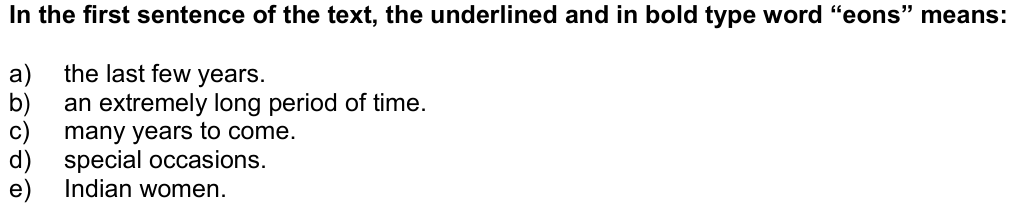
In the first sentence of the text, the underlined and in bold type word “eons” means:
- Athe last few years.
- Ban extremely long period of time.
- Cmany years to come.
- Dspecial occasions.
- EIndian women.
Reportar erro na questão
Resolução comentada
"Eons" (também escrito "aeons") é um substantivo que designa períodos de tempo enormes, de milhões ou bilhões de anos. Na linguagem do dia a dia, é usado de modo exagerado para dizer "desde tempos imemoriais" ou "há uma eternidade".
Veja como o texto ajuda a confirmar isso:
- A primeira frase diz que as mulheres do sul da Ásia se vestem com sedas e algodões coloridos "for eons", isto é, "por eras".
- O segundo parágrafo reforça a ideia ao dizer que as mulheres usam o sári há "millennia" (milênios).
- O terceiro parágrafo lembra que o primeiro registro do sári está no Rig Veda, de cerca de 3.000 a.C.
Todas essas pistas apontam para um passado muito distante e uma tradição antiquíssima. Logo, "eons" quer dizer "um período de tempo extremamente longo", que em inglês é an extremely long period of time.
Alternativa B.
Por que as outras alternativas estão erradas
- A"The last few years" indica passado recente, o oposto da ideia de milênios de tradição apresentada no texto.
- C"Many years to come" aponta para o futuro, mas o verbo está no perfeito ("have draped") e o texto fala do passado.
- D"Special occasions" (ocasiões especiais) não tem relação com a palavra e o texto não trata de ocasiões.
- E"Indian women" confunde a palavra com o sujeito da frase ("South Asian women"); "eons" indica tempo, não pessoas.
Assuntos: vocabulário em contexto, interpretação de texto em inglês.
Reportar erro na resolução
Ver como caiu na prova
Fonte: UFPR 2022 · Fase única. Prova oficial ↗