PRÁTICA COM QUESTÕES OFICIAIS
Questão 73 da UFPR 2018 (inglês)
O texto a seguir é referência para as questões 73 e 74. · 1ª fase
The ways Mexicans tell time
Understanding this takes not a fluency in the language but rather a fluency in Mexican culture.
Mexicans are famous in the Spanish-speaking world for their extensive use of the diminutive. While in most Spanish-speaking countries the addition of the diminutive ‘ita’ to an adverb like ahora (meaning ‘now’) would strengthen it to indicate immediacy (i.e. ‘right now’), this is not the case in Mexico. Dr Company explained that Mexicans instead use the diminutive form to break down the space between the speaker and the listener and lessen formality. In this case of ‘ahorita’, the addition of the diminutive reduces urgency rather than increasing it – a difference that can be extremely confusing for foreigners.
(Disponível: <http://www.bbc.com/travel/story/20170725-the-confusing-way-mexicans-tell-time>. Adaptado. Acesso: 26 de julho de 2017.)
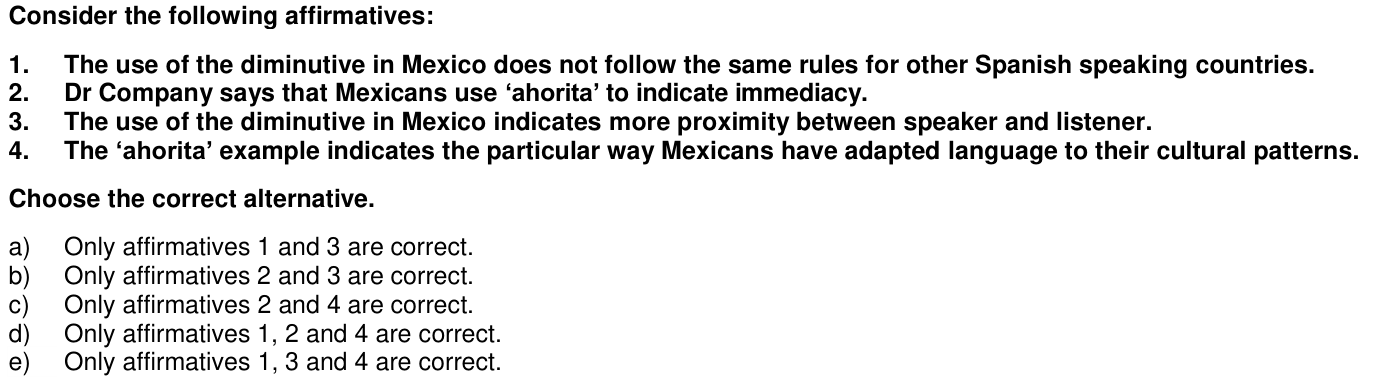
Consider the following affirmatives:
- The use of the diminutive in Mexico does not follow the same rules for other Spanish speaking countries.
- Dr Company says that Mexicans use ‘ahorita’ to indicate immediacy.
- The use of the diminutive in Mexico indicates more proximity between speaker and listener.
- The ‘ahorita’ example indicates the particular way Mexicans have adapted language to their cultural patterns.
Choose the correct alternative.
- AOnly affirmatives 1 and 3 are correct.
- BOnly affirmatives 2 and 3 are correct.
- COnly affirmatives 2 and 4 are correct.
- DOnly affirmatives 1, 2 and 4 are correct.
- EOnly affirmatives 1, 3 and 4 are correct.
Você já respondeu questões neste aparelho. Crie sua conta grátis para guardar o histórico e refazer as que errou.
Resposta salva no seu histórico.
Reportar erro na questão
Resolução comentada
Vamos checar cada afirmativa com o que o texto diz.
1. Correta. O texto afirma que na maioria dos países de língua espanhola o diminutivo "-ita" em ahora reforça a ideia de imediatismo ("right now"), mas "this is not the case in Mexico". Ou seja, o México não segue a mesma regra.
2. Incorreta. Segundo a Dra. Company, os mexicanos usam o diminutivo para reduzir a formalidade e a urgência. Indicar imediatismo é o uso dos outros países, não o do México.
3. Correta. O diminutivo serve para "break down the space between the speaker and the listener", isto é, diminuir a distância entre quem fala e quem ouve, o que indica mais proximidade.
4. Correta. O subtítulo diz que entender isso exige fluência na cultura mexicana, não só na língua. "Ahorita" é o exemplo de como o idioma foi adaptado aos padrões culturais do país.
As corretas são 1, 3 e 4.
Alternativa E.
Pegadinha: A afirmativa 2 engana ao atribuir à Dra. Company o sentido de imediatismo, que é o uso dos outros países e não o do México.
Por que as outras alternativas estão erradas
- AOmite a afirmativa 4, que também está correta: o exemplo de 'ahorita' mostra a adaptação cultural da língua.
- BInclui a 2, falsa: no México 'ahorita' reduz a urgência, não indica imediatismo.
- CInclui a 2, falsa, e deixa de fora as corretas 1 e 3.
- DInclui a 2, falsa, e deixa de fora a correta 3.
Assunto: Informações explícitas e detalhes.
Reportar erro na resolução
Ver como caiu na prova
Fonte: UFPR 2018 · 1ª fase. Prova oficial ↗