PRÁTICA COM QUESTÕES OFICIAIS
Questão 76 da UFPR 2013 (inglês)
Are these statements true (T) or false (F), according to the text?
( ) Armstrong had recently turned eighty-two years old when he died.
( ) Armstrong died due to complications from cardiovascular surgery.
( ) Armstrong had a heart-bypass surgery in the beginning of the year.
( ) Armstrong’s heart problems occurred because he was an astronaut.
( ) Armstrong’s heart had some blocked arteries that had to be relieved.
Mark the alternative which presents the correct sequence, from top to bottom.
Teen Googles his way to new cancer testing method
by Lauren O'Neil
Posted: August 24, 2012 3:30 PM
Last Updated: August 24, 2012 4:48 PM
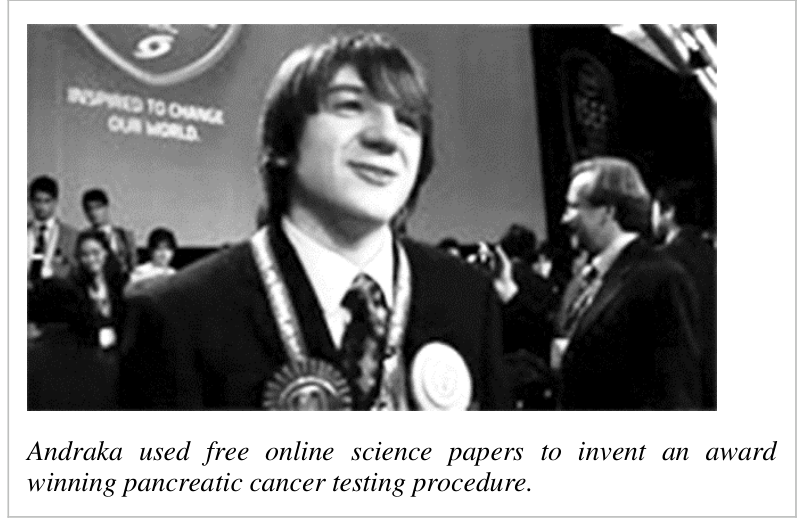
Fifteen-year-old high school student Jack Andraka likes to kayak and watch the US television show Glee. And when time permits, he also likes to do advanced research in one of the most respected cancer laboratories in the world.
Jack Andraka took home top science fair honours this year for the development of a cancer-testing method found to be 168 times faster, 26,000 times cheaper and 400 times more sensitive than the current gold-medal standard. His work was impressive enough to earn the Maryland high school student a total of $100,500 in grants and prizes at the 2012 Intel Science Fair.
Even more impressive is the source he credits for much of his success: Google. "I definitely could not have done this research and project without the use of the internet", Andraka told BBC News in an interview published this week. "I basically went to Google and was looking up cancer statistics, also looking at a bunch of different documents on like, single-walled carbon nanotubes and pancreatic cancer biology", he told the BBC. He also said that the method he created detects “pancreatic cancer, ovarian cancer and lung cancer all in their early stages, where you have possibly a 50pc survival rate”.
Andraka was able to find enough information using search engines and free online science papers to invent his procedure, which is now being hailed as "revolutionary" by the American Cancer Society and science publications around the world. The test uses a method similar to that of a diabetic testing strip, with a dipstick sensor that can test either blood or urine for the presence of mesothelin in the body – a chemical known to be a biomarker for early-stage pancreatic cancer. As Forbes reports, this method could also affect how other types of cancer are diagnosed and treated in the future.
Andraka has filed for a patent for his work with the help of lawyers from Johns Hopkins University, where he conducted his tests for the project. Pathology professor Dr. Anirban Maitra was the only doctor out of 200 that Andraka had contacted to give the eager young student lab access at Johns Hopkins to conduct his science fair project. "You're going to read about him a lot in the years to come", Dr. Maitra told the Baltimore Sun in May. "What I tell my lab is, 'Think of Thomas Edison and the light bulb'. This kid is the Edison of our times. There are going to be a lot of light bulbs coming from him".
(Adapted from http://www.cbc.ca/news/yourcommunity/2012/08/teen-googles-his-way-to-new-cancer-testing-method.html and http://www.bbc.co.uk/news/magazine-19291258)
- AT – F – F – T – T.
- BF – T – F – T – F.
- CF – T – T – F – F.
- DT – T – F – F – T.
- ET – F – T – T – F.
Reportar erro na questão
Resolução comentada
As cinco afirmações falam de Neil Armstrong (82 anos, cirurgia cardíaca), mas o texto fornecido trata de Jack Andraka, um estudante de 15 anos que desenvolveu um teste de câncer. Nenhuma das afirmações pode ser conferida nesse texto: ele parece ser de outra prova, ou o texto correto (sobre a morte de Armstrong) não veio com a questão.
Para resolver, uso o que se sabe sobre Armstrong, que morreu em 25/08/2012, aos 82 anos (nasceu em 5/08/1930). A notícia original dizia que ele fez uma cirurgia de ponte de safena (bypass) para aliviar artérias coronárias bloqueadas, que morreu por complicações após essa cirurgia, e que o problema cardíaco não tinha relação com a carreira de astronauta.
- Tinha acabado de fazer 82 anos: T.
- Morreu por complicações da cirurgia cardiovascular: T.
- Bypass "no início do ano": a cirurgia foi em agosto, poucos dias antes da morte, então F.
- Problemas cardíacos por ser astronauta: F.
- Artérias bloqueadas que precisavam ser aliviadas: T.
Sequência: T – T – F – F – T.
Alternativa D.
Pegadinha: A afirmação 3 engana: o bypass foi feito poucos dias antes da morte, em agosto, e não no início do ano. Além disso, o texto colado não corresponde às afirmações.
Por que as outras alternativas estão erradas
- AMarca como falsa a morte por complicações da cirurgia e como verdadeira a ligação com a profissão de astronauta.
- BDiz que ele não tinha 82 anos e liga o problema cardíaco à carreira de astronauta.
- CNega a idade de 82 anos e aceita que o bypass foi no início do ano.
- ENega a morte por complicações cirúrgicas, aceita o bypass no início do ano e liga o problema à profissão de astronauta.
Assunto: Informações explícitas e detalhes.
Reportar erro na resolução
Ver como caiu na prova
Fonte: UFPR 2013 · 1ª fase. Prova oficial ↗