PRÁTICA COM QUESTÕES OFICIAIS
Questão 75 da UFPR 2013 (inglês)
Texto-base das questões 73 a 76 · 1ª fase
Neil Armstrong, US astronaut, dies aged 82
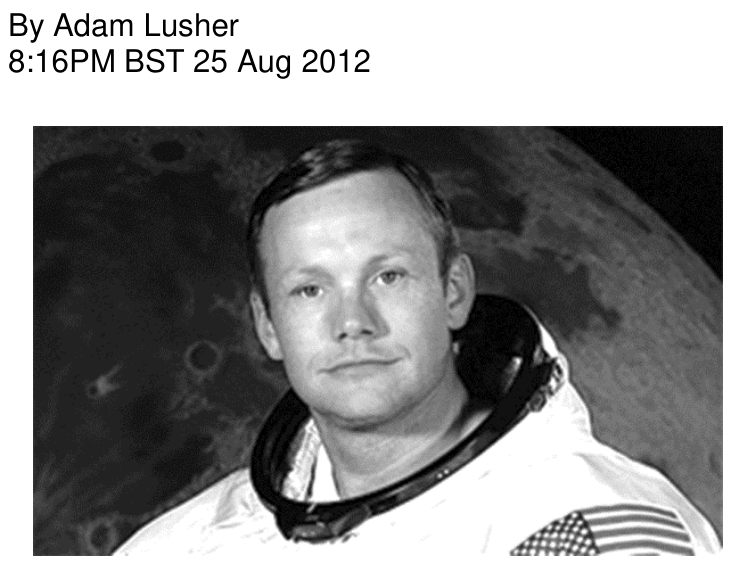
Armstrong underwent a heart-bypass surgery earlier this month to relieve blocked coronary arteries.
As commander of the Apollo 11 mission, Armstrong became the first human to set foot on the moon, hours after Apollo's Eagle lunar module had touched down on July 20 1969. He radioed back to Earth the historic statement: "That's one small step for man, one giant leap for mankind". He then spent nearly three hours walking on the moon with fellow astronaut Edwin "Buzz" Aldrin.
Praising Armstrong his family said in a statement on Saturday: “Neil was our loving husband, father, grandfather, brother and friend. Neil Armstrong was also a reluctant American hero who always believed he was just doing his job. He served his Nation proudly, as a navy fighter pilot, test pilot, and astronaut". The statement also said that he died following complications resulting from cardiovascular procedures, at the age of 82.
Armstrong was born in Wapakoneta, Ohio, on August 5, 1930. On July 20, 1936, when he was 6, he experienced his first airplane flight in Warren, Ohio, when he and his father Stephen, an auditor for the Ohio state government, took a ride in a Ford Trimotor, a three-engined transport plane that was also known as the "Tin Goose".
After serving as a naval pilot from 1949 to 1952, and serving in the Korean War, Armstrong joined the National Advisory Committee for Aeronautics (NACA) – the precursor to NASA, the National Aeronautics and Space Administration – in 1955. As a research pilot at NASA's Flight Research Center, Edwards, Calif., he was a project pilot on many pioneering high speed aircraft, including the well-known, 4000-mph X-15.
Armstrong joined the NASA astronaut corps in 1962. He was assigned as command pilot for the Gemini 8 mission. Gemini 8 was launched on March 16, 1966, and Armstrong performed the first successful manned docking of two vehicles in space. His second and last spaceflight was as mission commander for the Apollo 11 moon landing.
After commanding the Apollo 11 mission, Armstrong subsequently held the position of Deputy Associate Administrator for Aeronautics, NASA Headquarters, in Washington D.C. In this position, he was responsible for the coordination and management of overall NASA research and technology work related to aeronautics. He was Professor of Aerospace Engineering at the University of Cincinnati between 1971-1979.
Armstrong and his wife, Carol, married in 1999, made their home in the Cincinnati suburb of Indian Hill, but he had largely stayed out of public view in recent years. He spoke at Ohio State University during a February event honouring fellow astronaut John Glenn and the 50th anniversary of Glenn becoming the first American to orbit the Earth.
(Adapted from <www.telegraph.co.uk> and <http://www.telegraph.co.uk/science/space/9499759/Neil-Armstrong-US-astronaut-dies-aged-82.html>)
Which of these statements DOES NOT CORRESPOND to information given in the text about Neil Armstrong?
- AHe joined the National Advisory Committee for Aeronautics in 1955.
- BHis last spaceflight was his mission as the Apolo 11 commander.
- CHis first mission as an astronaut was as the command pilot for the Gemini 8.
- DHe was honoured for being the first American to orbit the Earth.
- EHe taught Aerospace Engineering at the University of Cincinnati.
Você já respondeu questões neste aparelho. Crie sua conta grátis para guardar o histórico e refazer as que errou.
Resposta salva no seu histórico.
Reportar erro na questão
Resolução comentada
A questão pede a afirmação que não corresponde ao texto, então é preciso conferir cada alternativa com o que está escrito.
- A: o texto diz que Armstrong entrou na NACA em 1955 ("joined the National Advisory Committee for Aeronautics (NACA) ... in 1955"). Confere.
- B: o texto diz "His second and last spaceflight was as mission commander for the Apollo 11". Confere.
- C: ele entrou no corpo de astronautas em 1962 e foi designado piloto de comando da Gemini 8, lançada em 1966, antes da Apollo 11. Foi sua primeira missão como astronauta. Confere.
- D: o último parágrafo diz que Armstrong falou num evento em homenagem a John Glenn, o primeiro americano a orbitar a Terra. Quem foi homenageado por isso foi Glenn, não Armstrong. Armstrong foi o primeiro humano a pisar na Lua. Não confere.
- E: ele foi "Professor of Aerospace Engineering at the University of Cincinnati" entre 1971 e 1979, ou seja, lecionou Engenharia Aeroespacial. Confere.
Portanto, a única afirmação sem respaldo no texto é a D.
Alternativa D.
Pegadinha: A alternativa D engana porque o texto cita o feito de John Glenn (primeiro americano a orbitar a Terra) no mesmo trecho em que fala de Armstrong, e o aluno atribui a homenagem a ele.
Por que as outras alternativas estão erradas
- AEstá de acordo com o texto, que diz que ele entrou na NACA em 1955.
- BEstá de acordo com o texto, que diz que a Apollo 11 foi sua segunda e última viagem espacial, como comandante.
- CEstá de acordo com o texto, pois a Gemini 8 (1966) foi a primeira missão dele como astronauta, com ele como piloto de comando.
- EEstá de acordo com o texto, que diz que ele foi professor de Engenharia Aeroespacial na Universidade de Cincinnati.
Assunto: Informações explícitas e detalhes.
Reportar erro na resolução
Ver como caiu na prova

Fonte: UFPR 2013 · 1ª fase. Prova oficial ↗