PRÁTICA COM QUESTÕES OFICIAIS
Questão 80 da UFPR 2011 (inglês)
O texto a seguir é referência para as questões 77 a 80. · 1ª fase
Germans make wonderful beer. Yet the productivity of the German beer industry is only 43 percent that of the U.S. beer industry. Meanwhile, the German metalworking and steel industries are equal in productivity to their American counterparts. Since the Germans are evidently capable of organizing industries well, why can’t they do so when it comes to beer?
It turns out that the German beer industry suffers from small-scale production. There are a thousand tiny beer companies in Germany, shielded from competition with one another because each German brewery has virtually a local monopoly, and they are also shielded from competition with imports. The United States has 67 major beer breweries, producing 23 billion liters of beer per year. All of Germany’s 1,000 breweries combined produce only half as much. Thus the average U.S. brewery produces 31 times more beer than the average German brewery.
This fact results from local tastes and German government policies. German beer drinkers are fiercely loyal to their local brand, so there are no national brands in Germany analogous to our Budweiser, Miller, or Coors. Instead, most German beer is consumed within 30 miles of the factory where it is brewed. Therefore, the German beer industry cannot profit from economies of scale. In the beer business, as in other businesses, production costs decrease greatly with scale. The bigger the refrigerating unit for making beer, and the longer the assembly line for filling bottles with beer, the lower the cost of manufacturing beer. Those tiny German beer companies are relatively inefficient. There’s no competition; there are just a thousand local monopolies.
The local beer loyalties of individual German drinkers are reinforced by German laws that make it hard for foreign beers to compete in the German market. The German government has so-called beer purity laws that specify exactly what can go into beer. Not surprisingly, those government purity specifications are based on what German breweries put into beer, and not what American, French, and Swedish breweries like to put into beer. Because of those laws, not much foreign beer gets exported to Germany, and because of inefficiency and high prices much less of that wonderful German beer than you would otherwise expect gets sold abroad. (Before you object that German Löwenbräu beer is widely available in the United States, please read the label on the next bottle of Löwenbräu that you drink here: it’s not produced in Germany but in North America, under license, in big factories with North American productivities and efficiencies of scale).
(Diamond, J. ,2005. Guns, Germs, and Steel. New York: Norton.)
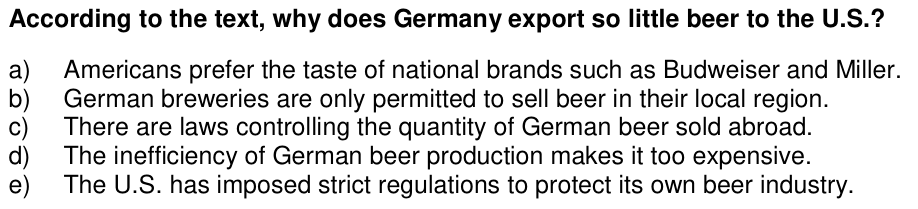
According to the text, why does Germany export so little beer to the U.S.?
- AAmericans prefer the taste of national brands such as Budweiser and Miller.
- BGerman breweries are only permitted to sell beer in their local region.
- CThere are laws controlling the quantity of German beer sold abroad.
- DThe inefficiency of German beer production makes it too expensive.
- EThe U.S. has imposed strict regulations to protect its own beer industry.
Reportar erro na questão
Resolução comentada
A pergunta é sobre a causa de a Alemanha exportar pouca cerveja. A resposta está no último parágrafo.
O trecho decisivo é: "because of inefficiency and high prices much less of that wonderful German beer than you would otherwise expect gets sold abroad". Em português: por causa da ineficiência e dos preços altos, muito menos cerveja alemã do que se esperaria é vendida no exterior.
O raciocínio do texto é este:
- As cervejarias alemãs são pequenas (cerca de mil) e não aproveitam economias de escala.
- Sem escala, o custo de produção fica alto.
- Custo alto significa preço alto, e isso reduz a exportação.
O texto também diz que as leis de pureza dificultam a entrada de cerveja estrangeira na Alemanha, mas isso afeta as importações, não as exportações para os EUA.
A alternativa que resume a causa apontada pelo texto é a que fala da ineficiência da produção alemã, que encarece a cerveja.
Alternativa D.
Pegadinha: A alternativa C engana porque o texto cita leis, mas elas atrapalham as importações alemãs, não as exportações.
Por que as outras alternativas estão erradas
- AA lealdade a marcas nacionais (Budweiser, Miller) é dos alemães às suas marcas locais; o texto não fala de americanos rejeitando a cerveja alemã.
- BO texto diz que as cervejarias têm monopólio local de fato, pelo gosto dos consumidores, e não por proibição legal de vender em outras regiões.
- CAs leis citadas (pureza) restringem a cerveja estrangeira na Alemanha, não limitam a quantidade exportada.
- EO texto não menciona regulações americanas protegendo a indústria local de cerveja.
Assunto: Informações explícitas e detalhes.
Reportar erro na resolução
Ver como caiu na prova
Fonte: UFPR 2011 · 1ª fase. Prova oficial ↗