PRÁTICA COM QUESTÕES OFICIAIS
Questão 79 da UFPR 2011 (inglês)
O texto a seguir é referência para as questões 77 a 80. · 1ª fase
Germans make wonderful beer. Yet the productivity of the German beer industry is only 43 percent that of the U.S. beer industry. Meanwhile, the German metalworking and steel industries are equal in productivity to their American counterparts. Since the Germans are evidently capable of organizing industries well, why can’t they do so when it comes to beer?
It turns out that the German beer industry suffers from small-scale production. There are a thousand tiny beer companies in Germany, shielded from competition with one another because each German brewery has virtually a local monopoly, and they are also shielded from competition with imports. The United States has 67 major beer breweries, producing 23 billion liters of beer per year. All of Germany’s 1,000 breweries combined produce only half as much. Thus the average U.S. brewery produces 31 times more beer than the average German brewery.
This fact results from local tastes and German government policies. German beer drinkers are fiercely loyal to their local brand, so there are no national brands in Germany analogous to our Budweiser, Miller, or Coors. Instead, most German beer is consumed within 30 miles of the factory where it is brewed. Therefore, the German beer industry cannot profit from economies of scale. In the beer business, as in other businesses, production costs decrease greatly with scale. The bigger the refrigerating unit for making beer, and the longer the assembly line for filling bottles with beer, the lower the cost of manufacturing beer. Those tiny German beer companies are relatively inefficient. There’s no competition; there are just a thousand local monopolies.
The local beer loyalties of individual German drinkers are reinforced by German laws that make it hard for foreign beers to compete in the German market. The German government has so-called beer purity laws that specify exactly what can go into beer. Not surprisingly, those government purity specifications are based on what German breweries put into beer, and not what American, French, and Swedish breweries like to put into beer. Because of those laws, not much foreign beer gets exported to Germany, and because of inefficiency and high prices much less of that wonderful German beer than you would otherwise expect gets sold abroad. (Before you object that German Löwenbräu beer is widely available in the United States, please read the label on the next bottle of Löwenbräu that you drink here: it’s not produced in Germany but in North America, under license, in big factories with North American productivities and efficiencies of scale).
(Diamond, J. ,2005. Guns, Germs, and Steel. New York: Norton.)
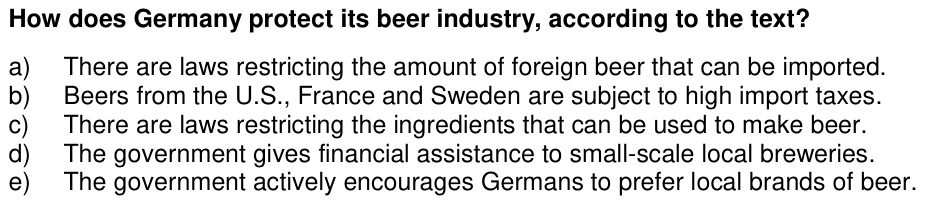
How does Germany protect its beer industry, according to the text?
- AThere are laws restricting the amount of foreign beer that can be imported.
- BBeers from the U.S., France and Sweden are subject to high import taxes.
- CThere are laws restricting the ingredients that can be used to make beer.
- DThe government gives financial assistance to small-scale local breweries.
- EThe government actively encourages Germans to prefer local brands of beer.
Reportar erro na questão
Resolução comentada
A pergunta é: como a Alemanha protege sua indústria cervejeira, segundo o texto? A resposta está no último parágrafo.
Lá o autor diz que a lealdade local dos bebedores é reforçada por leis que dificultam a concorrência das cervejas estrangeiras. Qual é essa lei? As beer purity laws, que "specify exactly what can go into beer" (especificam exatamente o que pode entrar na cerveja).
O texto explica o efeito: essas especificações se baseiam no que as cervejarias alemãs usam, e não no que as cervejarias americanas, francesas e suecas costumam usar. Ou seja, a barreira é a regra sobre os ingredientes, e não uma cota de importação nem um imposto.
Conferindo as demais:
- Não há menção a limite de quantidade importada, nem a taxas de importação.
- Não se fala em ajuda financeira do governo às cervejarias pequenas; o texto atribui o tamanho reduzido ao gosto local e à falta de concorrência.
- A preferência pela marca local vem dos próprios consumidores (local tastes), e o governo não faz campanha para isso.
Portanto, a proteção é feita pelas leis que restringem os ingredientes permitidos.
Alternativa C.
Pegadinha: A engana por parecer a consequência das leis (pouca cerveja estrangeira entra), mas o texto cita como mecanismo a regulação dos ingredientes, não um limite de importação.
Por que as outras alternativas estão erradas
- AO texto não fala em limite de quantidade importada; a barreira são as regras sobre o que pode conter a cerveja.
- BNão há referência a impostos de importação sobre cervejas dos EUA, França ou Suécia.
- DO texto não menciona subsídio ou ajuda financeira do governo às cervejarias locais.
- EA lealdade à marca local vem dos gostos dos consumidores, não de incentivo ativo do governo.
Assunto: Informações explícitas e detalhes.
Reportar erro na resolução
Ver como caiu na prova
Fonte: UFPR 2011 · 1ª fase. Prova oficial ↗