PRÁTICA COM QUESTÕES OFICIAIS
Questão 73 da UFPR 2011 (inglês)
O texto a seguir é referência para as questões 73 a 76. · 1ª fase
Lucy’s Big Brother Reveals New Facets of her Species
First came Lucy. Then came Lucy’s baby, an infant of her species. Now comes Lucy’s “big brother”: the partial skeleton of a large male of Australopithecus afarensis, unveiled this week in the Proceedings of the National Academy of Sciences. The roughly 40% complete skeleton has been nicknamed Kadanuumuu, which means “big man” in the Afar language of the Afar Depression of Ethiopia, where it was found. “It was huge – a big man, with long legs”, says lead author Yohannes Haile-Selassie, a palaeoanthropologist at the Cleveland Museum of Natural History in Ohio.
Dated to 3.6 million years ago, the new skeleton is almost half a million years older than Lucy and the second oldest skeleton found of a possible human ancestor. It had long legs and a torso and a pelvis more like those of a modern human than an African ape, showing that fully upright walking was in place at this early date, Haile-Selassie says. Although headless, the skeleton also preserves parts not found before in Lucy’s species. “It is important because it provides the ribs and scapula”, says palaeoanthropologist Carol Ward of the University of Missouri, Columbia.
In 2005, a sharp-eyed member of Haile-Selassie’s team, Alemayehu Asfaw, spotted a fragment of lower arm bone on the ground at Woranso-Mille, about 48 kilometers north of Lucy’s grave at Hadar. Over the next 4 years, the team unearthed the shoulder blade, collarbone, ribs, and neck vertebra, the first time those bones were found together in an A. afarensis adult. The team also found a pelvis, an arm, and leg bones. Although they never found the skull or teeth, which are typically used to assign species, the skeleton’s age and similarity to Lucy suggest that it belongs to her species, says co-author Owen Lovejoy of Kent State University in Ohio.
The robust male stood between 1.5 and 1.7 meters tall, about 30% larger than Lucy. Isolated bones of other individuals suggest that some males were even larger, so the new skeleton doesn’t settle a long-standing debate over just how much sexual dimorphism there was in A. afarensis, Lovejoy says. The shoulder blade looks more like that of a gorilla and a modern human than that of a chimpanzee. The curvature of the second rib suggests a wide rib cage at the top and a barrel shape overall, similar to that of modern humans and distinct from the more funnel-shaped rib cage of a chimpanzee, the authors say.
(Science Magazine, 25 June 2010.)
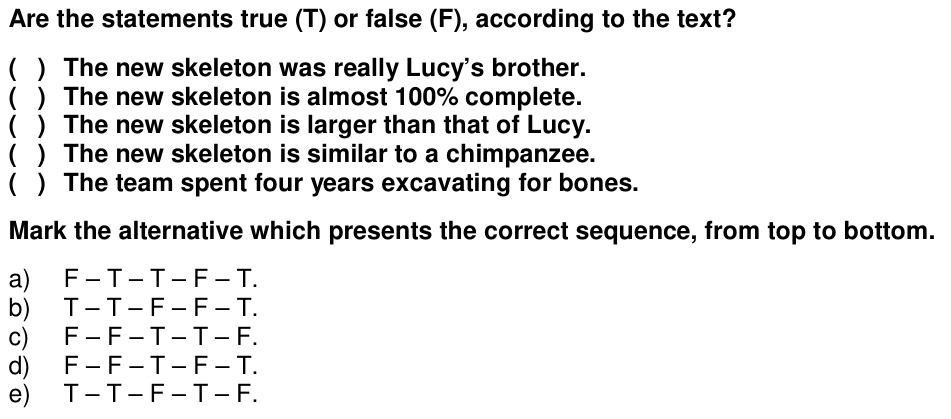
Are the statements true (T) or false (F), according to the text?
( ) The new skeleton was really Lucy’s brother.
( ) The new skeleton is almost 100% complete.
( ) The new skeleton is larger than that of Lucy.
( ) The new skeleton is similar to a chimpanzee.
( ) The team spent four years excavating for bones.
Mark the alternative which presents the correct sequence, from top to bottom.
- AF – T – T – F – T.
- BT – T – F – F – T.
- CF – F – T – T – F.
- DF – F – T – F – T.
- ET – T – F – T – F.
Reportar erro na questão
Resolução comentada
Vamos conferir cada afirmação com o texto.
-
The new skeleton was really Lucy's brother. O texto usa "big brother" entre aspas, só como apelido. O esqueleto tem 3,6 milhões de anos e Lucy é quase meio milhão de anos mais nova, então não são irmãos. Falsa (F).
-
Almost 100% complete. O texto diz "roughly 40% complete". Falsa (F).
-
Larger than Lucy's. O texto diz que o macho era "about 30% larger than Lucy". Verdadeira (T).
-
Similar to a chimpanzee. O texto diz que a escápula se parece mais com a de um gorila e de um humano moderno do que com a de um chimpanzé. A caixa torácica é semelhante à humana e distinta da do chimpanzé. Pelve e tronco também lembram mais o humano. Falsa (F).
-
The team spent four years excavating. O trecho "Over the next 4 years, the team unearthed the shoulder blade, collarbone, ribs..." mostra que foram quatro anos de escavação. Verdadeira (T).
A sequência é F – F – T – F – T.
Alternativa D.
Pegadinha: O apelido "big brother" entre aspas induz a marcar T no primeiro item, mas é só um modo de falar.
Por que as outras alternativas estão erradas
- AMarca o item 2 como verdadeiro, mas o esqueleto tem só cerca de 40% completo.
- BToma o apelido "big brother" ao pé da letra e aceita 100% de completude; também erra o item 3.
- CMarca como falso o item sobre as escavações e como verdadeiro o da semelhança com o chimpanzé, contra o texto.
- EErra os itens 1, 2, 3, 4 e 5, tomando o apelido como parentesco e dizendo que se parece com chimpanzé.
Assunto: Informações explícitas e detalhes.
Reportar erro na resolução
Ver como caiu na prova
Fonte: UFPR 2011 · 1ª fase. Prova oficial ↗