PRÁTICA COM QUESTÕES OFICIAIS
Questão 77 da UFPR 2007 (inglês)
Texto-base das questões 73 a 77 · 1ª fase
As questões 73 a 77 referem-se ao texto a seguir.
In Hans Christian Andersens classic tale of *The Emperors New Clothes*, two charlatans come to the Emperors city, posing as weavers of such fine fabrics that only the truly intelligent can see them. The charlatans are hired by the Emperor, and in exchange they will receive gold and silk to weave the fabric. The ruse is simple enough: appeal to the intellectual vanity of the Emperor and his court. Each member of the Emperors court in turn is sent to the charlatansroom to check on the progress of the fabric. Each returns to the Emperor “bedazzled” by the beauty of the fabric. No one in the Emperors court wants to appear dim-witted and admit that there is no fabric to be seen. The ruse is complete on the day the Emperor is to show off his new clothes. There in the dressing room stands the naked Emperor, with his court and the charlatans, each gushing over the beautiful colors and textures of the nonexistent fabric. Although the Emperor can see that he is entirely naked, he too refuses to admit that there is no fabric to be seen. It takes the clear-minded honesty of a child to point out the nakedness of the Emperor.
(http://www.msbp.com/Disordered.htm)
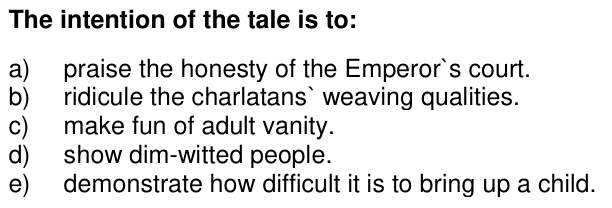
The intention of the tale is to:
- Apraise the honesty of the Emperor`s court.
- Bridicule the charlatans` weaving qualities.
- Cmake fun of adult vanity.
- Dshow dim-witted people.
- Edemonstrate how difficult it is to bring up a child.
Reportar erro na questão
Resolução comentada
A pergunta é sobre a intenção do conto, ou seja, a mensagem que o autor quer passar, e não só o que acontece nele.
O que o texto mostra:
- Os charlatães se passam por tecelões de um tecido que "só os verdadeiramente inteligentes" conseguem ver. O golpe depende da vaidade intelectual do Imperador e da corte (the intellectual vanity of the Emperor and his court).
- Ninguém na corte quer parecer tolo (dim-witted), então todos elogiam um tecido que não existe.
- O próprio Imperador vê que está nu, mas também finge, pelo mesmo motivo.
- Quem aponta a verdade é uma criança, com sua honestidade (clear-minded honesty).
O conto ridiculariza a vaidade dos adultos, que preferem mentir a admitir que não enxergam algo. A criança funciona como contraste, pois não tem essa vaidade.
Conclusão: a intenção é zombar da vaidade adulta, que corresponde a "make fun of adult vanity".
Alternativa C.
Por que as outras alternativas estão erradas
- AA corte é desonesta, pois finge ver o tecido; quem é honesto é a criança.
- BOs charlatães não têm qualidade de tecelagem alguma, pois o tecido nem existe, e o alvo da crítica é a vaidade de quem é enganado.
- DO conto não pretende mostrar pessoas tolas, e sim o medo de parecer tolo, que leva à mentira.
- EO texto não trata da dificuldade de criar filhos; a criança só aparece como voz da verdade.
Assunto: Poemas, canções e textos literários.
Reportar erro na resolução
Ver como caiu na prova
Fonte: UFPR 2007 · 1ª fase. Prova oficial ↗