PRÁTICA COM QUESTÕES OFICIAIS
Questão 76 da UFPR 2007 (inglês)
Texto-base das questões 73 a 77 · 1ª fase
As questões 73 a 77 referem-se ao texto a seguir.
In Hans Christian Andersens classic tale of *The Emperors New Clothes*, two charlatans come to the Emperors city, posing as weavers of such fine fabrics that only the truly intelligent can see them. The charlatans are hired by the Emperor, and in exchange they will receive gold and silk to weave the fabric. The ruse is simple enough: appeal to the intellectual vanity of the Emperor and his court. Each member of the Emperors court in turn is sent to the charlatansroom to check on the progress of the fabric. Each returns to the Emperor “bedazzled” by the beauty of the fabric. No one in the Emperors court wants to appear dim-witted and admit that there is no fabric to be seen. The ruse is complete on the day the Emperor is to show off his new clothes. There in the dressing room stands the naked Emperor, with his court and the charlatans, each gushing over the beautiful colors and textures of the nonexistent fabric. Although the Emperor can see that he is entirely naked, he too refuses to admit that there is no fabric to be seen. It takes the clear-minded honesty of a child to point out the nakedness of the Emperor.
(http://www.msbp.com/Disordered.htm)
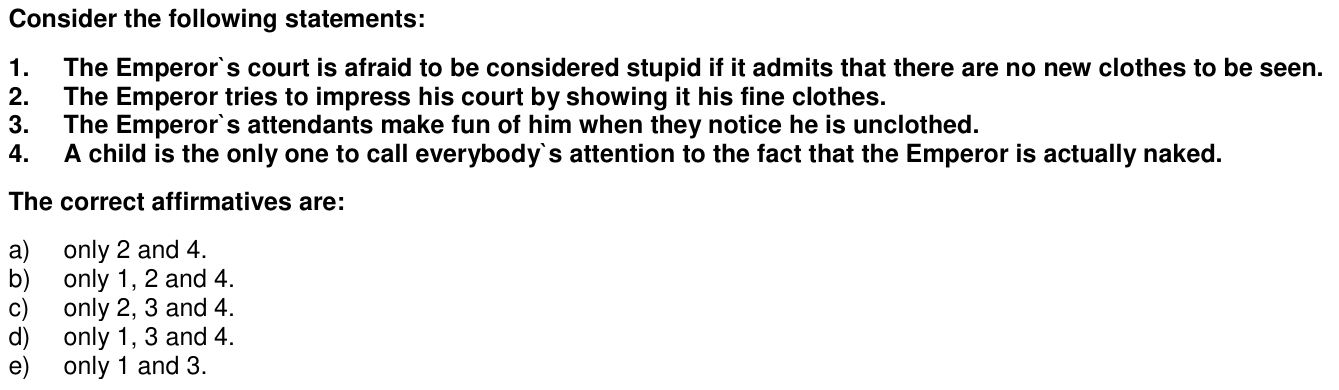
Consider the following statements:
1. The Emperor`s court is afraid to be considered stupid if it admits that there are no new clothes to be seen.
2. The Emperor tries to impress his court by showing it his fine clothes.
3. The Emperor`s attendants make fun of him when they notice he is unclothed.
4. A child is the only one to call everybody`s attention to the fact that the Emperor is actually naked.
The correct affirmatives are:
- Aonly 2 and 4.
- Bonly 1, 2 and 4.
- Conly 2, 3 and 4.
- Donly 1, 3 and 4.
- Eonly 1 and 3.
Reportar erro na questão
Resolução comentada
Vamos conferir cada afirmação com o texto.
-
Correta. O texto diz: "No one in the Emperor's court wants to appear dim-witted and admit that there is no fabric to be seen". Ou seja, ninguém quer parecer tolo e admitir que não há tecido.
-
Falsa. Quem engana a corte são os charlatães, que apelam à vaidade intelectual de todos. O Imperador não quer impressionar a corte. Ele próprio finge ver o tecido para não parecer tolo: "he too refuses to admit that there is no fabric to be seen".
-
Falsa. Os cortesãos não zombam dele. Todos continuam elogiando ("gushing over") as cores e texturas do tecido que não existe.
-
Correta. "It takes the clear-minded honesty of a child to point out the nakedness of the Emperor". Só a criança aponta a nudez.
São corretas apenas as afirmações 1 e 4. Nenhuma alternativa traz exatamente esse par. As alternativas com 1 e 4 são B (1, 2 e 4) e D (1, 3 e 4), e ambas incluem uma afirmação falsa. Das duas, a que mais se aproxima é a B, porque a afirmação 2 é plausível: o Imperador está exibindo suas "novas roupas" ("show off his new clothes") diante da corte. Embora o texto não diga que ele tenta impressioná-la, o verbo "show off" leva a essa leitura, ao contrário da afirmação 3, que contradiz o texto.
Alternativa B.
Pegadinha: A alternativa D engana por reunir 1 e 4, corretas, mas inclui a 3, que o texto contradiz: a corte continua elogiando o tecido inexistente.
Por que as outras alternativas estão erradas
- AOmite a afirmação 1, que está correta, pois a corte teme parecer tola.
- CInclui a 3, que contradiz o texto: os cortesãos elogiam o tecido, não zombam do Imperador.
- DInclui a 3, falsa, pois ninguém ri do Imperador nu.
- EInclui a 3, falsa, e omite a 4, que é verdadeira.
Assunto: Informações explícitas e detalhes.
Reportar erro na resolução
Ver como caiu na prova
Fonte: UFPR 2007 · 1ª fase. Prova oficial ↗