PRÁTICA COM QUESTÕES OFICIAIS
Questão 78 da UFPR 2006 (inglês)
Texto-base das questões 77 a 80 · 1ª fase
Winter
Winter influences nature, people and even history. The winter of 1941 caused the Nazis many casualties from lack of cold weather equipment and played a part in the failure of Operation Barbarossa, the Nazi march on Moscow.
In animals and plants, winter plays an important role in their life cycles. Some fur-coated mammals grow a heavier fur coat during the winter. This improves the heat-retention qualities of the fur. The coat is then shed following the winter season to allow better cooling. The heavier winter coat makes this season a favorite for trappers who seek more profitable skins. Snow also affects the ways animals behave, as many take advantage of the insulating properties of snow by burrowing in it. Mice and voles typically live under the snow layer.
Annual plants never survive the winter. As for perennial plants, many small ones profit from the insulating effects of snow by being buried in it. Larger plants, particularly deciduous trees, usually let their upper part die, but their roots are still protected by the snow layer.
Passing seasons change the habits and moods of people. Around winter months, a gloominess, called “winter blues” or “February blahs” or “Holiday depression” – during November and December – is informally noted amongst people. The severest cases of this type of depression are diagnosed as seasonal affective disorder (SAD). Symptoms include sleeping more, tiredness, depression, and physical aches. Although cases include genetic disposition and stress, the prevailing environmental influence is decreased exposure to light due to winter weather patterns.
(http:// en. Wikipedia.org/wiki/Winter)
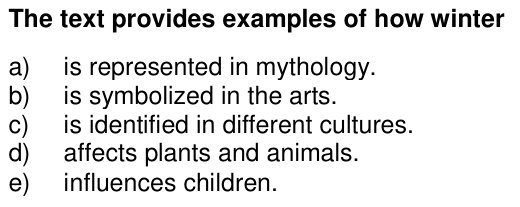
The text provides examples of how winter
- Ais represented in mythology.
- Bis symbolized in the arts.
- Cis identified in different cultures.
- Daffects plants and animals.
- Einfluences children.
Você já respondeu questões neste aparelho. Crie sua conta grátis para guardar o histórico e refazer as que errou.
Resposta salva no seu histórico.
Reportar erro na questão
Resolução comentada
A pergunta pede o que o texto exemplifica sobre o inverno: ele diz que o inverno "influences nature, people and even history" (influencia a natureza, as pessoas e até a história).
Vamos ver o que o texto realmente traz:
- História: o inverno de 1941 causou baixas aos nazistas e contribuiu para o fracasso da Operação Barbarossa.
- Animais: mamíferos criam pelagem mais grossa no inverno e a perdem depois; a neve serve de isolante, e camundongos e ratos-do-campo vivem sob ela.
- Plantas: as anuais não sobrevivem; as perenes pequenas se protegem sob a neve; as árvores maiores perdem a parte aérea, mas as raízes ficam protegidas.
- Pessoas: depressão sazonal ("winter blues", SAD), com sintomas como sono excessivo e cansaço.
Portanto, boa parte do texto mostra exemplos de como o inverno afeta plantas e animais, o que corresponde à alternativa D. Mitologia, artes e culturas diferentes não aparecem em nenhum trecho. Crianças também não são mencionadas; o texto fala de pessoas em geral.
Alternativa D.
Por que as outras alternativas estão erradas
- AO texto não menciona mitologia em nenhum momento.
- BNão há referência a simbolismo ou representação do inverno nas artes.
- CNão se comparam culturas; o texto trata de natureza, história e saúde humana.
- EO texto fala de pessoas em geral (depressão sazonal), sem foco em crianças.
Assunto: Informações explícitas e detalhes.
Reportar erro na resolução
Ver como caiu na prova
Fonte: UFPR 2006 · 1ª fase. Prova oficial ↗