PRÁTICA COM QUESTÕES OFICIAIS
Questão 90 (2º semestre) da UFG 2010 (inglês)
Leia o texto abaixo e responda às questões de 86 a 90. · 1ª etapa
Power of Images: Creating the Myths of Our Time
by J. Francis Davis
The history of human social interchange has evolved through three distinct phases: oral, text-based, and now image-centered communication. In oral cultures, learning and tradition were passed on by word of mouth, primarily through storytelling. The invention of writing made it possible to preserve information and literacy traditions beyond the capacity of memory, but the circulation of hand-written books was still limited to an elite few.
With the invention of the printing press, written texts were in effect transferred from the exclusive property of those wealthy enough to afford hand-copied manuscripts to a broad reading public.
A similar revolution began about 150 years ago with the invention of photography. For the first time, visual representation of objects in space could be reproduced on a mass scale. Image communication was born.
It only took about 50 years for this new method of representation to become a major player in the communication of social values in American society. The rise of the advertising industry spurred this change, for advertisers quickly learned that the most effective way to sell products was not through stories or plain-text facts, but through the creation of images that appealed to basic human needs and emotions.
Television cemented the era of image communication, for it tells stories and we watch and listen just like our ancestors who sat mesmerized around campfires.
But television's most important stories are those not verbalized – the stories and myths hidden in its constant flow of images. These images suggest myths – and thus help construct our world and values – in much the same way that stories did in oral culture.
Once identified, myths are easy to recognize: the good life consists of buying possessions that cost lots of money; leave it to the experts (who are usually white, middle-aged men); your body is not good enough; happiness and satisfaction are available with the next consumer purchase; businesses and corporations are concerned for the public welfare.
Only when we learn to read these myths on a daily basis will we have the power to substitute other motivating ideas and goals of our choosing. Only then can we consciously transcend the Age of Image Communication and stop blindly accepting the myths of the image culture.
Disponível em: <http://medialit.org/reading_room/article80.html>. Acesso em: 13 out. 2009. (Adaptado).
Glossary:
spurred: estimulou
mesmerized: fascinados
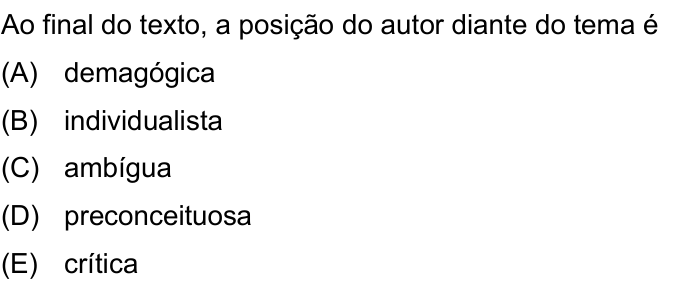
Ao final do texto, a posição do autor diante do tema é
- Ademagógica
- Bindividualista
- Cambígua
- Dpreconceituosa
- Ecrítica
Você já respondeu questões neste aparelho. Crie sua conta grátis para guardar o histórico e refazer as que errou.
Resposta salva no seu histórico.
Reportar erro na questão
Resolução comentada
A pergunta é sobre a posição do autor diante da cultura da imagem, especialmente no último parágrafo. Para isso, vale ver como ele constrói o argumento.
- Ele descreve a evolução da comunicação (oral, escrita, imagem) e mostra que a imagem, via publicidade e televisão, passou a transmitir valores sociais.
- Afirma que as histórias mais importantes da TV são as "não verbalizadas", ou seja, mitos escondidos no fluxo de imagens.
- Lista esses mitos: a boa vida é comprar coisas caras, a felicidade está na próxima compra, as empresas se preocupam com o bem público. Todos são apresentados com tom claramente irônico e questionador.
- Na conclusão, diz que só quando aprendermos a "ler" esses mitos poderemos substituí-los por ideias nossas e deixar de "aceitar cegamente" (blindly accepting) os mitos da cultura da imagem.
O autor, portanto, não aceita passivamente a cultura da imagem: ele a examina, denuncia seus mitos e defende que o leitor desenvolva consciência para questioná-la. Essa atitude de análise e questionamento é uma posição crítica.
Não há defesa de interesses pessoais, contradição, nem ataque a um grupo por preconceito: o texto argumenta de forma coerente e racional.
Alternativa E.
Por que as outras alternativas estão erradas
- ADemagogia é discurso que manipula emoções para ganhar apoio; o autor argumenta de forma analítica e não busca isso.
- BO texto não defende o individualismo; fala em "nós" e em uma sociedade que precisa aprender a ler as imagens.
- CAmbígua seria uma posição indefinida; o autor é claro ao recomendar que se deixe de aceitar cegamente os mitos.
- DPreconceito é juízo sem fundamento; o autor apoia suas ideias em fatos históricos e exemplos, e não em ideias preconcebidas.
Assunto: Inferência e ponto de vista do autor.
Reportar erro na resolução
Ver como caiu na prova
Fonte: UFG 2010 · 2º semestre · 1ª etapa. Prova oficial ↗