PRÁTICA COM QUESTÕES OFICIAIS
Questão 88 (2º semestre) da UFG 2010 (inglês)
Leia o texto abaixo e responda às questões de 86 a 90. · 1ª etapa
Power of Images: Creating the Myths of Our Time
by J. Francis Davis
The history of human social interchange has evolved through three distinct phases: oral, text-based, and now image-centered communication. In oral cultures, learning and tradition were passed on by word of mouth, primarily through storytelling. The invention of writing made it possible to preserve information and literacy traditions beyond the capacity of memory, but the circulation of hand-written books was still limited to an elite few.
With the invention of the printing press, written texts were in effect transferred from the exclusive property of those wealthy enough to afford hand-copied manuscripts to a broad reading public.
A similar revolution began about 150 years ago with the invention of photography. For the first time, visual representation of objects in space could be reproduced on a mass scale. Image communication was born.
It only took about 50 years for this new method of representation to become a major player in the communication of social values in American society. The rise of the advertising industry spurred this change, for advertisers quickly learned that the most effective way to sell products was not through stories or plain-text facts, but through the creation of images that appealed to basic human needs and emotions.
Television cemented the era of image communication, for it tells stories and we watch and listen just like our ancestors who sat mesmerized around campfires.
But television's most important stories are those not verbalized – the stories and myths hidden in its constant flow of images. These images suggest myths – and thus help construct our world and values – in much the same way that stories did in oral culture.
Once identified, myths are easy to recognize: the good life consists of buying possessions that cost lots of money; leave it to the experts (who are usually white, middle-aged men); your body is not good enough; happiness and satisfaction are available with the next consumer purchase; businesses and corporations are concerned for the public welfare.
Only when we learn to read these myths on a daily basis will we have the power to substitute other motivating ideas and goals of our choosing. Only then can we consciously transcend the Age of Image Communication and stop blindly accepting the myths of the image culture.
Disponível em: <http://medialit.org/reading_room/article80.html>. Acesso em: 13 out. 2009. (Adaptado).
Glossary:
spurred: estimulou
mesmerized: fascinados
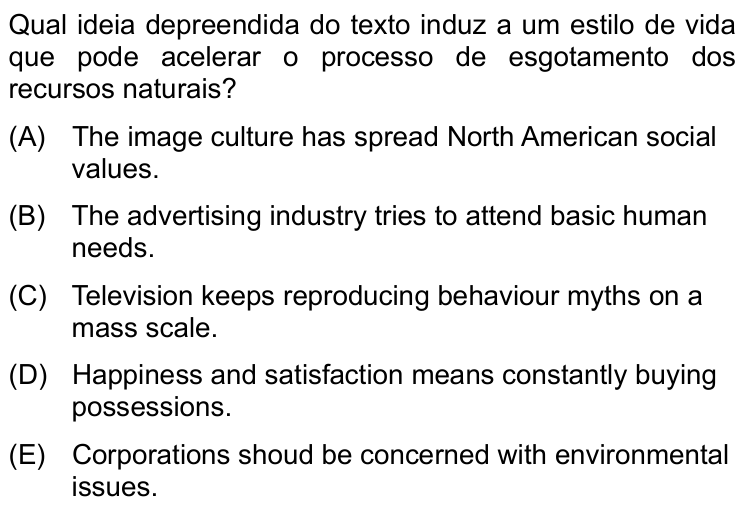
Qual ideia depreendida do texto induz a um estilo de vida que pode acelerar o processo de esgotamento dos recursos naturais?
- AThe image culture has spread North American social values.
- BThe advertising industry tries to attend basic human needs.
- CTelevision keeps reproducing behaviour myths on a mass scale.
- DHappiness and satisfaction means constantly buying possessions.
- ECorporations shoud be concerned with environmental issues.
Você já respondeu questões neste aparelho. Crie sua conta grátis para guardar o histórico e refazer as que errou.
Resposta salva no seu histórico.
Reportar erro na questão
Resolução comentada
A pergunta pede a ideia do texto que leva a um estilo de vida capaz de acelerar o esgotamento dos recursos naturais. Ou seja, procuramos a ideia que incentiva o consumo constante.
O texto lista os mitos da cultura da imagem. Dois deles tratam de consumo: "the good life consists of buying possessions that cost lots of money" (a vida boa consiste em comprar bens caros) e "happiness and satisfaction are available with the next consumer purchase" (felicidade e satisfação estão na próxima compra).
Se as pessoas acreditam que a felicidade vem da próxima compra, compram sempre mais. Mais produção e mais consumo significam mais extração de recursos naturais.
As alternativas:
- A trata da difusão de valores norte-americanos, que não tem relação direta com o uso de recursos.
- B fala da publicidade e das necessidades humanas básicas, sem ligação com o consumo excessivo.
- C fala da TV reproduzindo mitos de comportamento em massa, o que é genérico e não indica consumismo.
- D diz que felicidade e satisfação significam comprar bens o tempo todo. É a ideia do consumo contínuo, que pressiona os recursos naturais.
- E diz que empresas deveriam se preocupar com questões ambientais. Isso inverte o sentido, e o texto apresenta a preocupação das empresas com o bem-estar público como um mito.
Alternativa D.
Por que as outras alternativas estão erradas
- ATrata da difusão de valores norte-americanos, sem relação com consumo ou esgotamento de recursos.
- BDiz que a publicidade atende necessidades básicas, mas isso não indica consumo excessivo.
- CFala de mitos reproduzidos em massa pela TV, ideia genérica que não aponta para o consumismo.
- EAfirma que empresas deveriam se preocupar com o meio ambiente, o que não é um estilo de vida que esgota recursos; o texto ainda trata a preocupação das empresas como mito.
Assunto: Inferência e ponto de vista do autor.
Reportar erro na resolução
Ver como caiu na prova
Fonte: UFG 2010 · 2º semestre · 1ª etapa. Prova oficial ↗