PRÁTICA COM QUESTÕES OFICIAIS
Questão 90 da UFG 2004 (inglês)
Leia o texto a seguir para responder às questões de números 88 a 90. · 1ª etapa
The Rose
There was once a poor woman who had two children. The youngest had to go every day into the forest to fetch wood. Once when she had gone a long way to seek it, a little child, who was quite strong, came and helped her industriously to pick up the wood and carry it home, and then before a moment had passed the strange child disappeared. The child told her mother this, but at first she would not believe it. At length she brought a rose home, and told her mother that the beautiful child had given her this rose, and had told her that when it was in full bloom, he would return. The mother put the rose in water. One morning her child could not get out of bed. The mother went to the bed and found her dead, but she lay looking very happy. On the same morning, the rose was in full bloom.
The complete Grimm´s fairy tales. New York: Random House, 1972. p. 819-820.
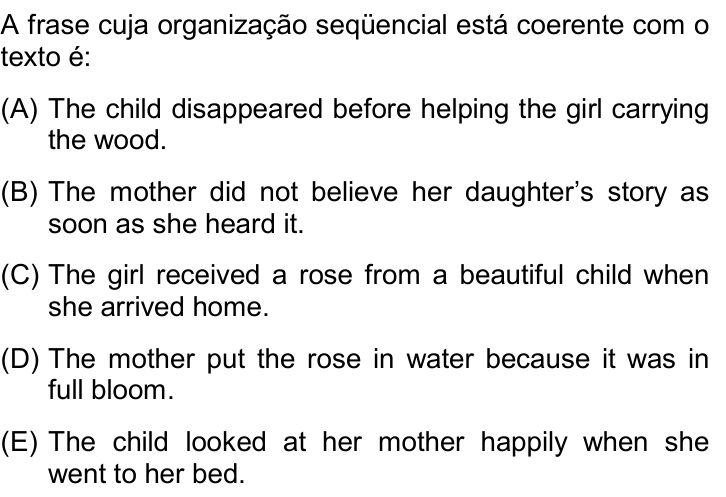
A frase cuja organização seqüencial está coerente com o texto é:
- AThe child disappeared before helping the girl carrying the wood.
- BThe mother did not believe her daughter’s story as soon as she heard it.
- CThe girl received a rose from a beautiful child when she arrived home.
- DThe mother put the rose in water because it was in full bloom.
- EThe child looked at her mother happily when she went to her bed.
Você já respondeu questões neste aparelho. Crie sua conta grátis para guardar o histórico e refazer as que errou.
Resposta salva no seu histórico.
Reportar erro na questão
Resolução comentada
A questão pede a frase cuja ordem dos fatos (sequência) corresponde à do texto. Vamos reconstruir a ordem dos acontecimentos:
- A filha mais nova vai à floresta buscar lenha.
- Uma criança estranha aparece, ajuda a carregar a lenha até em casa e depois desaparece.
- A menina conta isso à mãe, que a princípio não acredita ("at first she would not believe it").
- Por fim, a menina traz uma rosa e diz que a criança a deu.
- A mãe põe a rosa na água.
- Na manhã seguinte, a menina é encontrada morta, feliz, e a rosa está em plena flor.
Agora, as alternativas:
- (A) inverte a ordem: a criança desapareceu depois de ajudar, não antes.
- (B) "não acreditou assim que ouviu" confere com "at first she would not believe it". A sequência está correta.
- (C) diz que a rosa foi recebida quando a menina chegou em casa, mas ela a recebeu da criança, depois, e só então a trouxe para casa.
- (D) cria causa errada: a mãe pôs a rosa na água antes de ela florescer; o florescimento veio no fim.
- (E) a menina estava morta quando a mãe foi à cama, e não olhou para ela.
Portanto, só a (B) respeita a sequência do texto.
Alternativa B.
Por que as outras alternativas estão erradas
- Ainverte a ordem: a criança desapareceu depois de ajudar a carregar a lenha, não antes.
- Ca rosa foi dada pela criança na floresta e depois levada para casa, não recebida ao chegar.
- Dtroca a ordem e a causa: a rosa só floresceu na manhã final, depois de posta na água.
- Ea menina já estava morta quando a mãe foi à cama; não olhou para a mãe.
Assunto: Informações explícitas e detalhes.
Reportar erro na resolução
Ver como caiu na prova
Fonte: UFG 2004 · 1ª etapa. Prova oficial ↗