PRÁTICA COM QUESTÕES OFICIAIS
Questão 27 (1º exame) da UERJ 2025 (inglês)
Texto-base das questões 23 a 27 · 1º Exame de Qualificação
Crocodiles, sharks, snakes, tigers, lions are but a few of the animals that evoke a sense of fear in humans. Attacks by these animals are always widely splashed across the media, giving further merit to these fears. But are we actually more scared of them than they are of us? And do we perhaps have reason to be?
Wild animals are afraid of humans. Studies have shown that even apex predators change their eating patterns and habits when they perceive humans to be around. We are the only super predator that exists on this planet. Through conditioning, animals have come to instinctually fear our very existence.
In Santa Cruz, California, a study was directed. The scientists wished to determine how much impact the perception of human presence would have on the predators in the area, namely the mountain lion, bobcat, opossum and skunk. The scientists broadcasted human voices in certain areas while they used the sound of tree frogs in other regions as a control. The results were alarming in that the predators changed their habits more than expected, when they perceived humans to be present. Mountain lions would leave their kill if they heard voices and deliberately avoided the areas where they believed there was human activity. The skunk and opossum foraged less, and the bobcat became solely nocturnal.
Some might suggest that our upright stance and forward-facing eyes have animals understanding that we are a predator and a threat, but it is more than just how we look that has them running for the hills. Through centuries of hunting and destroying their habitat their fear of us has become instinctual. We are the annihilators, super destroyers of the earth and its wildlife. We have taught animals that we are the most destructive and deadly species on the planet and this conditioned them to fear us.
The human population kills nine times as many carnivores as they kill each other and four times more middle food web animals than large carnivores do. We are one of the few animals capable of distorting ecosystem functioning and eradicating species. In most scenarios, the mere presence of a human will have wild animals darting away. Even in some extreme situations where animals show aggression, if humans stand their ground and make noise, the result is often the animal showing one final act of defiance before they move off back into their natural habitat.
But although wild animals will choose to run away most of the time, rather than standing against or going after us, this is not always the case. A threatened animal will fight against us to defend itself, and chances are you, with your lack of claws, blunt teeth and squishy body, will come off second best. Despite our destructive behavior, an unarmed human has almost no defense against an animal. Fear incites violence and animals will react aggressively if they feel threatened. We might be the mighty super predator, but ultimately we are no match for Mother Nature when she chooses to fight back.
Adaptado de nayturr.com.
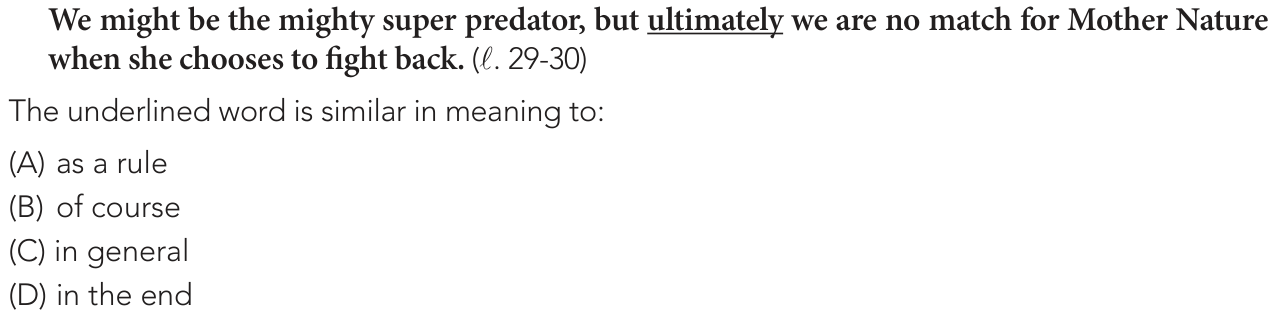
We might be the mighty super predator, but ultimately we are no match for Mother Nature when she chooses to fight back. (\ell. 29-30)
The underlined word is similar in meaning to:
- Aas a rule
- Bof course
- Cin general
- Din the end
Você já respondeu questões neste aparelho. Crie sua conta grátis para guardar o histórico e refazer as que errou.
Resposta salva no seu histórico.
Reportar erro na questão
Resolução comentada
"Ultimately" é um advérbio que indica o resultado final, a conclusão de um raciocínio: significa "no fim das contas", "em última análise". Na frase, o autor admite que o ser humano é um "super predador poderoso", mas conclui que, no fim das contas, não é páreo para a natureza quando ela reage.
Testando cada opção:
- "As a rule" e "in general" significam "em geral", "normalmente". Isso indicaria frequência ou regra geral, e não conclusão.
- "Of course" significa "claro", "naturalmente", e expressa algo óbvio. Não é o sentido da frase.
- "In the end" significa "por fim", "no final das contas". Mantém o sentido de conclusão da frase.
Substituindo: "We might be the mighty super predator, but in the end we are no match for Mother Nature". O sentido se mantém.
Alternativa D.
Pegadinha: As alternativas A e C enganam quem confunde "ultimately" com "em geral"; a palavra indica conclusão, não generalização.
Por que as outras alternativas estão erradas
- A"As a rule" quer dizer "geralmente", ideia de regra ou frequência, não de conclusão.
- B"Of course" quer dizer "claro, naturalmente", expressa obviedade, não resultado final.
- C"In general" quer dizer "em geral", e não "no fim das contas".
Assunto: Vocabulário em contexto e falsos cognatos.
Reportar erro na resolução
Ver como caiu na prova
Fonte: UERJ 2025 · 1º Exame de Qualificação. Prova oficial ↗