PRÁTICA COM QUESTÕES OFICIAIS
Questão 16 da UERJ 2021 (inglês)
Texto-base das questões 12 a 18 · Exame Único
The boxer
I am just a poor boy, though my story’s seldom told I have squandered my resistance for a pocketful of mumbles, such are promises All lies and jest, still a man hears what he wants to hear And disregards the rest
When I left my home and my family, I was no more than a boy In the company of strangers In the quiet of the railway station, runnin’ scared, laying low, Seeking out the poorer quarters, where the ragged people go Looking for the places only they would know
Lie la lie, lie la la la lie lie
Asking only workman’s wages, I come looking for a job But I get no offers Just a come-on from the whores on 7th Avenue I do declare, there were times when I was so lonesome I took some comfort there
Now the years are rolling by me They are rockin’ evenly I am older than I once was And younger than I’ll be; that’s not unusual Nor is it strange
After changes upon changes We are more or less the same After changes we are more or less the same
And I’m laying out my winter clothes and wishing I was gone Goin’ home Where the New York City winters aren’t bleedin’ me Leadin’ me Goin’ home
In the clearing stands a boxer and a fighter by his trade And he carries the reminders Of every glove that laid him down or cut him ‘Til he cried out in his anger and his shame “I am leaving, I am leaving”, but the fighter still remains
PAUL SIMON and ART GARFUNKEL
Adaptado de genius.com.
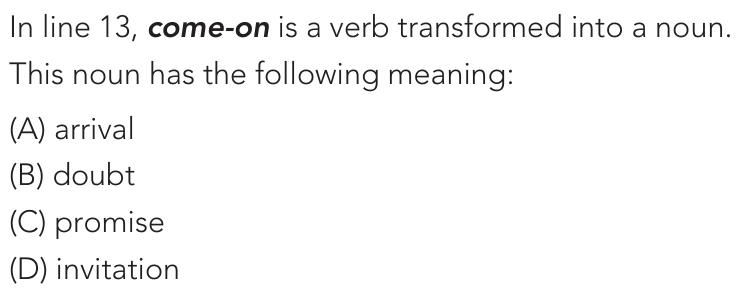
In line 13, come-on is a verb transformed into a noun.
This noun has the following meaning:
- Aarrival
- Bdoubt
- Cpromise
- Dinvitation
Reportar erro na questão
Resolução comentada
O trecho é: "Asking only workman’s wages, I come looking for a job / But I get no offers / Just a come-on from the whores on 7th Avenue".
O phrasal verb to come on tem vários sentidos. Um deles é "fazer insinuações, tentar seduzir alguém". Quando vira substantivo (a come-on), significa uma provocação ou um convite sedutor, uma isca para atrair a pessoa.
O contexto confirma esse sentido:
- O narrador procura emprego, mas não recebe nenhuma oferta de trabalho (I get no offers).
- A única coisa que ele recebe (just a come-on) vem das prostitutas da 7th Avenue.
- Ou seja, o que lhe oferecem é um chamado, um convite de caráter sexual.
- Os versos seguintes reforçam isso: ele diz que, de tão solitário, "tomou algum conforto ali".
Portanto, come-on equivale a "invitation", isto é, convite, e não a chegada, dúvida ou promessa.
Alternativa D.
Por que as outras alternativas estão erradas
- AConfunde come-on com o verbo come (chegar); arrival não tem relação com a insinuação feita pelas mulheres.
- BNão há ideia de dúvida; o substantivo indica um chamado ativo, não incerteza.
- CPromise (promessa) lembra o verso anterior da letra, mas come-on é um convite sedutor, não um compromisso futuro.
Assuntos: phrasal verbs, vocabulário em contexto.
Reportar erro na resolução
Ver como caiu na prova
Fonte: UERJ 2021 · Exame Único. Prova oficial ↗