PRÁTICA COM QUESTÕES OFICIAIS
Questão 27 (1º exame) da UERJ 2019 (inglês)
Texto-base das questões 24 a 28 · 1º Exame de Qualificação
The potential impacts of climate change have returned to headlines in recent weeks as scientists, activists and policy makers try to understand the possible implications of a warming planet. While rising temperatures and sea levels are important to be considered, changing climate patterns can have vast implications for epidemic risk as well.
Changes in global climate patterns have been widely discussed; however, rising temperatures also have implications for risk reduction and management, including impacts on infectious disease epidemics. With 2016 the hottest year ever recorded and 2017 following suit, we anticipate a continued growth in the distribution of disease agents, like mosquitoes and ticks. These can spread illnesses such as zika, yellow fever and dengue to areas where they previously could not be effectively transmitted.
As predicted by climate scientists, increases in extreme weather events may also lead to increases in infectious disease outbreaks. Epidemics have previously been seen as a consequence of natural disasters, which can lead to displaced and crowded populations, the ideal situation for infection transmission. Severe rainfall or flooding is particularly effective at creating environments suitable for the transmission and propagation of infectious diseases, such as measles or cholera.
Even without rising to the level of a natural catastrophe, significant variation in weather patterns can result in changes in human and animal interactions, increasing the potential for pathogens to move from animals into human populations. For example, unusually heavy rains may predispose regions to ebola outbreaks by creating more favorable environments for bats hosting the virus. Similarly, food scarcity brought about by drought, political instability or animal disease may lead to more animal hunting, therefore raising the risk for ebola virus epidemic.
It is important to take note of the impact of climate change on epidemic risk, but it is equally important to prepare for its impact on global health. The global health community has largely come to realize that public health preparedness is crucial to responding efficiently to infectious disease outbreaks. For this reason, our work is, then, centered around helping governments manage and quantify infectious disease risk. Besides, regardless of weather patterns, insights into epidemics and into mechanisms for ensuring adequate support are critical for managing this risk.
Since the public health community agrees that the question is not if another outbreak will happen, but when, the steps we take in the coming years to prepare for and reduce the increasing frequency of outbreaks will determine the broader implications these diseases have on our world.
contagionlive.com
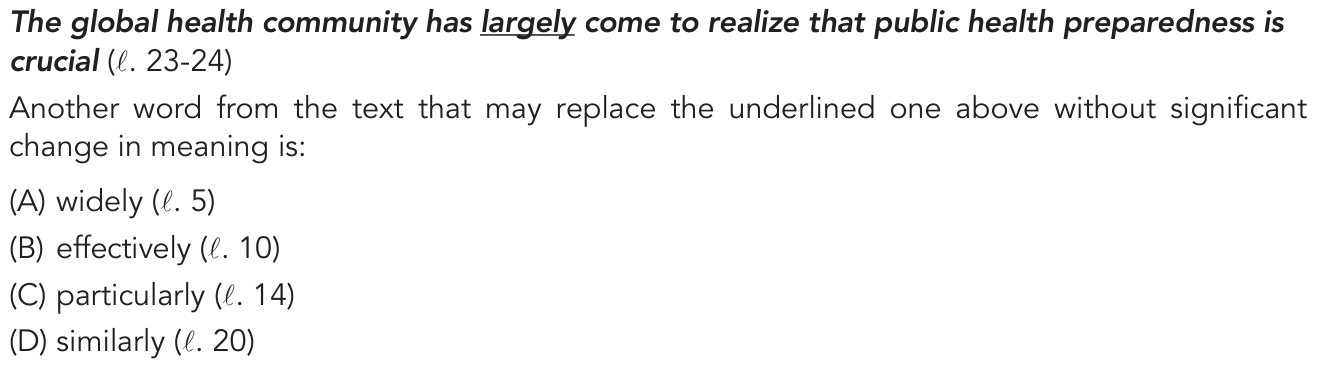
The global health community has largely come to realize that public health preparedness is crucial (\ell. 23-24)
Another word from the text that may replace the underlined one above without significant change in meaning is:
- Awidely (\ell. 5)
- Beffectively (\ell. 10)
- Cparticularly (\ell. 14)
- Dsimilarly (\ell. 20)
Você já respondeu questões neste aparelho. Crie sua conta grátis para guardar o histórico e refazer as que errou.
Resposta salva no seu histórico.
Reportar erro na questão
Resolução comentada
Em "has largely come to realize", o advérbio largely quer dizer "em grande parte, amplamente, na maioria". Ele indica que a maior parte da comunidade de saúde global já percebeu a importância da preparação, não que a percebeu de forma "grande" em tamanho.
É preciso testar cada palavra do texto no lugar de largely:
- widely ("amplamente, de modo geral"): "has widely come to realize" mantém a ideia de algo difundido entre muitos. É o sentido mais próximo. O texto usa widely em "have been widely discussed", com esse mesmo valor de abrangência.
- effectively ("de modo eficaz"): fala de eficiência, não de extensão. Muda o sentido.
- particularly ("especialmente"): destaca um caso em relação aos outros. Não indica que a maioria reconhece.
- similarly ("da mesma forma"): estabelece comparação ou paralelo, sem relação com quantidade.
Só widely preserva a noção de "em grande extensão, por muitos".
Alternativa A.
Por que as outras alternativas estão erradas
- Beffectively significa "de modo eficaz", ideia de eficiência e não de abrangência.
- Cparticularly significa "especialmente", destaca algo em vez de indicar a maioria.
- Dsimilarly significa "da mesma forma", é conector de comparação e não expressa extensão.
Assunto: Vocabulário em contexto e falsos cognatos.
Reportar erro na resolução
Ver como caiu na prova
Fonte: UERJ 2019 · 1º Exame de Qualificação. Prova oficial ↗